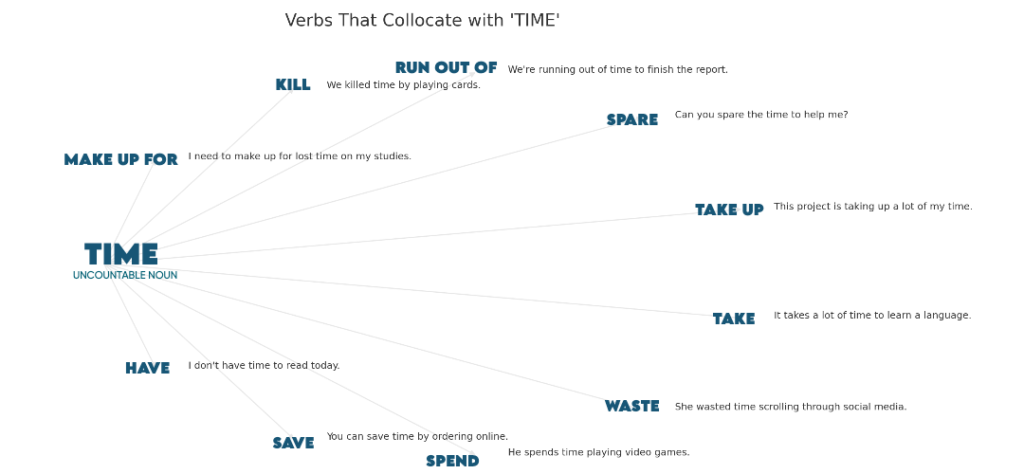
Common Verb Collocations with “TIME”
1. Have (TIME) for something & Have (TIME) to do something
- Meaning: To possess enough time available for an activity.
- Examples:
- I don’t have time for long phone calls during the day.
- She always has time for her friends.
- I don’t have time to watch TV these days.
- Do you have time to help me with this report?
2. Save (TIME) by doing something
- Meaning: To use time efficiently or reduce the amount of time needed for a task.
- Examples:
- You can save time by using a faster route.
- He saved time by preparing his meals in advance.
- We saved time by taking a direct flight instead of stopping over.
3. Spend (TIME) doing something & Spend (TIME) on something
- Meaning: To use time for a particular activity.
- Examples:
- She spends a lot of time reading books.
- He spends too much time playing video games.
- I spent a whole day on this assignment.
- She spends a lot of time on social media.
4. Waste (TIME) doing something & Waste (TIME) on something
- Meaning: To use time inefficiently or for unimportant activities.
- Examples:
- He wasted hours watching pointless videos.
- We wasted too much time arguing instead of solving the problem.
- Don’t waste time on negative thoughts.
- They wasted time on unnecessary paperwork.
5. Take (a lot of TIME) to do something & Take (your TIME)
-
Take (a lot of time) to do something:
- Meaning: Something requires a significant amount of time to complete. Commonly used with “a long time/quite a while/ages” to mean a lot of time & “hardly any time/very little time” to indicate the opposite.
- Examples:
- It takes a lot of time to learn a new language.
- This project took me a long time to complete.
-
Take (your time):
- Meaning: To do something slowly and carefully, without rushing.
- Examples:
- Take your time; there’s no need to hurry.
- She took her time getting ready for the party.
6. Takes up (a lot of my TIME)
- Meaning: Something consumes a large portion of someone’s available time. A common synonym is “it’s time-consuming”
- Examples:
- This project is taking up a lot of my time.
- Commuting takes up too much of my day.
- His new responsibilities take up most of his working hours.
7. Spare (the TIME) to do something
- Meaning: To find or make time available for something.
- Examples:
- Can you spare the time to help me with this report?
- I can’t spare the time for a long chat right now.
- She always spares time for exercise, no matter how busy she is.
8. Run out of (TIME)
- Meaning: To have no more time left to do something.
- Examples:
- We’re running out of time; we need to make a decision quickly!
- I ran out of time before I could finish the test.
- She always runs out of time when trying to meet deadlines.
9. Kill (TIME) (by) doing something
- Meaning: To pass time while waiting for something, often in a way that is not very productive.
- Examples:
- I killed time by reading a book at the airport.
- Let’s play a game to kill time while we wait.
- He killed time by scrolling through his phone.
10. Make up for (lost TIME)
- Meaning: To compensate for time that was wasted or lost.
- Examples:
- We worked extra hours to make up for lost time.
- I missed so many classes that now I have to study hard to make up for lost time.
- She took a long break, but now she’s making up for lost time by working twice as hard.
Let’s see what you remember – Do the quiz!
Press Submit to check your answers—correct ones turn green, incorrect ones pink. Fix mistakes and submit again until all are green! ✅
Time Collocations Quiz