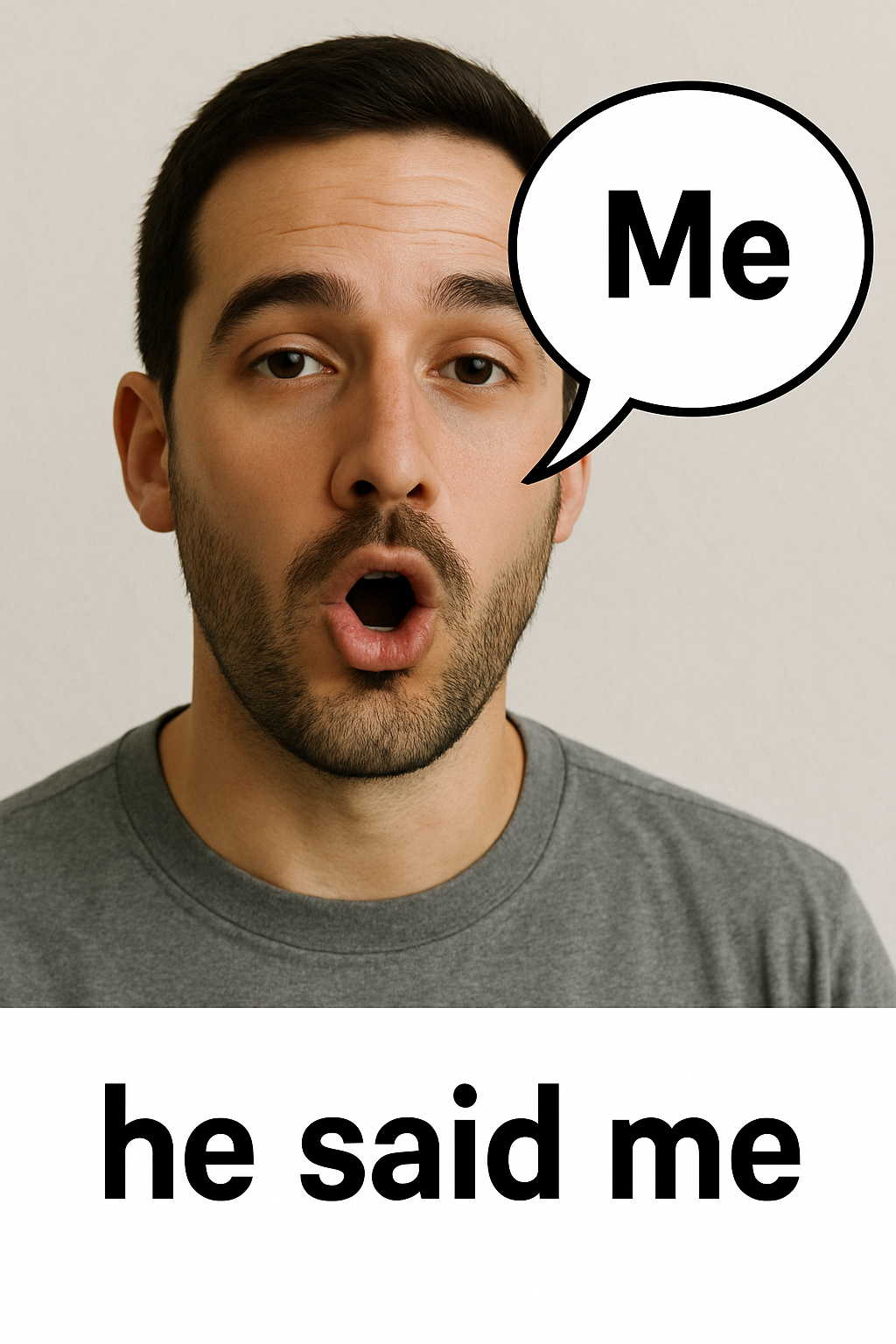
Learn why “He said me….” is a BIG mistake
Understanding the Difference: Say vs Tell
Reading time: 8 minutes | Level: A2-B2
Why This Matters
Say and tell are two of the most common communication verbs in English, but they cause endless confusion for learners. You might write 'My teacher said me' in an email, or 'She told goodbye' in a story, and native speakers will immediately notice something sounds wrong. These errors happen because many languages use just one verb where English uses two. The difference isn't about formality or politeness—it's about grammar patterns and who you're talking to. Getting this right will make your English sound natural and help you avoid awkward mistakes in everyday conversations, emails, and writing.
Common Mistakes:
- Using 'say' with a person directly: *'He said me the answer' instead of 'He told me the answer'
- Using 'tell' with fixed expressions: *'She told goodbye' instead of 'She said goodbye'
- Forgetting the person after 'tell': *'The manager told that we have a meeting' instead of 'The manager told us that we have a meeting'
By the end, you'll know exactly when to use 'say' versus 'tell', understand their different grammar patterns, and stop making the most common mistakes.
Let's Fix These Common Mistakes
Before we dive into each term, let's look at real errors students make and understand why they happen:
Why: Say cannot take a person as a direct object. You must use 'told' when mentioning who received the information, or use 'said to me' with the preposition.
💡 Say + to + person, but Tell + person (no preposition needed)
Why: When giving instructions or commands (infinitive pattern), you must use 'tell', never 'say'. The pattern 'tell someone to do something' has no equivalent with 'say'.
💡 For instructions: tell someone to do something (say cannot be used this way)
Why: 'Say goodbye' is a fixed expression. Tell cannot be used with greetings or farewells like goodbye, hello, or good morning.
💡 Always 'say goodbye/hello', never 'tell goodbye/hello'
Why: Tell requires a person (indirect object). When you don't mention who you're telling, use 'say'.
💡 Tell needs a listener: tell someone something
Why: 'Tell the truth' is a fixed collocation. We always say 'tell the truth' and 'tell a lie', never with 'say'.
💡 Fixed expressions: tell the truth, tell a lie, tell a story
Why: Tell almost always requires an indirect object (the person being told). Without mentioning who, you should use 'said'.
💡 Tell who? If there's no answer, use 'say' instead
Why: We use 'tell a story', not 'say a story'. Stories, jokes, and lies are told, not said.
💡 Tell a story/joke/lie (these are fixed collocations)
Why: 'Say yes/no' is a fixed expression. Use 'say' for yes/no responses, not 'tell'.
💡 Always 'say yes/no', never 'tell yes/no'
Text with Errors:
- Error 1: 'said me' – Say cannot take a direct person object without the preposition 'to'. Should be 'told me' or 'said to me'.
- Error 2: 'said to complete' – When giving instructions, you need 'tell someone to do'. Should be 'told me to complete' or 'said that I should complete'.
- Error 3: 'tell what time' – Tell requires a person. Should be 'tell me what time' or 'Could you say what time'.
Corrected Version:
Key Learning: In formal writing like emails, 'tell' is used for direct communication to a specific person, and it always needs that person mentioned in the sentence.
Text with Errors:
- Error 1: 'said me' – Should be 'told me' when mentioning the person receiving the information.
- Error 2: 'told goodbye' – Fixed expression: must be 'said goodbye', never 'told goodbye'.
- Error 3: 'said the truth' – Fixed collocation: always 'told the truth', never 'said the truth'.
Corrected Version:
Key Learning: Fixed expressions like 'say goodbye' and 'tell the truth' must be memorized because they don't follow the general rules.
Text with Errors:
- Error 1: 'said me an amazing story' – Should be 'told me an amazing story'. We tell stories, and tell requires the person.
- Error 2: 'told that life' – Tell needs a person: should be 'told me that life' or 'said that life'.
- Error 3: 'said her to help' – Instructions require 'tell': should be 'told her to help'.
- Error 4: 'tells how hard' – Missing person: should be 'tells me how hard' or 'tells us how hard'.
Corrected Version:
Key Learning: In narratives, 'tell' is used for stories and instructions to specific people, while 'say' can be used for general statements or reported speech without mentioning the listener.
Understanding 'Say'
Core Meaning: To express something in words, focusing on the words themselves rather than who hears them.
Grammar Notes
As noun: Rarely used as a noun meaning 'opportunity to express opinion': 'Everyone should have a say in the decision.' Usually appears in phrases like 'have your say' or 'final say'.
As verb: When mentioning the person, you MUST use the preposition 'to': 'I said to her' (NOT 'I said her'). Say cannot take a person as a direct object. Past tense: said (pronounced 'sed'). Cannot be followed by infinitive for instructions.
⚠️ Say + to + person OR just say + that clause (no person mentioned)
Common Collocations
- say goodbye/hello
- say yes/no
- say a word
- say something
- say a prayer
- needless to say
- that is to say
💭 Memory Tip: Think of SAY as 'Speaking About Your words' – it's about WHAT you said, not WHO you said it to.
Understanding 'Tell'
Core Meaning: To communicate information directly to a specific person, emphasizing the transfer from speaker to listener.
Grammar Notes
As noun: Very rare: an archaeological tell (ancient settlement mound). Not used in everyday English.
As verb: Tell almost always requires an indirect object (the person). Pattern: tell + person + information. Past tense: told. Can be followed by infinitive for instructions: 'tell someone to do something'. Cannot be used with direct quotations.
⚠️ Tell + person (no preposition) + what you're telling them
Common Collocations
- tell the truth
- tell a lie
- tell a story/joke
- tell the difference
- tell the time
- time will tell
- tell someone off
- I told you so
💭 Memory Tip: Think of TELL as 'Talking to Everybody who Listens' – you must mention the LISTENER (the person being told).
Seeing Them in Context
Now let's see how these terms work correctly in real situations:
Business Email
Thank you for your email. My colleague told me about the new project timeline. The project plan says that we need to complete Phase 1 by March 15th. Could you tell me more about the budget requirements? I want to say that I'm excited to work on this initiative.
Terms used: tell, say
Use 'told me' because we're mentioning who received the information. Use 'says' for what the written document states. Use 'tell me' for a direct request to a specific person. Use 'say that' for expressing your own statement.
Classroom Conversation
The teacher told us to read Chapter 5 before next class. She said that there would be a quiz on Friday. When I asked about the assignment, she said to me that I should focus on the main concepts. The textbook says the exam covers three chapters.
Terms used: tell, say
Use 'told us to read' for instructions. Use 'said that' for general announcement. Use 'said to me' with the preposition when mentioning the person with 'say'. Use 'says' for what written text states.
Social Gathering
At the party, Maria told everyone a funny story about her vacation. When it was time to leave, she said goodbye to the hosts. They said that she should visit again soon. She told them that she had a wonderful time.
Terms used: tell, say
Use 'told everyone a story' because stories are told. Use 'said goodbye' (fixed expression). Use 'said that' for their statement. Use 'told them' when mentioning who received the message.
Keep This Reference Handy:
| Term | When to Use | Remember | NOT When |
|---|---|---|---|
| say | Focus on the words spoken, not the listener | say + to + person OR say + that clause | Don't use for instructions, stories, or truth/lies |
| tell | Direct information to a specific person | tell + person (no 'to') + information | Don't use for goodbye/hello/yes/no or direct quotes |
SAY focuses on WHAT was said; TELL focuses on WHO you said it to—and tell needs that person in the sentence!
Check Your Understanding:
- □ I can explain the main difference between say and tell (say focuses on words, tell focuses on the recipient)
- □ I know that 'tell' needs a person without 'to', but 'say' needs 'to' before the person
- □ I understand that instructions use 'tell someone to do', never 'say'
- □ I can spot and correct errors like 'said me' and 'told goodbye'
- □ I know the fixed expressions: say goodbye/yes/no, tell the truth/a story
- □ I feel confident using these terms in my own speaking and writing