Verbs That Always Take -ING Forms
Core PathWay
1 Understanding Gerunds as Activity Nouns
You have chosen to learn about verbs followed by -ING forms, let’s get started. The -ING form often talks about activities, but it works as a noun, not as a verb in continuous tense. For example, in ‘I am enjoying myself’, the word ‘enjoying’ is the continuous form of the verb ‘enjoy’. However, in ‘I enjoy reading books’, the word ‘reading’ is a gerund, which means it is a noun that describes an activity. Some verbs must always be followed by these gerund nouns. You cannot say ‘I enjoy to read’ because enjoy requires a gerund or noun after it. Understanding this pattern will help you speak and write more naturally. Let’s look at groups of verbs that follow this important rule.
2 Verbs About Preferences and Reactions
Several verbs describe what we like, dislike, or how we react to activities. I appreciate having supportive friends in my life. My brother detests waking up early on weekends. Do you fancy going to the cinema tonight? She doesn’t dislike working from home, but she prefers the office. These verbs always need a gerund or noun after them. You can also say ‘I appreciate your help’ because ‘help’ is a noun, but you must say ‘I appreciate helping others’, not ‘I appreciate to help others’. The pattern stays the same whether you’re talking about preferences or strong reactions.
3 Verbs About Decisions and Actions
Many verbs in this group relate to decisions we make or actions we take. The company decided to discontinue producing that model. We should avoid making the same mistake twice. I consider moving to a different city every year. They had to delay launching the new product due to problems. The manager doesn’t allow eating at our desks during work hours. She managed to escape paying the fine by explaining the situation. Some people try to evade answering difficult questions in meetings. When you finish reading this section, move to the next one.
4 Verbs About Communication and Awareness
The final group includes verbs about how we communicate and understand situations. He refused to admit making the error at first. The team needs to discuss changing the project timeline. I anticipate hearing from them by next week. She didn’t acknowledge receiving my email yesterday. Please advise taking the train instead of driving in this weather. Can you forgive me for forgetting your birthday? The witness decided to deny seeing anything unusual that night. All these verbs follow the same gerund pattern, which means you should always use an -ING form or a noun after them, never an infinitive with ‘to’.
Use the VAS to build solid recognition and recall of the terms below.
✔ Every correct Match = +1 point
✔ Every correct Recall = +2 points
🎓 Reach 5 points with good accuracy and the term is automatically promoted to your Personal Dictionary.
Incorrect answers lower accuracy, meaning more correct Matches or Recalls may be needed to reach promotion.
Member-Exclusive Vocabulary Review & Acquisition System
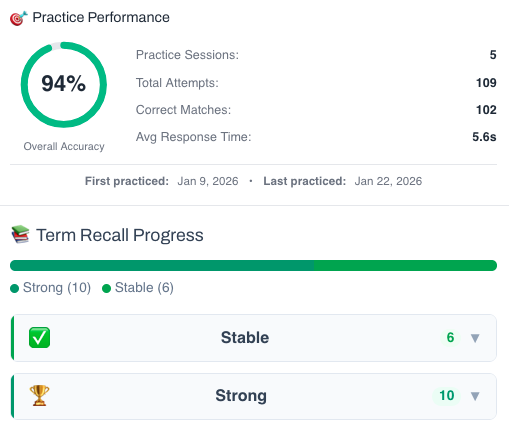
This isn’t a simple quiz — it’s a fully tracked learning system. You build knowledge through recognition, then recall, and your progress feeds directly into the Integrated Practice Bar (Writing tasks, AI Chat, and more).
- Practice sessions, accuracy, and response-time tracking
- Term strength levels (Learning → Stable → Strong)
- Personal progress history for each unit
This feature is available to YSP members.
Explore Membership BenefitsMember-Exclusive Practice Bar
Access a wide range of integrated practice for this unit — from Vocabulary and Grammar activities to AI-curated Writing tasks and Thematic Chat practice.
This feature is available to YSP members.
Explore Membership BenefitsMember-Exclusive Sentence Builder
Reconstruct scrambled sentences to practice word order and develop your grammar intuition.
This feature is available to YSP members.
Explore Membership Benefits