Verbs Followed by Gerunds: Essential Patterns
Core PathWay
1 Understanding Gerunds After Verbs
In English, certain verbs are always followed by the -ing form (called a gerund). You can’t use ‘to + infinitive’ with these verbs – it would sound wrong to native speakers. For example, we say ‘I enjoy reading’ (not ‘I enjoy to read’). This lesson focuses on 22 essential verbs that follow this pattern.
The good news? Once you learn these patterns, you’ll sound much more natural when speaking English. Native speakers use these verbs constantly in everyday conversation, so mastering them will significantly improve your fluency.
2 Category 1: Thinking and Memory Verbs
These verbs relate to mental processes – how we think about and remember things. They all require the -ing form when talking about actions or events.
Imagine works when you’re thinking about possible situations:
– Can you imagine living in another country?
– I can’t imagine working in such a noisy office.
Recall and recollect both mean to remember something (they’re quite formal):
– I don’t recall meeting him before.
– She couldn’t recollect seeing the document.
Understand means to know why or how something happens:
– I don’t understand wanting to work on weekends.
– Do you understand needing more time for this project?
Mention means to talk about something briefly:
– She mentioned visiting Paris last summer.
– Did he mention changing the meeting time?
Key Terms
3 Category 2: Suggestion and Communication Verbs
These verbs are about giving advice, making suggestions, or sharing information with others.
Recommend means to say something is good or suitable:
– I recommend trying the new restaurant on Main Street.
– The doctor recommended getting more exercise.
Suggest means to mention an idea or plan for others to consider:
– He suggested meeting at 3 PM instead.
– They suggested taking a different route.
Report means to give information about something that happened:
– The newspaper reported finding new evidence.
– Witnesses reported seeing a blue car.
Key Terms
4 Category 3: Continuation and Delay Verbs
These verbs describe continuing actions or delaying them until later.
Keep (+ -ing) means to continue doing something:
– She kept talking during the movie.
– They keep asking the same questions.
Practice means to do something regularly to improve:
– You should practice speaking English every day.
– He practices playing the guitar for an hour daily.
Resume means to start again after stopping:
– We’ll resume working after lunch.
– The meeting resumed discussing the budget.
Postpone and put off both mean to delay something until later:
– They postponed making a decision.
– Don’t put off doing your homework!
Key Terms
5 Category 4: Avoidance and Resistance Verbs
This group includes verbs about avoiding things, disliking them, or preventing them from happening.
Mind (in questions and negatives) means to dislike or object to something:
– Do you mind waiting a few minutes?
– I don’t mind helping you with that.
Miss means to feel sad about not doing something you enjoyed:
– I miss living near the beach.
– Don’t you miss seeing your old friends?
Prevent means to stop something from happening:
– The rain prevented us from going out.
– What can prevent making this mistake again?
Risk means to do something that might have a bad result:
– Don’t risk losing your job by being late.
– He risked failing the exam by not studying.
Resent means to feel angry about something unfair:
– She resented having to work late every day.
– They resent being treated differently.
Resist means to stop yourself from doing something you want to do:
– I can’t resist eating chocolate.
– He resisted checking his phone during the meeting.
Shun means to avoid someone or something deliberately:
– Some people shun using social media.
– He shuns attending large parties.
Tolerate means to accept something unpleasant without complaining:
– I can’t tolerate working in such heat.
– She won’t tolerate being interrupted.
Involve means to include something as a necessary part:
– The job involves traveling to different cities.
– Does this course involve giving presentations?
Key Terms
6 Practice Patterns
Now let’s see how these verbs work in connected speech. Notice how natural they sound when you use the -ing form:
Making suggestions in conversations:
– ‘I suggest starting with the easier tasks first.’
– ‘The guide recommended visiting the museum in the morning.’
Talking about habits and routines:
– ‘I keep forgetting to send that email!’
– ‘She practices speaking French with her neighbor.’
Expressing preferences and feelings:
– ‘Do you mind opening the window?’
– ‘I really miss going to the gym regularly.’
Describing work and responsibilities:
– ‘My job involves meeting new clients every week.’
– ‘We postponed launching the product until next month.’
📝 Complete Terms List
Verbs:
Phrasal Verbs:
Use the VAS to build solid recognition and recall of the terms below.
✔ Every correct Match = +1 point
✔ Every correct Recall = +2 points
🎓 Reach 5 points with good accuracy and the term is automatically promoted to your Personal Dictionary.
Incorrect answers lower accuracy, meaning more correct Matches or Recalls may be needed to reach promotion.
Member-Exclusive Vocabulary Review & Acquisition System
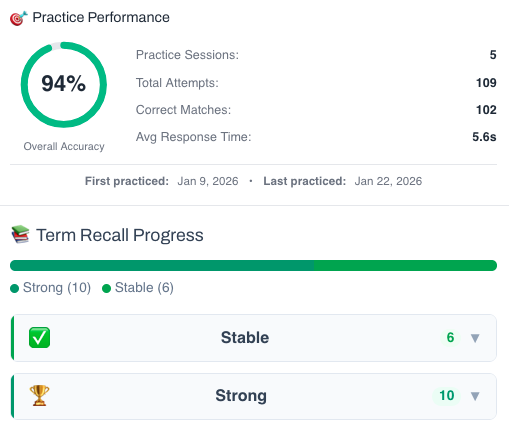
This isn’t a simple quiz — it’s a fully tracked learning system. You build knowledge through recognition, then recall, and your progress feeds directly into the Integrated Practice Bar (Writing tasks, AI Chat, and more).
- Practice sessions, accuracy, and response-time tracking
- Term strength levels (Learning → Stable → Strong)
- Personal progress history for each unit
This feature is available to YSP members.
Explore Membership BenefitsMember-Exclusive Sentence Builder
Reconstruct scrambled sentences to practice word order and develop your grammar intuition.
This feature is available to YSP members.
Explore Membership Benefits