To Fit, To Be Fit For: Mastering Perfect Matches in English
Core PathWay
1 🎯 Why This Word Is Your Secret Weapon
Imagine you’re shopping for jeans. You find a pair you love, but when you try them on, they’re too tight around the waist. The shop assistant asks, ‘How do they fit?’ This simple question shows why mastering to fit transforms your English. Without it, you’d struggle to explain one of the most common problems in daily life: when things don’t match the right size or requirements.
But here’s where it gets interesting. ‘Fit’ isn’t just about clothes. When your boss says ‘Sarah is a good fit for the team,’ she’s not talking about Sarah’s body size! The word works in physical situations (Does this key fit the lock?) and abstract ones (Is he fit for the manager role?). This flexibility makes it incredibly powerful.
Knowing to fit and to be fit for helps you in three crucial situations. First, when shopping – you can describe sizing problems clearly and ask for help in the fitting-room. Second, at work – you can discuss whether someone or something is suitable for a job or purpose. Third, in everyday problem-solving – you can explain why something doesn’t work or isn’t appropriate. Native speakers use these expressions dozens of times every week, and now you will too.
💬 Shopping for the Perfect Jacket
A customer is trying on clothes in a store and needs help finding the right size
2 🧠 The Full Picture: Meanings That Matter
Meaning 1: Physical Size Match (Most Common)
This means something is the right size or shape for a particular space or person.
Example: ‘These shoes don’t fit me – they’re too small.’
Context note: Used in everyday spoken and written English, completely neutral register.
Notice how to fit works both ways: ‘The shoes fit me’ OR ‘I fit the shoes’ (less common but possible). The most natural pattern is: [thing] + fits + [person/space].
Meaning 2: Suitability for Purpose
This means something is appropriate or suitable for a particular job, role, or use. We often use the form to be fit for + purpose/use.
Example: ‘This old computer isn’t fit for modern gaming.’
Context note: Slightly more formal, common in workplace and technical contexts.
The phrase fit for purpose is especially important in British English for describing whether something does the job it’s meant to do.
Meaning 3: Physical Health and Strength
This means someone is healthy and strong enough to do something.
Example: ‘The doctor says I’m fit to return to work next week.’
Context note: Common in medical and sports contexts, uses the pattern ‘fit to + verb’ or ‘fit for + noun’.
Meaning 4: The Noun Form – A Fit/Good Fit
This describes how well something matches in size OR how suitable something/someone is.
Example (physical): ‘It’s a tight fit, but the sofa will go through the door.’
Example (abstract): ‘The new designer is a perfect fit for our creative team.’
Context note: Very common in both casual and professional English, shows the quality of matching.
💬 Discussing a Job Candidate
Two managers are reviewing candidates after interviews to decide who to hire
3 🎬 See It In Action: Real Communication
Scenario 1: Professional/Workplace Situation
Context: A hiring manager is discussing a job candidate with her team after interviews.
‘I really like Sarah’s experience, and I think she’d be a good fit for the marketing role. Her skills fit our requirements perfectly, and she seems fit for the challenge of leading a small team.’
Why it works: Shows all three uses – abstract compatibility (good fit), matching requirements (fit our requirements), and capability (fit for the challenge).
Scenario 2: Social/Casual Conversation
Context: Two flatmates are shopping for furniture online, trying to find a desk for their small apartment.
‘What about this one? Do you think it’ll fit in the corner by the window? It says it’s 120cm wide.’
‘Hmm, it’s going to be a tight fit. We should measure the space first – can you check if it fits?’
Why it works: Natural spoken English using ‘fit’ for physical space, plus the common expression ‘tight fit’ for something that barely matches the available space.
Scenario 3: Shopping/Retail Context
Context: A customer is in a clothing store trying on a jacket.
Customer: ‘Excuse me, this jacket doesn’t fit very well. The shoulders are too tight. Could I try the next size up?’
Assistant: ‘Of course! You can try it in the fitting-room over there. The larger size should give you a better fit.’
Why it works: Shows the practical vocabulary you need when clothes shopping, including the essential word ‘fitting-room’ and both verb and noun forms.
Scenario 4: Unexpected/Creative Use
Context: A friend is explaining why she quit her job, using ‘fit’ metaphorically.
‘The company was great, but the corporate culture just wasn’t a good fit for me. I need somewhere that fits my values better – I felt like I was trying to fit into a role that didn’t suit my personality.’
Why it works: Demonstrates how native speakers use ‘fit’ abstractly to talk about compatibility with values, culture, and personal preferences. Also shows the contrast with ‘suit’ (personal preference vs. objective matching).
4 ⚠️ Danger Zones & Safe Passages
Common Error 1: Confusing FIT and SUIT
Many learners use these interchangeably, but they mean different things!
❌ ‘This dress really fits you!’ (when you mean it looks good on someone)
Memory trick: FIT = size and requirements (objective facts). SUIT = personal preference and appearance (subjective opinion). If you’re talking about colour, style, or what looks good, use SUIT. If you’re talking about size or capability, use FIT.
Common Error 2: Wrong Preposition with FIT FOR
❌ ‘Is he fit to this job?’
❌ ‘This tool isn’t fit of heavy work.’
Memory trick: The pattern is always fit FOR when talking about suitability and purpose. Think: ‘fit for the purpose.’
Common Error 3: Using FIT as a Noun Incorrectly
❌ ‘The fit of this candidate is good.’ (sounds unnatural)
Register warning: In professional contexts, ‘a good fit’ for people is fine, but ‘the fit of a person’ sounds strange. However, ‘the fit of clothing/objects’ is perfectly natural.
5 🔧 Grammar Mechanics & Power Patterns
Pattern 1: Basic Verb Pattern – Subject + FIT + Object
Structure: [thing/person] + fit(s) + [person/space/requirements]
Examples:
– ‘The key fits the lock perfectly.’
– ‘These candidates fit our requirements.’
Note: In present simple, remember the ‘s’ for third person: ‘it fits’ not ‘it fit’. Past tense is regular: ‘fitted’ (British) or ‘fit’ (American).
Pattern 2: BE FIT FOR – Suitability Pattern
Structure: [person/thing] + be + fit for + [purpose/role/activity]
Examples:
– ‘This meat isn’t fit for human consumption.’ (formal)
– ‘Are you fit for work after your illness?’
Restriction: This pattern is more formal than simple ‘fit’. Don’t use it for everyday clothing – say ‘These jeans don’t fit’ NOT ‘These jeans aren’t fit for me.’
Pattern 3: Noun Transformations – A FIT / GOOD FIT / PERFECT FIT
Structure: [subject] + be + a/an + [adjective] + fit
Examples:
– ‘The new software is a perfect fit for our needs.’
– ‘It’s a tight fit, but the table will go through the door.’
Common adjectives with FIT: good, perfect, tight, loose, poor, bad, natural, close.
Pro Tip: When talking about people joining teams or organizations, native speakers almost always use the noun form: ‘She’s a great fit for the team’ sounds much more natural than ‘She fits the team well.’ This small change makes you sound significantly more fluent in professional English!
6 💡 The Story Behind the Word
The word fit has a fascinating journey that explains why it works in so many different situations today. It comes from Old Norse ‘fitja,’ meaning ‘to knit together’ or ‘to make suitable.’ Think about knitting – when pieces fit together perfectly, they create something whole and functional. This original meaning of ‘making things work together’ is still alive in modern English.
In the 1500s, ‘fit’ started being used for clothing that matched body size – a natural extension of the ‘knitting together’ idea. By the 1800s, during the Industrial Revolution, ‘fit for purpose’ became crucial language for describing whether machines and parts worked properly together. The health and fitness meaning developed around the same time, as people began to think about whether bodies were ‘fit’ (suitable) for physical work.
Here’s a surprising fact: the phrase a good fit for people joining organizations only became common in the 1980s, borrowed from engineering language! Before that, people talked about whether someone was ‘suitable’ or ‘appropriate.’ Now, ‘cultural fit’ and ‘team fit’ are some of the most common phrases in hiring worldwide.
The key takeaway? Whether you’re talking about shoes, software, or new employees, you’re using the same ancient idea: things that ‘knit together’ work better. When something fits – physically or metaphorically – it means the pieces work together smoothly, just like good knitting.
Member-Exclusive Practice Bar
Access a wide range of integrated practice for this unit — from Vocabulary and Grammar activities to AI-curated Writing tasks and Thematic Chat practice.
This feature is available to YSP members.
Explore Membership BenefitsMember-Exclusive Vocabulary Review & Acquisition System
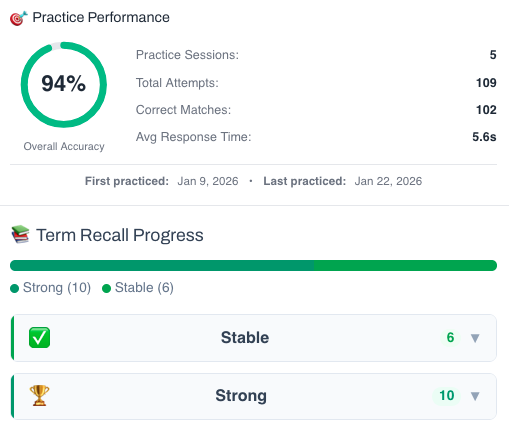
This isn’t a simple quiz — it’s a fully tracked learning system. You build knowledge through recognition, then recall, and your progress feeds directly into the Integrated Practice Bar (Writing tasks, AI Chat, and more).
- Practice sessions, accuracy, and response-time tracking
- Term strength levels (Learning → Stable → Strong)
- Personal progress history for each unit
This feature is available to YSP members.
Explore Membership Benefits🎮 Practice Games
Sentence Scrambler
To Fit, To be Fit For – Sentence Scramble
Member-Exclusive Sentence Builder
Reconstruct scrambled sentences to practice word order and develop your grammar intuition.
This feature is available to YSP members.
Explore Membership Benefits