The Present Perfect Continuous: An Overview of All Main Uses
Core PathWay
1 Section 1. What Is the Present Perfect Continuous?
Here is a tense that English does in its own special way — and once you understand it, you will start hearing it everywhere.
The Present Perfect Continuous is built from three parts: have/has + been + verb-ing. For example: I have been working, She has been running, They have been waiting. The structure is always the same.
This tense is a continuous tense, so it always describes actions — things you do, things that happen, things that move. It does not work with state verbs like know, believe, or own. Those verbs describe conditions, not actions, so they use different forms.
It is also a perfect tense. This is important. Perfect tenses build a bridge between two time periods — the past and the present. The Present Perfect Continuous looks back at a past action and connects it to right now. The action started in the past, and it is still relevant to the present moment.
Many languages do not have a direct equivalent of this form. If it feels unfamiliar at first, that is completely normal. But here is the good news: English speakers use it constantly, and it covers four clear situations.
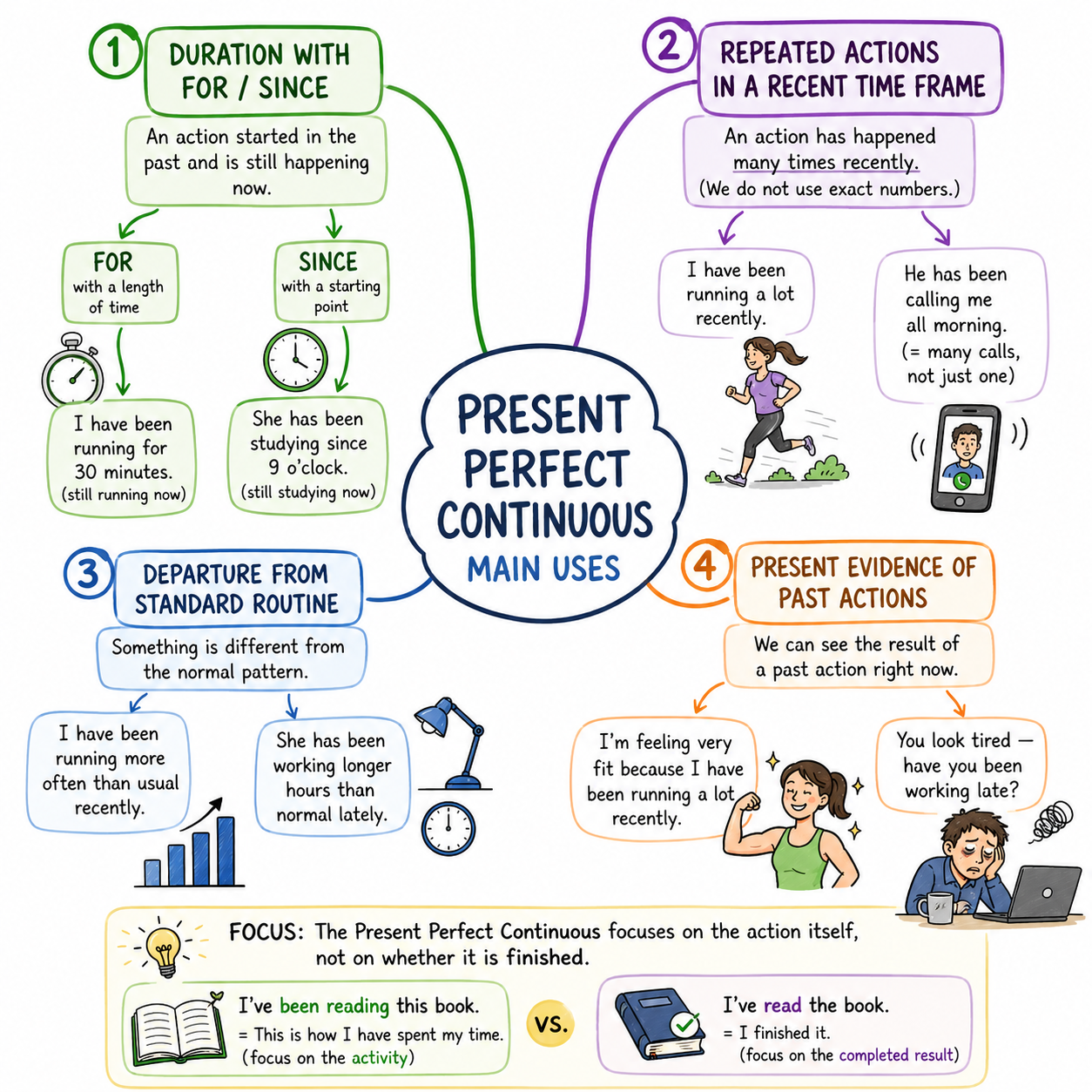
Use 1 — Duration with FOR / SINCE
We use this form to show that an action started in the past and is still happening now. We use for with a length of time and since with a starting point.
► I have been running for 30 minutes. (still running now)
► She has been studying since 9 o’clock. (still studying now)
Use 2 — Repeated actions in a recent time frame
We use this form to show that an action has happened many times recently. Notice: we do not use exact numbers here.
► I have been running a lot recently.
► He has been calling me all morning. (= many calls, not just one)
Use 3 — Departure from standard routine
We use this form to show that something is different from the normal pattern.
► I have been running more often than usual recently.
► She has been working longer hours than normal lately.
Use 4 — Present evidence of past actions
We use this form when we can see the result of a past action right now.
► I’m feeling very fit because I have been running a lot recently.
► You look tired — have you been working late?
One more thing to keep in mind: the Present Perfect Continuous focuses on the action itself, not on whether it is finished. Compare these two sentences:
► I’ve been reading this book. = This is how I have spent my time. (focus on the activity)
► I’ve read the book. = I finished it. (focus on the completed result)
This difference matters. We will look at each use in detail across the following sections.
2 Section 2. Use 1 — Duration: Actions That Are Still Happening
Let’s start with the most common use: describing an action that started in the past and is still happening now.
We use the Present Perfect Continuous with for and since to show duration. Remember: this is an action, not a state.
► I have been waiting for twenty minutes. (I am still waiting right now)
► Alex has been living in Madrid since 2019. (Alex is still there)
► They have been building the new office for six months. (still under construction)
Why not the Present Perfect Simple here?
The Present Perfect Simple with for and since works with state verbs — verbs that describe conditions rather than activities.
► I have known Sam for ten years. ✓ (know is a state verb — use Present Perfect Simple)
► I have been knowing Sam for ten years. ✗ (wrong — state verbs do not use continuous forms)
So the key rule is simple. Action verb? Use the Present Perfect Continuous. State verb? Use the Present Perfect Simple.
Here are some common action verbs that work well with this form: run, work, study, wait, travel, cook, train, read (as an activity), build, drive.
Here are common state verbs that do not: know, like, love, believe, own, understand, want, seem.
The Negative Form
The negative is also very useful. We use haven’t / hasn’t been + verb-ing to say that a repeated action or ongoing activity has not been happening.
► I haven’t been sleeping well lately. [lack of good sleep over SEVERAL nights]
► Jordan hasn’t been going to the gym recently. [He usually goes to the gym, but has interrupted this habit]
► I haven’t been drinking coffee for six weeks now. [I have interrupted a habit]
Now look at this contrast carefully:
► I haven’t been drinking coffee for six weeks. = I interrupted the habit. I have not done this action repeatedly for six weeks, but maybe I have drunk some coffee
► I haven’t drunk coffee for six weeks. = Not even one cup. This focuses on the quantity — zero – not even one drop of coffee
The first sentence is about the absence of the action (no habit, no repeated behaviour). The second is about the amount (not a single drop). This is a small but important difference. English speakers use both, but they mean slightly different things.
3 Section 3. Uses 2 and 3 — Repeated Actions and Changes in Routine
Two of the most natural and conversational uses of the Present Perfect Continuous are about frequency and change. Let’s look at both.
Use 2 — Repeated actions recently
When we want to say that something has happened many times in a recent period, we use the Present Perfect Continuous with words like a lot, lately, and recently.
► I have been working a lot lately.
► She has been travelling a lot recently.
► Chris has been calling the office all morning. (= many calls, not just one)
That last example is important. I have been calling him all morning does not mean one single phone call. It means many attempts, repeated over a period of time. The continuous form carries this sense of repeated action naturally.
Important note: with this use, we do not give exact numbers or specific quantities. We cannot say I have been running three times — that is not how this form works. Instead, we use general expressions like a lot, quite a bit, not much, or not very often.
✗ I’ve been eating out five times recently. (use Present Perfect Simple for specific quantities)
This use is the heart of one of the most common questions in English conversation:
► What have you been doing lately?
This question asks: what actions and events have filled your time recently? It is a warm, natural way to catch up with someone. Native speakers use it constantly.
Use 3 — Departure from standard routine
The Present Perfect Continuous is also perfect for describing something that is different from your normal pattern. Think of it as the past version of the Present Continuous used for temporary situations.
Present Continuous (now): I don’t usually work ten-hour days, but I am working ten-hour days at the moment.
Present Perfect Continuous (recently): I’ve been working ten-hour days recently.
The Present Perfect Continuous pulls the tail of that temporary situation back into the recent past. It says: this is not my normal routine, but it has been happening.
► I’ve been eating more than usual lately. (not my normal habit)
► She’s been taking the bus recently. (she usually drives)
► We’ve been having a lot of meetings this month. (more than normal)
Key phrases that signal this use: more than usual, more often than normal, less than usual, more recently, this week/month (when the quantity is unusual).
Together, Uses 2 and 3 make the Present Perfect Continuous one of the most expressive tenses for talking about your life, your habits, and your recent experiences.
4 Section 4. Use 4 — Present Evidence of Past Actions
Sometimes you do not need to have seen the action happen. You can see the result right now — and that result tells you what has been happening.
This is one of the most interesting uses of the Present Perfect Continuous. The action is not happening at this moment, but the present evidence shows that it was recent or repeated.
Look at these examples:
► You look tanned. Have you been sunbathing?
(The tan is the present evidence. The sunbathing is in the past.)
► This room smells of smoke. Somebody has been smoking in here.
(The smell is the present evidence. The smoking has stopped.)
► Look — the road is all wet. It has been raining.
(The wet road is the present evidence. It is not raining now.)
► Your eyes are red. Have you been crying?
(Red eyes = evidence. The crying happened before this moment.)
In each case, we use the Present Perfect Continuous because the action is what matters — not just the result. Compare:
► It has been raining. = Focus on the action of raining (repeated, ongoing until recently)
► It has rained. = Focus on the fact that rain occurred (completed event)
This use appears a lot in spoken English when people notice something and make a deduction — a reasonable guess based on what they can see.
Here are some useful patterns for this use:
► You look + adjective — have you been + verb-ing?
► This place smells / feels / looks + adjective — someone has been + verb-ing.
► Look at + noun — it / they must have been + verb-ing.
Practice noticing this use in real life. When you see a result — a wet umbrella, a tired face, a messy kitchen — ask yourself: what has been happening here? The Present Perfect Continuous is your answer.
5 Section 5. Writing Task — Putting It All Together
You have explored all four main uses of the Present Perfect Continuous. Now it is time to use them yourself. Write an email to a friend you have not spoken to for a while. Use the Present Perfect Continuous naturally to talk about what has been happening in your life.
Use the Present Perfect Continuous to:
1. Describe something you have been doing for a period of time (use FOR or SINCE)
2. Mention something you have been doing a lot recently
3. Mention something that is different from your normal routine
4. Describe something your friend can see or notice as a result of your recent actions
Try to use: have/has been + verb-ing, for, since, lately, recently, a lot, more than usual.
Start your email with: ‘Hi [friend’s name], sorry I haven’t been in touch — I’ve been really busy lately!’
6 Recap — Actions, Repetition, and Amounts
Let’s bring everything together.
The Present Perfect Continuous (have/has been + verb-ing) is a uniquely English form. It builds a bridge between the past and the present — and it always focuses on actions, never states.
Here are the four uses you have studied:
1. Duration — An action started in the past and is still happening now.
► I’ve been waiting here for an hour. (still waiting)
Use for with a length of time. Use since with a starting point.
2. Repeated actions — An action has happened many times in a recent period.
► She’s been calling a lot lately.
Use words like a lot, recently, and lately. Do not use exact numbers.
3. Departure from routine — Something is different from the normal pattern.
► I’ve been working longer hours than usual recently.
Use phrases like more than usual or more often than normal.
4. Present evidence — You can see the result of a past action right now.
► The road is wet — it has been raining.
The action is finished, but the evidence is visible.
Three themes run through all of these uses. Keep them in mind:
— Action: This tense is always about doing — running, working, waiting, calling. Not knowing, not owning, not believing.
— Repetition: How often something has been happening matters. We use a lot, not much, quite a bit, not very often — general amounts, not exact numbers.
— Amounts — a lot / not much: These two expressions are your best friends with this tense. I’ve been sleeping a lot. I haven’t been eating much. They are natural, common, and very useful.
The next pages in this pathway look at each use in detail. You are ready, but review with the image below and then complete the practice tasks.
Member-Exclusive Practice Bar
Access a wide range of integrated practice for this unit — from Vocabulary and Grammar activities to AI-curated Writing tasks and Thematic Chat practice.
This feature is available to YSP members.
Explore Membership Benefits🎮 Practice Games
Sentence Scrambler
Uses of Present Perfect Continuous – Overview – Sentence Scramble
Member-Exclusive Sentence Builder
Reconstruct scrambled sentences to practice word order and develop your grammar intuition.
This feature is available to YSP members.
Explore Membership Benefits