🎙 Have You Ever Tried It?
Present Perfect — experience“TIMES, Lexical Sense: all common uses of 'TIMES' but including 'not even one time ' = never, One time = once etc, hundreds of times, lots of times.”
Use the present perfect to talk about experiences in your life. Ask and answer questions with ever and never about things you have done.
🚌 On the go
Press play once and listen to the whole episode: the welcome, the grammar, the word focus and the story. Perfect for the bus, the car or a walk.
One button, the whole episode. Good for the bus, the car or a walk.
🧩 Piece by piece
Take your time. Listen to one part at a time, then open Read and replay line by line to hear any sentence again.
Welcome
Josie: “Welcome to the YouSpeakPlus Audio Cast. I am Josie.”
Marco: “And I am Marco. Good to be here.”
Josie: “Today we look at experiences. Things you have done in your life. Listen. I have tried surfing. That is the structure. Have or has, then a past participle.”
Marco: “And we also look at a very useful word. Times. It has more than one meaning.”
Josie: “Lots of times, one time, not even one time. We use it in different ways. Then we hear a story that puts everything together.”
Marco: “Ready? Let us start.”
Part 1 · Grammar
Josie: “Today we talk about experiences. Things that happened in your life. Listen to this sentence. I have eaten sushi. That is our structure today.”
Marco: “Have eaten. That sounds different. Is it the past?”
Josie: “Yes. It connects to the past. But we do not say when. We just say: it happened in my life. That is the key idea. Now listen. Have you ever eaten sushi, Marco?”
Marco: “Yes! I have eaten sushi. In Rome, last year.”
Josie: “Good try. But stop there. We do not use last year with this structure. Just say: I have eaten sushi. No time. We use this when the time is not important. Only the experience matters.”
Marco: “OK. So it is just the experience. I have eaten sushi. Full stop.”
Josie: “Exactly. Now listen to four more examples. I have seen that film. She has tried yoga. We have been to London. He has won a prize. All experiences. No time.”
Marco: “Different situations. But all experiences in life.”
Josie: “Right. Now look at the form. It is have or has, then a past participle. Listen. I have seen. She has eaten. We have been. Do you see the pattern?”
Marco: “So I, you, we, they use have. He, she, it uses has.”
Josie: “Perfect. Now you try. Tell me one thing you have done in your life. Any experience.”
Marco: “I have ridden a horse. In the countryside near my town.”
Josie: “Excellent. I have ridden a horse. That is a good past participle. Ridden is the past participle of ride. Now ask me something with ever.”
Marco: “Have you ever been to Japan?”
Josie: “I have never been to Japan. I really want to go one day. Notice the word never. We use never to say: this experience did not happen in my life. Your turn. What about your friend Sofia? Has she ever won a prize?”
Marco: “Yes. She has won a school prize. For a drawing.”
Josie: “She has won. Good. You used has for she. That is correct. One more. Tell me something you have never done.”
Marco: “I have never seen the sea in winter. Is that OK?”
Josie: “That is perfect. Now, two classic mistakes. Listen carefully. First one: She have tried it. Can you hear the problem?”
Marco: “She have? That is wrong. It needs has.”
Josie: “Right. She have tried it is wrong. Say: she has tried it. Say it now.”
Marco: “She has tried it.”
Josie: “Good. Second mistake. I haven't never eaten sushi. That is wrong. We only use one negative in this structure. Say: I have never eaten sushi. Try it.”
Marco: “I have never eaten sushi. OK. One never is enough.”
Josie: “Exactly. So remember this. Use have or has. Then the past participle. And no finished time. Now go and tell someone one thing you have never done. Use the structure we practised today.”
Part 2 · Word focus
Josie: “OK Marco, new word now. Times. Listen to this sentence. I have been to Rome three times. What does three times mean there?”
Marco: “Three occasions? Three visits to Rome?”
Josie: “Exactly. Three times means three occasions. That is the most common use. We count occasions with times. Listen to these. She has tried yoga two times. He has called me five times today. Times tells you how many occasions.”
Marco: “So times just tells you how many occasions. Simple.”
Josie: “Right. Now, sometimes the number is very big. We say lots of times. Or many times. Or even hundreds of times. Listen. I have eaten pizza hundreds of times. I have heard that song lots of times. All three phrases mean the same thing — a very big number of occasions.”
Marco: “Hundreds of times. That is a lot of pizza.”
Josie: “Ha. Yes, it is. You can also say many times. Same meaning. I have seen that film many times. I have read that book many times. Lots of times, many times, hundreds of times — all the same idea.”
Marco: “OK. Lots of times, many times, hundreds of times. All the same idea.”
Josie: “Good. Now listen to this one. One time, I went to a concert alone. One time means one single occasion. It is the same as once. Try it. Tell me something you did one time.”
Marco: “One time, I cooked dinner for twenty people. It was very hard.”
Josie: “Perfect. Now, once is another way to say one time. Once, I cooked dinner for twenty people. Same meaning. Both are fine. You can use one time or once — they mean the same thing.”
Marco: “Once and one time are the same?”
Josie: “Yes. One time and once both mean one single occasion. Now here is an interesting one. Not even one time. This means never. Zero occasions. Listen. Not even one time have I been to Australia. That means I have never been to Australia. But not even one time sounds stronger. It shows feeling.”
Marco: “Oh. So not even one time is a strong way to say never.”
Josie: “Exactly. It adds feeling. It sounds stronger than just saying never. Listen. Not even one time did she say sorry. You can hear that the speaker is not happy about it. Now, times has one more use. Maths. Three times four is twelve.”
Marco: “Ah yes. Times means multiply. Like in school. Two times five is ten.”
Josie: “Good. Three times four is twelve. Two times five is ten. Simple. Now, here is a common mistake. Listen. I go there many time. Can you hear the problem?”
Marco: “Many time? It needs an s. Many times.”
Josie: “Right. Many time is wrong. Always say many times. The same with lots of times and a number. Three times, not three time. Say all three now.”
Marco: “Many times. Lots of times. Three times.”
Josie: “Perfect. Now a quick check. I say a sentence. You tell me what times means in that sentence. Ready?”
Marco: “Ready.”
Josie: “First one. I have called you four times today.”
Marco: “Four occasions. Times is counting occasions.”
Josie: “Good. Second one. Not even one time did he help me.”
Marco: “That means never. Zero occasions. He never helped.”
Josie: “Exactly. Last one. Six times seven is forty-two.”
Marco: “Maths. Multiply. Six times seven.”
Josie: “Perfect. So remember this. Times counts occasions. Use it with a number, with lots of, many, or hundreds of. Use once or one time for one single occasion. Use not even one time when you want to say never with strong feeling. And in maths, times means multiply. Always add that s — many times, not many time.”
- how many occasions something happens — a countable number of occasions I have been to Paris three times.
- used in phrases to show a large or small number of occasions — lots of times, many times, hundreds of times I have watched that film hundreds of times.
- once — one time, a single occasion I tried skiing one time and I loved it.
- never — not even one time, zero occasions Not even one time did she call me.
- used in multiplication — three times four is twelve Five times two is ten.
- a period in history or in life — in difficult times, in my grandfather's time Things were different in those times.
Part 3 · Story
Josie: “Now here is a story. Listen for have and has. And listen for the word times. Ready? Listen.”
Nina: “Clara is thirty years old today. Her friend Bea has a plan. She wants to take Clara somewhere special. Clara does not know where.”
Nina: “Bea says, I have booked something amazing. You are going to love it. Clara laughs and says, Have you ever done something like this for me before? Bea says, Lots of times. You just never noticed.”
Nina: “They drive for one hour. Then Clara sees a big green hill. And she sees people in the sky. She says, Are those people flying? Bea smiles and says, Yes. We are going paragliding.”
Nina: “Clara stops walking. She says, I have never done that. Not even one time. Bea says, I know. That is why we are here. It is on your bucket list.”
Nina: “Clara looks at the sky. She feels nervous. She says, Have you ever done this, Bea? Bea nods and says, Yes. I have done it three times. It is wonderful every time.”
Nina: “A young instructor walks over. His name is Dan. He says, Hello. Has anyone here flown before? Bea raises her hand. She says, I have flown three times. Clara shakes her head.”
Nina: “Dan smiles at Clara. He says, Do not worry. I have taught hundreds of people. Clara says, Hundreds of times? Dan laughs and says, Yes. Hundreds of times. You are safe.”
Nina: “Dan shows Clara the equipment. He says, Have you ever worn a harness before? Clara thinks. She says, One time. For rock climbing. Years ago. Dan says, Good. This is similar.”
Nina: “They walk to the top of the hill. The wind is strong. Clara looks down at the valley below. It is beautiful. She takes a long breath.”
Nina: “Dan says, Are you ready? Clara nods slowly. Then she runs. Then she is in the air. She has done it. She has jumped.”
Nina: “Clara shouts, I have never felt this free! The wind takes her up. She can see the whole valley. She can see Bea on the hill, waving.”
Nina: “For ten minutes, Clara flies. Then Dan guides her down slowly. Her feet touch the ground. She has landed. She is safe.”
Nina: “Bea runs over. She says, So? What do you think? Clara is shaking. But she is smiling. She says, I have never done anything like that in my life.”
Nina: “Bea laughs and says, Was it scary? Clara says, Yes. Many times I wanted to close my eyes. But I did not. I kept them open.”
Nina: “Dan comes over. He says, Well done. You have been very brave today. Clara looks at Bea. She says, Has anyone ever told you that you are a wonderful friend?”
Nina: “Bea laughs. She says, Not even one time. Clara shakes her head and says, Well. I am telling you now. This is the best birthday I have ever had.”
Nina: “They walk back to the car. Clara is quiet. Then she says, I want to do it again. Bea says, I knew it. Clara smiles and says, How many times can we come back?”
Nina: “Bea says, As many times as you want. Clara laughs. She looks up at the sky one more time. She feels proud. She has done something she has never done before.”
Josie: “That is the end of the story. Now listen again. Listen for have and has. How many times did you hear them? And listen for the word times. How many times did you hear that?”
Josie: “Have and has came up ten times in the story. And the word times came up eleven times. Well done for listening. See you in the next episode.”
Member-Exclusive Practice Bar
Access a wide range of integrated practice for this unit — from Vocabulary and Grammar activities to AI-curated Writing tasks and Thematic Chat practice.
This feature is available to YSP members.
Explore Membership BenefitsMember-Exclusive Vocabulary Review & Acquisition System
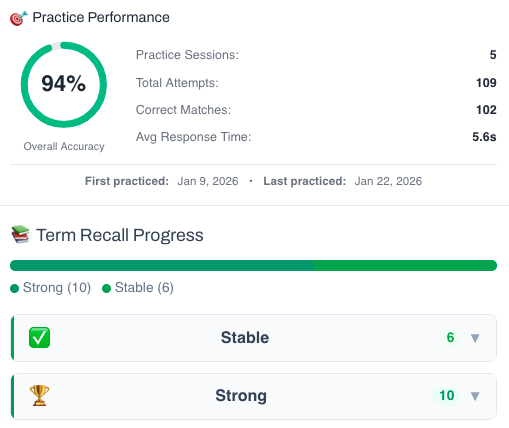
This isn’t a simple quiz — it’s a fully tracked learning system. You build knowledge through recognition, then recall, and your progress feeds directly into the Integrated Practice Bar (Writing tasks, AI Chat, and more).
- Practice sessions, accuracy, and response-time tracking
- Term strength levels (Learning → Stable → Strong)
- Personal progress history for each unit
This feature is available to YSP members.
Explore Membership Benefits