Have You Heard the Latest? — Listening to Present Perfect in Action
Core PathWay
1 Section 1. Breaking News: The Evening Bulletin
Listen to this evening news broadcast. Notice how the anchor uses the Present Perfect to introduce each story — the ‘headline’ — and then each correspondent uses past tenses to fill in the details.
💬 Dialogue 1: The Evening Bulletin — Five Stories, Five Correspondents
A live evening news programme. The anchor is in the studio. Five correspondents are reporting from different locations.
📝 Comprehension Check: Evening News Bulletin
Answer the questions based on what you heard in the audio.
What does Leila say about how long the recovery will take?
Who addressed staff in an internal video message?
How many jobs are expected to be lost?
Who said that the players had worked incredibly hard?
What does the government want to reduce the use of?
What is the penalty for non-compliance?
What does 'landfall' in 'the storm made landfall' mean?
When did Sofia Vega's new film premiere?
Anchor: “Good evening. Here are tonight's headlines. A major tech company has announced plans to cut thousands of jobs worldwide. Global markets have fallen sharply following the news. Our business correspondent, Dana, has the details.”
Dana: “Thank you. The announcement came this morning when the company's CEO addressed staff in an internal video message. He said the company had been losing ground to competitors for the past eighteen months and that the restructuring was necessary to secure the firm's long-term future. Around four thousand positions are expected to go, mainly in the company's marketing and logistics divisions. Unions were quick to condemn the decision and called for an emergency meeting with senior management.”
Anchor: “Thank you, Dana. In sport, the national football team has reached the semi-finals of the international tournament for the first time in twelve years. Our sports correspondent, Marcus, was at the stadium.”
Marcus: “It was an extraordinary night here. The team went into the match as underdogs, but they played with real discipline from the first whistle. They scored twice in the second half — the winning goal came in the eighty-ninth minute — and the crowd went absolutely wild. The coach said afterwards that the players had worked incredibly hard over the past three months and that tonight was the reward for that effort. The semi-final takes place next Thursday.”
Anchor: “Wonderful scenes there. Now to politics. The government has introduced a new bill that would significantly limit the use of single-use plastics in food packaging. Our political correspondent, Priya, is outside parliament.”
Priya: “That's right. The bill was formally tabled in parliament this afternoon after months of cross-party negotiations. Under the proposals, retailers would have two years to phase out single-use plastic packaging for fresh food, and manufacturers would face heavy fines for non-compliance. Opposition parties gave the bill a cautious welcome but said the timeline was too long. Environmental groups, however, called it a significant step forward and said they would be watching closely to make sure the government followed through.”
Anchor: “Thank you, Priya. On the environment, a powerful storm has caused widespread destruction across the southern coastal region. Our environment correspondent, Leila, has been following the story.”
Leila: “The storm made landfall in the early hours of this morning, bringing winds of up to one hundred and forty kilometres per hour and heavy rainfall that caused serious flooding in low-lying areas. Emergency services were deployed overnight, and rescue teams were still working through the afternoon to reach people who had been cut off by floodwater. Local authorities have declared a state of emergency, and the government has pledged immediate financial support for affected communities. Forecasters say conditions should improve by tomorrow evening, but the clean-up operation is expected to take several weeks.”
Anchor: “Our thoughts are with those affected. Finally, in entertainment, the internationally acclaimed director Sofia Vega has released her long-awaited new film, and critics have given it an overwhelmingly positive reception. Our entertainment correspondent, Tom, has been watching.”
Tom: “Sofia Vega's new film premiered last night at a star-studded event in the city centre. The film — a psychological thriller set in the 1970s — had been in production for nearly four years, and the anticipation was enormous. Critics who attended the premiere described it as her most ambitious work to date. Several major publications have already given it five stars, and early audience reactions on social media were overwhelmingly enthusiastic. The film opens in cinemas nationwide this Friday, and advance bookings have already broken the record for the studio's biggest ever opening weekend.”
Anchor: “Exciting news for film fans everywhere. That's the evening bulletin. Stay with us — more details on all of tonight's stories throughout the evening. I'm Jordan Clarke. Good night.”
Key Terms
2 Section 2. Catching Up — Three Friends, Lots of News
Three friends — Alex, Sam, and Jordan — haven’t seen each other for a few weeks. Listen to how they share news about their own lives and their mutual friends. Notice the phrases they use to introduce gossip and updates.
💬 Dialogue 2: The Big Catch-Up
A café on a Saturday afternoon. Alex, Sam, and Jordan are meeting after several weeks apart.
📝 Comprehension Check: Catching Up
Answer the questions based on what you heard in the audio.
Which speaker shares news about someone who left their job after many years?
Which speaker already knew about a friend's new job before hearing the full story?
Which speaker tells the group about a recent engagement?
Which speaker says they have applied for a higher position at work?
What does Jordan say about the online course they are doing?
What does Sam say about Chris and Lena's relationship?
Why does Alex say their friend accepted a new job offer in another country?
What does Sam say about Alex's news at the end of the conversation?
Alex: “Finally! It feels like ages since we've all been in the same place. So much has happened. Where do we even start?”
Sam: “I know, right? OK — you'll never guess what Mia has done. She's handed in her notice at the law firm. Just like that. After six years.”
Jordan: “No way! When did that happen? I had no idea she was even thinking about it.”
Sam: “Apparently she made the decision a few weeks ago. She said she'd been feeling burnt out for months and she just reached a point where she couldn't carry on. She told her manager on Monday morning and walked out on Friday. She's planning to take some time off and then maybe retrain as a therapist.”
Alex: “Wow. Good for her, honestly. Have you heard the latest about Dan, by the way? He's moved to another city — got a new job and everything.”
Jordan: “Oh, I knew about the job — he mentioned it when I bumped into him last month — but I didn't know he'd actually moved already. Which city?”
Alex: “He's gone to Porto, apparently. He started the new role about three weeks ago. He said the interview process was brutal — four rounds over six weeks — but he got through it and the offer was too good to turn down.”
Sam: “Porto! That's amazing. He always talked about living abroad. Right, well — have you two heard? Chris and Lena have got engaged. The proposal happened last weekend in Paris, apparently.”
Jordan: “Shut up! Really? I mean, they've only been together for — what — eighteen months?”
Sam: “Fourteen months, actually. But they seem really happy. Lena posted about it on Saturday morning — the photo had over three hundred likes within an hour. They haven't set a date yet, but Lena said they were thinking about next autumn.”
Alex: “That's lovely. OK, what about you two? What's been going on in your lives? Jordan, you've been very quiet.”
Jordan: “Ha! Well, since you ask — I've finally started that online course I've been putting off forever. The data science one. I signed up properly last month, and I've done three modules so far. It's genuinely hard but I'm really enjoying it.”
Sam: “That's brilliant! I've been meaning to do something like that. How long does the whole thing take?”
Jordan: “About eight months if you do it part-time. The first assignment is due next week, which is slightly terrifying. But yeah — it feels good to actually be doing it.”
Alex: “Right, I'd better share my news too. I've applied for a promotion at work. My manager encouraged me to go for it, so I submitted my application on Thursday. The interviews are in two weeks. I'm nervous, but I figured — why not?”
Sam: “Alex, that's huge! You've been in that role for ages. You absolutely deserve it. We need to celebrate — same time next month, and hopefully you'll have good news to share!”
Key Terms
3 Section 3. Back from Holiday — Project Update Meeting
Project Manager Chris has just returned from two weeks’ holiday. Team members Sam and Dana are bringing Chris up to speed on two projects. Listen to how they use Present Perfect to introduce what has happened, then past tenses to explain the details.
💬 Dialogue 3: The Two-Week Catch-Up: Project Orion and Project Delta
A meeting room on a Monday morning. Chris has just returned from annual leave. Sam leads Project Orion; Dana leads Project Delta.
📝 Comprehension Check: Project Update Meeting
Answer the questions based on what you heard in the audio.
Which speaker says that the team fixed a problem by working at the weekend?
Which speaker says that a company they were depending on left the project without warning?
Which speaker asks for a written document to be ready before a meeting with the client?
What does Sam say about the schedule for Project Orion?
Why does Dana say she did not give the client full details about the supplier problem?
What does Dana say about the cost of using the new supplier?
Chris: “Good to be back — though two weeks goes very fast. OK, let's get straight into it. Sam, can you give me the headline on Project Orion first? Where are we?”
Sam: “Sure. The good news is that we've completed the first development sprint and the client has approved the prototype. That happened last Tuesday — they came in for a review session and gave us the green light to move forward.”
Chris: “That's great progress. Any issues along the way?”
Sam: “There were a couple. We hit a technical problem in week one — a compatibility issue with the client's existing software. The dev team worked on it over the weekend and resolved it by Monday. We lost about two days, but we made that time up by the end of the sprint. The timeline is back on track.”
Chris: “Good to hear. What's next for Orion?”
Sam: “We've already scheduled the next sprint review for the fourteenth. The client wants to see the full user interface by then, so the team is working towards that. I've also drafted the updated project plan and it's ready for you to review whenever you have time.”
Chris: “Perfect. I'll look at that this afternoon. Dana — how has Delta been going? I know there were some concerns before I left.”
Dana: “Yes — and honestly, it's been a challenging two weeks. The supplier we were relying on for the hardware components has pulled out of the contract. They notified us in writing on the Wednesday after you left. It was completely unexpected.”
Chris: “That's a significant setback. What have you done about it?”
Dana: “We've already identified two alternative suppliers and we've sent them both a formal request for quotation. One of them — TechCore — responded very quickly and their pricing looks competitive. We had a call with them on Friday and they said they could deliver within our original timeframe if we confirm the order by the end of this week.”
Chris: “That sounds promising. What about the budget? Has the supplier change affected our costs?”
Dana: “Potentially, yes. TechCore's quote is about eight percent higher than what we originally agreed with the previous supplier. I've flagged this with the finance team and they're currently reviewing whether we have any contingency budget available. We should have an answer by Wednesday.”
Chris: “OK. I'll need to loop in the client on this — they'll want to know about any cost implications. Have you kept them informed so far?”
Dana: “I've sent them a brief status update by email but I haven't gone into the full detail yet. I wanted to wait until we had more concrete information before raising it formally. I thought it was better to come to them with a solution rather than just a problem.”
Chris: “Agreed — that was the right call. Let's set up a client call for Thursday once we have the finance team's answer. Dana, can you prepare a short briefing document before then? And Sam — great work keeping Orion on track while I was away.”
Key Terms
4 Section 4. What You've Been Hearing — A Quick Recap
Across these three dialogues, one pattern has been doing a lot of work. Every time a speaker wants to introduce something new — a headline, a piece of gossip, a project update — they use the Present Perfect. It signals: ‘This is new information. Pay attention.’ Then, once the listener is tuned in, the speaker switches to the past simple (and sometimes the past continuous or past perfect) to explain what actually happened: the when, the where, the how, and the why.
This two-step rhythm — Present Perfect for the ‘what’, past tenses for the detail — is one of the most natural patterns in spoken English. You heard it in a formal news broadcast (‘The government has introduced a new bill… The bill was formally tabled this afternoon’), in casual gossip (‘She’s handed in her notice… She told her manager on Monday’), and in a professional meeting (‘We’ve completed the first sprint… The client came in last Tuesday’). The context changes, but the rhythm stays the same.
Notice too how speakers use future forms to round off a story — to say what will or might happen next. The storm correspondent said conditions ‘should improve by tomorrow’. Chris told Dana to ‘set up a client call for Thursday’. This is the full arc of a news story: new information → details → consequences. Present Perfect opens the door. Past tenses walk through it. Future forms tell us where the story is going.
Keep listening for this pattern. You will hear it in podcasts, in meetings, in everyday conversation. Once you notice it, you will start using it naturally yourself.
Member-Exclusive Practice Bar
Access a wide range of integrated practice for this unit — from Vocabulary and Grammar activities to AI-curated Writing tasks and Thematic Chat practice.
This feature is available to YSP members.
Explore Membership BenefitsMember-Exclusive Vocabulary Review & Acquisition System
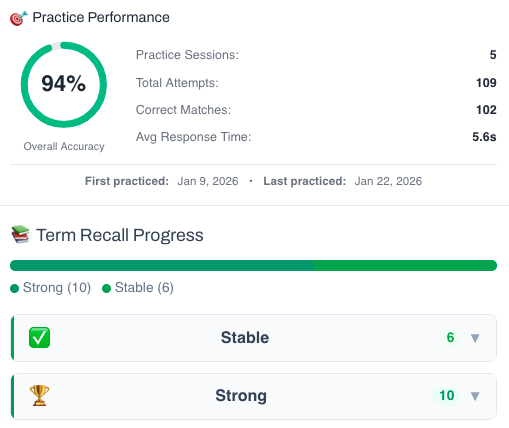
This isn’t a simple quiz — it’s a fully tracked learning system. You build knowledge through recognition, then recall, and your progress feeds directly into the Integrated Practice Bar (Writing tasks, AI Chat, and more).
- Practice sessions, accuracy, and response-time tracking
- Term strength levels (Learning → Stable → Strong)
- Personal progress history for each unit
This feature is available to YSP members.
Explore Membership Benefits