🎙 There Is, There Are: What Exists
There Is / There Are — basic existence“ACTUALLY”
Say what exists in a place using there is and there are. Ask and answer simple questions about what you can find in a room, a street, or a city.
🚌 On the go
Press play once and listen to the whole episode: the welcome, the grammar, the word focus and the story. Perfect for the bus, the car or a walk.
One button, the whole episode. Good for the bus, the car or a walk.
🧩 Piece by piece
Take your time. Listen to one part at a time, then open Read and replay line by line to hear any sentence again.
Welcome
Jane: “Welcome to the YouSpeakPlus Audio Cast.”
Giulia: “Today we have three parts for you.”
Jane: “First, two very useful words. There is. There are. We say: there is a café near here. We say: there are two cafés near here.”
Giulia: “Then we look at one small word with more than one use. Actually. Listen out for it.”
Jane: “And then a short story. You will hear both things in real life.”
Giulia: “Ready? Let's start.”
Part 1 · Grammar
Jane: “Today we learn two very useful words. There is. There are. Listen. There is a café on this street.”
Giulia: “There is. Okay. And there are?”
Jane: “Yes. There are two cafés on this street. We use these to say what is in a place.”
Jane: “Listen to four examples. There is a bed in my room. There are three windows in my room. There is a park near my house. There are many shops in my city.”
Giulia: “So I use it to say what is in a place?”
Jane: “Yes, exactly. One thing: there is. More than one thing: there are. Now, the pattern. Say this: there is, then one thing.”
Giulia: “There is a chair.”
Jane: “Good. Now say: there are, then two or more things.”
Giulia: “There are four chairs.”
Jane: “Perfect. Now you use it. Think of your kitchen. What is in your kitchen?”
Giulia: “There is a table. And there are some chairs.”
Jane: “Great. Some chairs. Very natural. Now, your street. Is there a bank?”
Giulia: “Yes. There is a bank near my house.”
Jane: “Good. And a station?”
Giulia: “No. There is not a station. There are no stations near my house.”
Jane: “Yes. We can also say: there are not any stations. Or short: there are not any. Good. Now, questions. Listen: is there a park near you?”
Giulia: “Is there a park? Yes, there is a big park near me.”
Jane: “Good. Now, two classic mistakes. Listen. Someone says: there is two chairs. That is not right. Say it right, twice: there are two chairs. There are two chairs.”
Giulia: “There are two chairs. Because two chairs is more than one.”
Jane: “Exactly. One more mistake. Someone says: it is a bank near here. Not right. We use there, not it. Say it right, twice: there is a bank near here. There is a bank near here.”
Giulia: “There is a bank near here. Not it is. I understand.”
Jane: “Good. Remember this: one thing, say there is. More than one thing, say there are. Use there, not it. Practice this today.”
Part 2 · Word focus
Jane: “Today we look at one small word. Actually. Listen to this. I think the shop is closed. Actually, it is open.”
Giulia: “Actually. Okay. So it means the real thing is different?”
Jane: “Yes. We use actually to say what is really true. The real thing is often different from what someone thinks. Listen again. I think there is one café here. Actually, there are three.”
Giulia: “So actually says: wait, the real answer is different.”
Jane: “Exactly. One more example. I think Marco is at home. Actually, he is at work. You hear the difference? Actually tells you: the real thing is not what you think.”
Giulia: “I see. And can I use actually to correct myself?”
Jane: “Yes. Listen. I have two sisters. Actually, I have three. You correct yourself with actually. It is gentle. It is not rude.”
Giulia: “Oh, I like that. So I can say: there is one bed in my room. Actually, there are two beds.”
Jane: “Perfect. You correct yourself and it sounds very natural. Now, a third use. Actually can start a new idea. Listen. Actually, can I ask you something? Actually, I want a coffee.”
Giulia: “So actually can start a sentence? Like, to get attention?”
Jane: “Yes. It is a soft way to say: I want to say something now. Listen. We are going to the park. Actually, I want to go home. It is not rude. It is just soft and natural.”
Giulia: “Okay. And one more use? You said there are four uses.”
Jane: “Good. You can use actually to show a small surprise. Something is better than you think. Listen. I tried the soup. It is actually very good. You are a little surprised. It is good.”
Giulia: “So actually can show surprise. Like: this is better than I think.”
Jane: “Yes. Now, a trap. Some learners say actually to mean now, or at this moment. That is not right. Actually does not mean now. Actually means really, or the real thing is different.”
Giulia: “Oh. So I cannot say: actually I am in the office, to mean right now I am in the office?”
Jane: “Not quite. That sentence is fine, but only if the real situation is different from what someone thinks. Not just to say now. For now, say right now or at the moment.”
Giulia: “Okay. Actually means really, not now. I understand.”
Jane: “Good. Quick check. I say a sentence. You tell me the use. Ready? He is actually very kind.”
Giulia: “That is a surprise. He is better than you think.”
Jane: “Yes. Next. There are two rooms. Actually, there are three.”
Giulia: “You correct yourself. The real number is different.”
Jane: “Good. Last one. Actually, can we sit here? What is that?”
Giulia: “You start a new idea. You want to say something.”
Jane: “Perfect. Remember this: actually tells people the real thing. Use it when the real answer is different from what someone thinks.”
- used to say what is really true, often different from what someone thinks I think the café is closed, but actually it is open.
- used to correct yourself or someone else, gently We have two cats. Actually, we have three.
- used to start saying something new or different, to get attention Actually, can I ask you something?
- used to show mild surprise that something is good or true I tried the soup. It is actually very good.
Part 3 · Story
Janet: “Now here is a story. Listen carefully. The story uses two very useful sentences. There is. And there are. Listen for them.”
Janet: “Marco arrives at a small hotel. He is tired. He wants a good room.”
Janet: “He walks to the desk. The woman at the desk smiles. She says: your room is number five. It is on the first floor.”
Janet: “Marco goes up. He opens the door. He looks around. There is one small bed. There is one small window. There is no view. He sees a wall.”
Janet: “Marco is not happy. He goes back to the desk. He says: excuse me. There is a problem with my room.”
Janet: “The woman says: a problem? What is the problem? Marco says: there is only one small window. And there are no nice things in the room. There is no view.”
Janet: “The woman looks at her computer. She says: oh. Actually, I have the wrong room for you. Your room is number fifteen. Not five. I am sorry.”
Janet: “Marco goes up to room fifteen. He opens the door. He stops. His mouth is open.”
Janet: “There are two big windows. There is a beautiful view. He can see a park and a river.”
Janet: “There is a big bed. There are two chairs near the window. There is a small table with fruit on it.”
Janet: “Marco sits on the bed. He says to himself: actually, this hotel is very good.”
Janet: “He looks out of the window. There is a garden below. There are people in the garden. There is a pool.”
Janet: “Marco picks up his phone. He calls his friend Sofia. He says: Sofia, I am at the hotel. It is actually very nice.”
Janet: “Sofia says: really? Is there a pool? Marco says: yes. There is a pool. And there are chairs near the pool. It is perfect.”
Janet: “Sofia says: and the room? Is there a good view? Marco says: actually, there are two windows. And the view is beautiful. I can see a park.”
Janet: “Sofia laughs. She says: so the hotel is good? Marco says: yes. Actually, it is great. I am very happy.”
Janet: “Marco goes back to the desk. He says to the woman: thank you. Room fifteen is perfect. The woman smiles. She says: I am glad.”
Janet: “Marco thinks about room five. There was one small bed and one small window. Actually, room five was not bad. But room fifteen is much better.”
Janet: “That evening, Marco sits near the window. There is a light in the park. There are stars in the sky. He is very happy.”
Janet: “And that is the end of our story. Now listen again. Count how many times you hear there is or there are. You will hear them fourteen times. And count actually. You will hear it five times. Good listening.”
Member-Exclusive Practice Bar
Access a wide range of integrated practice for this unit — from Vocabulary and Grammar activities to AI-curated Writing tasks and Thematic Chat practice.
This feature is available to YSP members.
Explore Membership BenefitsMember-Exclusive Vocabulary Review & Acquisition System
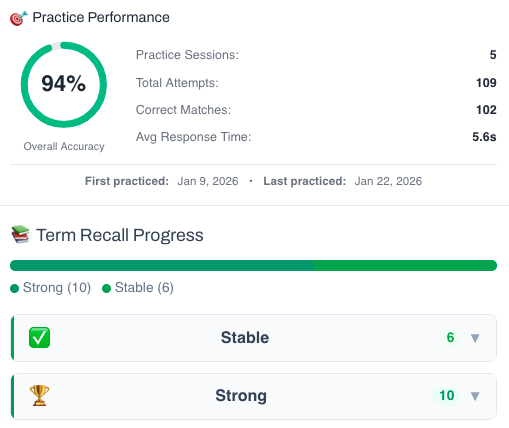
This isn’t a simple quiz — it’s a fully tracked learning system. You build knowledge through recognition, then recall, and your progress feeds directly into the Integrated Practice Bar (Writing tasks, AI Chat, and more).
- Practice sessions, accuracy, and response-time tracking
- Term strength levels (Learning → Stable → Strong)
- Personal progress history for each unit
This feature is available to YSP members.
Explore Membership Benefits