Section 1
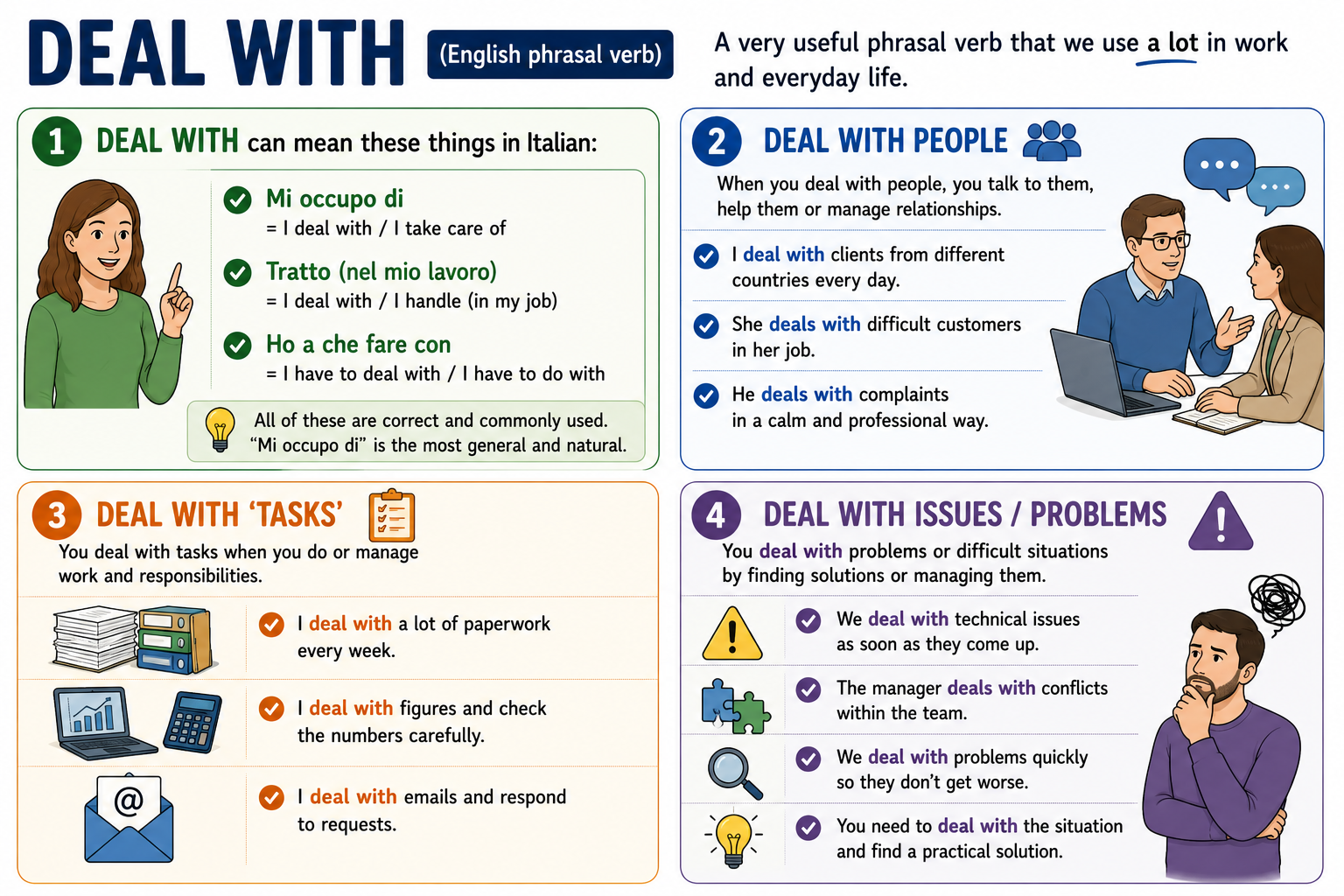
Deal with is a very useful phrase. It means to handle something or someone. You use it to talk about your job responsibilities — the things and people you work with every day.
In Italian, you can translate it as: *mi occupo di*, *tratto X nel mio lavoro*, or *ho a che fare con X nel mio lavoro*. The meaning depends on the context, but the English phrase stays the same.
Look at these patterns:
→ I deal with + THING (e.g. problems, emails, orders)
→ I deal with + PERSON (e.g. clients, suppliers, the team)
Now read this short conversation. Two colleagues talk about what they do at work.
—
Giulia: So, what do you do exactly?
Marco: I work in customer service. I deal with complaints and questions from clients every day. It’s busy!
Giulia: I understand. I deal with suppliers. I contact them, check orders, and solve problems when something goes wrong.
Marco: Do you ever deal with difficult people?
Giulia: Yes, sometimes. But I also deal with a lot of paperwork. That’s the part I don’t enjoy!
—
Notice: we say *I deal with complaints*, not *I deal complaints*. The word with is always there.
Section 2
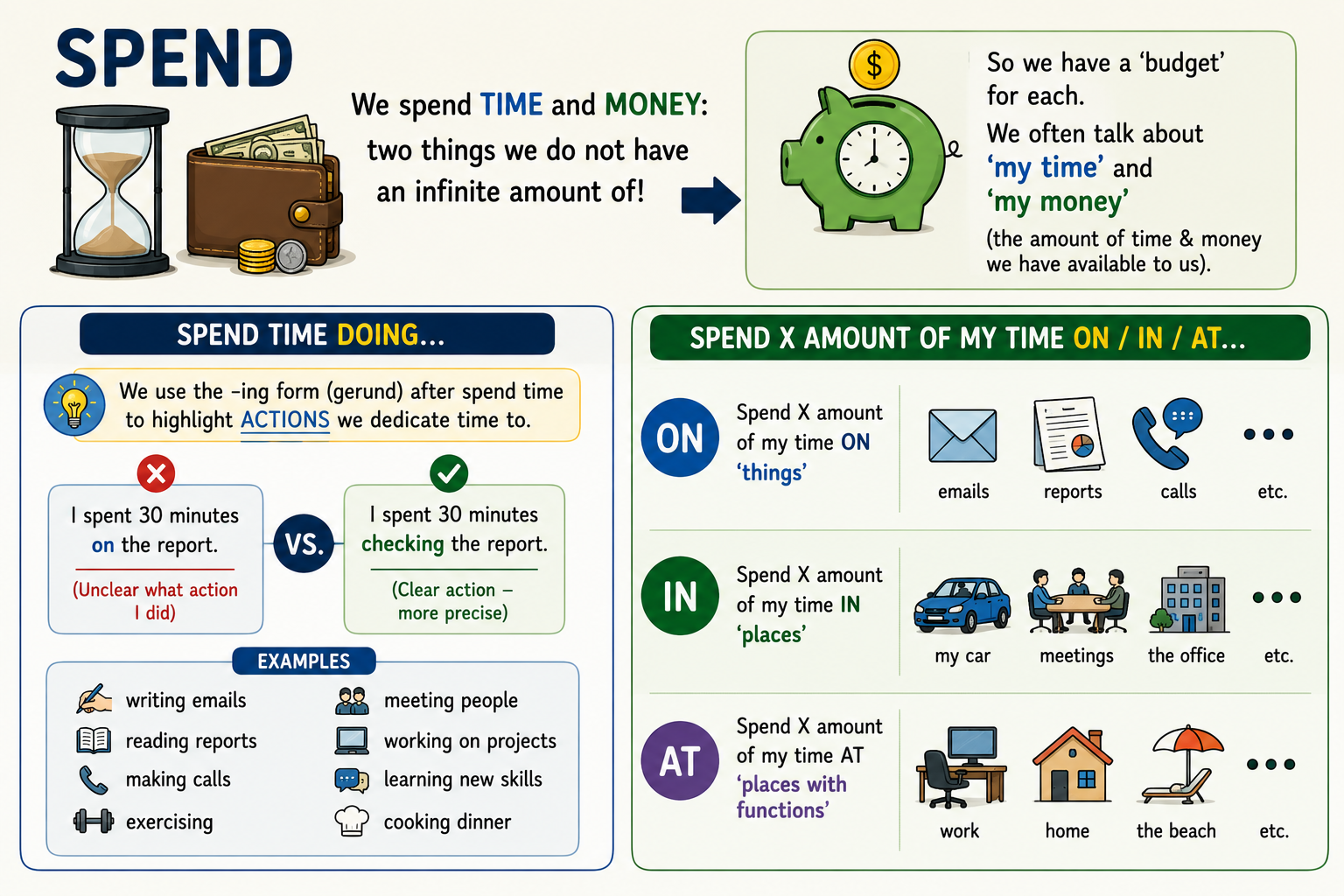
Spend time means to use your time doing something or being somewhere. In Italian, the main translation is *trascorrere* — but sometimes *passare* or *dedicarsi a* also work, depending on the meaning.
Here are the main patterns. Look carefully at the small words:
→ Spend time ON + noun = the task you give time to
*I spend a lot of time on emails.*
→ Spend time + ING = the activity you do
*I spend time writing reports.*
→ Spend time IN + place/situation = a location or context (often a room or meeting)
*I spend time in meetings.*
*I spend an hour in the car every morning.*
→ Spend time AT + place = a specific location
*I spend most of my day at my desk.*
*I spend time at home after work.*
A small note for Italian speakers: in Italian you might say *passo del tempo a fare qualcosa*. In English, we use spend time + ING — not *spend time to do*. So: *I spend time writing*, not ~~*I spend time to write*~~.
Now read this conversation. Two people talk about their work day.
—
Luca: How do you get to work, Chiara?
Chiara: I drive. I spend about 40 minutes in the car every morning. It’s quite long.
Luca: I take the train. I spend time reading on the way. It’s actually nice.
Chiara: Lucky you! And what about your day? How do you spend your time at work?
Luca: I spend a lot of time on reports. And I spend at least two hours in meetings.
Chiara: Me too. I spend most of my day at my desk, but I also visit clients sometimes.
Luca: And after work?
Chiara: I spend the evening at home with my family. I try not to work!
—
Section 3
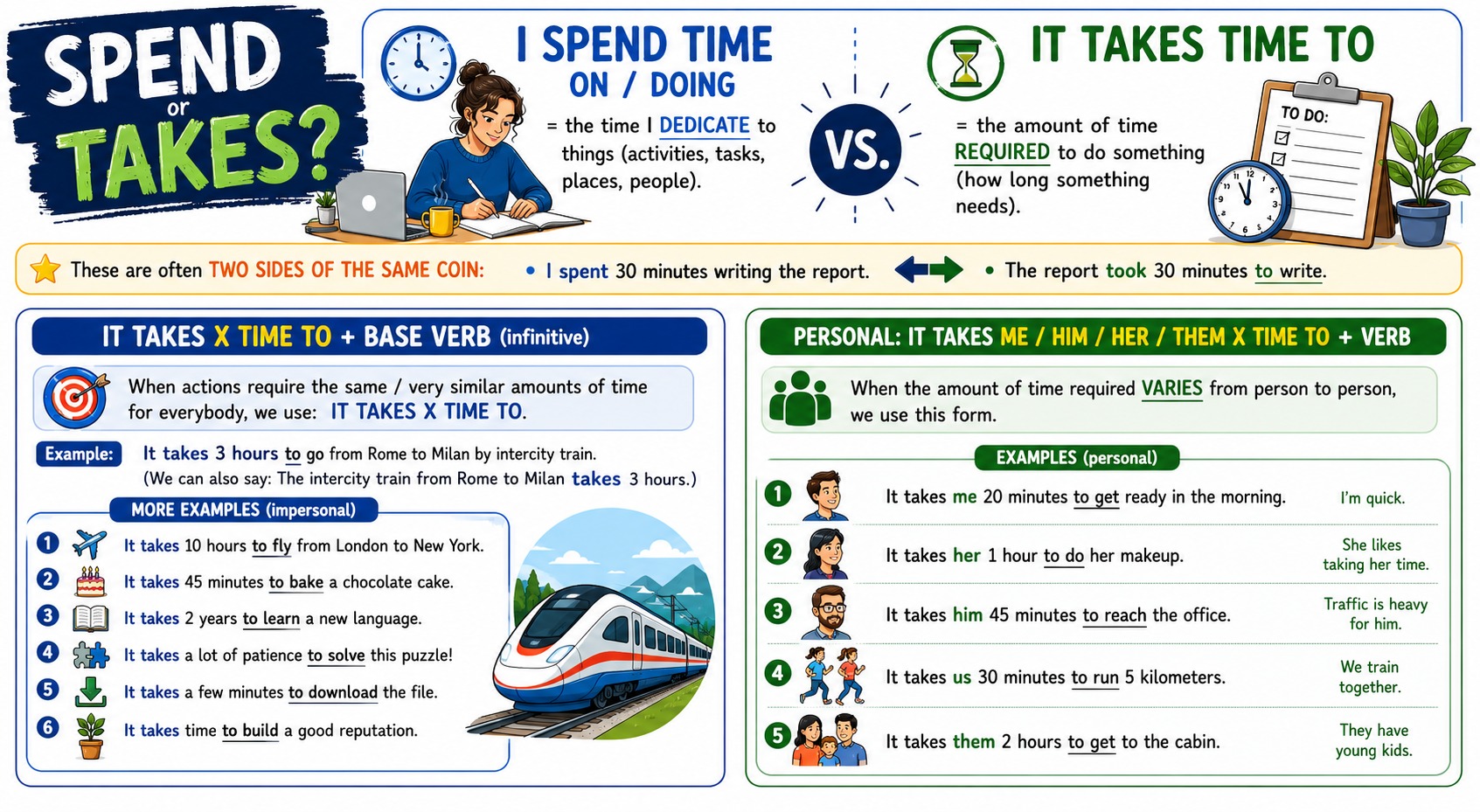
Now look at an important difference. Both sentences below talk about time — but they say something different.
→ *I spent 30 minutes writing the report.*
This means: I chose to give 30 minutes to this task.
→ *The report took 30 minutes to write.*
This means: the action required 30 minutes. It’s about the task, not me.
In English, we very often use the impersonal form: it takes + time + to + verb.
*It takes 30 minutes to write the report.*
*It takes a long time to learn a language.*
We do NOT usually say *I take 30 minutes to do something*. The natural personal form is:
It takes me + time + to + verb
*It takes me 30 minutes to write the report.*
*It takes me an hour to get to work.*
The question form is also very common:
→ How long does it take to + verb? (general)
→ How long does it take you to + verb? (personal)
Now read this conversation.
—
Sofia: How long does it take to get to your office from here?
Davide: By car, it takes about 20 minutes. But it takes me 35 minutes because I stop to buy coffee!
Sofia: Ha! And what about your work? How long does it take you to answer all your emails in the morning?
Davide: Honestly, it takes me at least an hour. There are so many.
Sofia: It takes a long time to build good communication habits, I think.
Davide: True. How long does it take you to prepare for a meeting?
Sofia: It depends. A small meeting? Maybe 15 minutes. A big presentation? It takes me two or three hours.
—
Notice the pattern: *It takes* + [me/you/him] + *time* + *to* + verb. This is very natural in English. Use it!
4 Section Writing Task — Describe Your Job and Your Day
Now use everything from this lesson. Write about your job and a typical day. Use all three phrases: deal with, spend time, and it takes (me) time to.
• deal with (+ a thing OR a person)
• spend time on (+ a task)
• spend time in (+ a place or situation)
• spend time at (+ a place)
• spend time + ING (+ an activity)
• it takes (+ time + to)
• it takes me (+ time + to)
Start your email like this:
‘Hi [name], thanks for your message! Let me tell you a little about my job and my typical day…’
Write 80–120 words. Use simple, clear sentences.
5 Section 5. Recap — Three Phrases, One Clear Picture
Section 5
Well done! You have now seen three important English phrases. Here is a quick summary.
Deal with = handle something or someone (your responsibilities at work).
*I deal with clients and complaints.*
Spend time = use your time on tasks or in places.
*I spend time on reports. I spend time in meetings. I spend time at my desk. I spend time writing emails.*
It takes time to = say how long an action requires.
*It takes 20 minutes to get to work. It takes me an hour to prepare a presentation.*
These three phrases are very common in English. They help you talk about your job, your day, and your routines in a natural way. The more you use them, the more natural they will feel!
Member-Exclusive Practice Bar
Access a wide range of integrated practice for this unit — from Vocabulary and Grammar activities to AI-curated Writing tasks and Thematic Chat practice.
This feature is available to YSP members.
Explore Membership BenefitsMember-Exclusive Vocabulary Review & Acquisition System
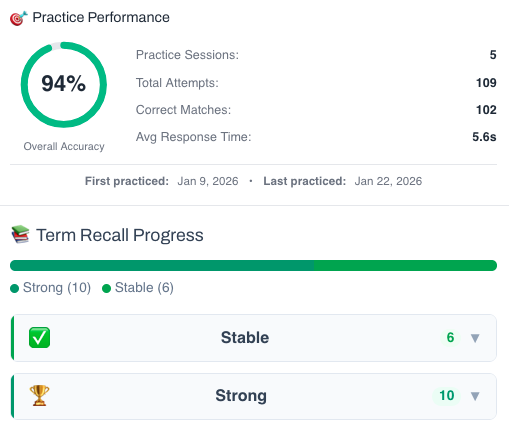
This isn’t a simple quiz — it’s a fully tracked learning system. You build knowledge through recognition, then recall, and your progress feeds directly into the Integrated Practice Bar (Writing tasks, AI Chat, and more).
- Practice sessions, accuracy, and response-time tracking
- Term strength levels (Learning → Stable → Strong)
- Personal progress history for each unit
This feature is available to YSP members.
Explore Membership Benefits🎮 Practice Games
Sentence Scrambler
Deal with – Spend time – Take time – Sentence Scramble
Member-Exclusive Sentence Builder
Reconstruct scrambled sentences to practice word order and develop your grammar intuition.
This feature is available to YSP members.
Explore Membership Benefits