The Power of Storytelling in Business: An Introduction to Corporate Storytelling
Core PathWay
1 Section 1. Why Stories Matter in Business
Welcome to your introduction to corporate storytelling! You might be wondering why so many companies now send their employees to storytelling workshops. After all, isn’t business about facts, figures, and data? Well, here’s the interesting truth: while data tells you what happened, stories help you understand why it matters.
In today’s business world, the ability to craft a good story has become a valuable professional skill. Whether you’re presenting to clients, leading a team meeting, or pitching a new idea, stories help you engage your audience in ways that spreadsheets simply can’t. Research shows that people remember stories up to 22 times more than facts alone. When you connect with people through a narrative, your message becomes memorable.
By the end of this lesson, you’ll understand what makes storytelling powerful in corporate settings, and you’ll have practical techniques and language tools to tell more effective stories at work. You’ll learn how to structure a business narrative, which phrases native speakers use to bring stories to life, and how to make your message stand out in meetings and presentations.
Storytelling isn’t just for marketing teams or sales professionals. Project managers use stories to explain why a project matters. Team leaders use them to motivate colleagues. Even technical experts use narratives to help non-specialists relate to complex ideas. The good news? Storytelling is a skill you can learn and improve with practice. Let’s explore how it works.
💬 Dialogue 1: Sharing a Project Story in a Team Meeting
A marketing manager tells colleagues about a successful campaign by using a story structure rather than just presenting results
2 Section 2. What Makes a Story Work in Business
So what exactly makes a story effective in a corporate environment? Let’s look at five practical principles you can apply immediately.
First, every good business story has a clear structure. The simplest framework is beginning-middle-end: you set the scene, introduce a challenge or problem, then show how it was resolved. This structure helps your audience follow along and remember the key points. For example, instead of saying ‘Our sales increased by 30%,’ you might say: ‘Last January, we were struggling to reach new customers. Then we tried a different approach. Within three months, our sales had increased by 30%.’
Second, effective stories focus on people, not just processes. Your audience needs someone to relate to. When you mention real people facing real challenges, your story becomes more engaging. You don’t need to share private information, just enough human detail to make the situation real.
Third, good business stories contain a challenge or problem. Without some difficulty to overcome, there’s no story, just a report. The challenge creates tension that keeps people listening. What obstacle did someone face? What made the situation difficult? This is what makes your audience want to know what happens next.
Fourth, keep your stories relevant and focused. A common mistake is including too many details or going off on tangents. Your story should drive home one main message. Ask yourself: what’s the one thing I want people to remember?
Finally, authentic stories work better than perfect ones. Don’t try to make everything sound amazing. Real stories include mistakes, uncertainty, and lessons learned. When you’re honest about challenges, your audience trusts you more and your message resonates with them on a deeper level.
💬 Dialogue 2: Explaining Why Storytelling Matters
A team leader introduces the concept of storytelling to explain an upcoming change in presentation style
3 Section 3. Your Storytelling Language Toolkit
Now let’s equip you with practical language you can use when telling stories in professional settings. These phrases will help you structure your narrative and get your message across clearly.
Starting your story: When you begin, you need to grab attention and set the scene. Try these natural openers: ‘Let me tell you about…’, ‘I’d like to share a quick story about…’, ‘This reminds me of when…’, ‘Here’s what happened when…’, ‘I’ll never forget the time…’, or ‘Let me walk you through what we experienced.’
Building the middle section: As you develop your story, use phrases that create flow: ‘At first, we thought…’, ‘The challenge was that…’, ‘What made it difficult was…’, ‘Then something interesting happened…’, ‘We started to realize…’, ‘The turning point came when…’
Useful phrases for key moments: When you want to emphasize important parts, these expressions help: ‘paint a picture‘ (describe something vividly), ‘bring to life‘ (make something feel real), ‘build up to‘ (gradually reach an important moment), ‘turn things around‘ (change a bad situation to good), ‘look back on‘ (remember and reflect on past events), ‘lead to‘ (cause a result).
Closing your story: Strong endings are crucial. Try: ‘In the end…’, ‘What we learned was…’, ‘The takeaway here is…’, ‘That experience taught us…’, ‘Looking back, the key was…’, or ‘That’s why I believe…’
Let’s see these phrases in action with two short workplace examples:
Mini-dialogue 1:
Sarah: Let me tell you about a project that really turned things around for our team.
Tom: What happened?
Sarah: Well, at first, we thought the problem was our product. But then we started to realize it was actually how we were explaining it.
Tom: So what did you do?
Sarah: We changed our whole approach. Instead of listing features, we told customer stories. That experience taught us that people connect with real examples, not technical specifications.
Mini-dialogue 2:
Alex: I’d like to share a quick story about why this change matters.
Jamie: Sure, go ahead.
Alex: Last quarter, we spent weeks preparing a presentation full of data. The client seemed bored. Then I remembered a conversation with one of their customers and shared that story instead.
Jamie: Did it work?
Alex: Completely changed the atmosphere. They started asking questions, getting involved. The takeaway here is that stories engage people in ways that numbers alone can’t.
4 Section 4. Recap – Your Storytelling Essentials
Let’s wrap up what we’ve covered about storytelling as a corporate strength.
Key ideas to remember: Stories make your message up to 22 times more memorable than facts alone. Effective business stories follow a clear structure (beginning-middle-end), focus on people facing challenges, and remain relevant and authentic. The goal isn’t to entertain but to help your audience understand why something matters and what they should do about it.
Your language toolkit includes: Natural openers like ‘Let me tell you about…’ and ‘I’d like to share…’, development phrases such as ‘The challenge was…’ and ‘The turning point came when…’, and strong closers like ‘What we learned was…’ and ‘The takeaway here is…’. These phrases help you structure your narrative and guide your audience through your message.
Next time you need to communicate at work, try this checklist:
Remember, storytelling is a skill that improves with practice. Every presentation, meeting, or conversation is an opportunity to craft a more engaging message. Start small, experiment with these techniques, and notice how people respond differently when you bring your ideas to life through narrative. You’ve got the tools—now it’s time to use them!
Member-Exclusive Practice Bar
Access a wide range of integrated practice for this unit — from Vocabulary and Grammar activities to AI-curated Writing tasks and Thematic Chat practice.
This feature is available to YSP members.
Explore Membership BenefitsMember-Exclusive Vocabulary Review & Acquisition System
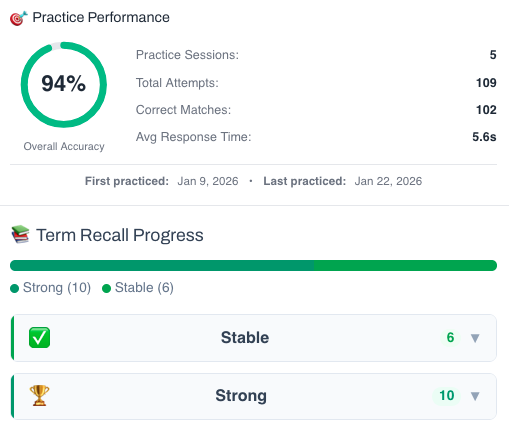
This isn’t a simple quiz — it’s a fully tracked learning system. You build knowledge through recognition, then recall, and your progress feeds directly into the Integrated Practice Bar (Writing tasks, AI Chat, and more).
- Practice sessions, accuracy, and response-time tracking
- Term strength levels (Learning → Stable → Strong)
- Personal progress history for each unit
This feature is available to YSP members.
Explore Membership Benefits🎮 Practice Games
Sentence Scrambler
Story Telling as a Corporate Strength – Sentence Scramble
Member-Exclusive Sentence Builder
Reconstruct scrambled sentences to practice word order and develop your grammar intuition.
This feature is available to YSP members.
Explore Membership Benefits