I've Been Here for Hours — Present Perfect Duration in Three Contexts
Core PathWay1 Section 1. On the Ward — Doctors Discuss a Patient
Three doctors are doing a ward round. They discuss the current state of a patient and how long that state has lasted. Notice how they use the Present Perfect Simple with state verbs — ‘has been’, ‘has had’, ‘has remained’ — to describe situations that are still true right now.
💬 Dialogue 1: Ward Round: Mr Okafor, Bed 7
A hospital ward, morning. Dr Reyes (senior consultant), Dr Singh (registrar), and Dr Patel (junior doctor) gather at the bedside of Mr Okafor, who is unconscious. They review his notes and discuss his condition.
📝 Comprehension Check: Ward Round: Bed 7
Answer the questions based on what you heard in the audio.
Which speaker says that the patient's kidneys were already having problems before he came to the hospital?
Which speaker says that the patient's relatives are waiting in the hospital and want to talk to someone?
Which speaker gives an instruction to call the radiology department directly if needed?
What does Dr Singh say about the scan of the patient's head?
What does Dr Patel say about the patient's oxygen levels?
Why is Dr Reyes worried about the patient's high temperature?
Dr Reyes: “Right, let's start with Bed 7. Dr Singh, what's the current picture? Give me the essentials.”
Dr Singh: “Mr Okafor has been unconscious since he arrived on Thursday evening. That's roughly 36 hours now. No change in his level of consciousness at any point during that time.”
Dr Patel: “His blood pressure has remained dangerously low for most of that time. We've had him on a vasopressor drip since last night to try to bring it up, but the response has been slow.”
Dr Reyes: “And his temperature? Has it been stable at all, or has it been fluctuating throughout?”
Dr Singh: “Not entirely stable, I'm afraid. He has had a fever since early Friday morning. It's been above 38.5 for about fourteen hours now, and it hasn't responded well to the paracetamol we've given him.”
Dr Reyes: “That concerns me. A persistent fever at that level alongside unconsciousness points to something serious. Has he been responsive at all — any reaction to pain stimulus?”
Dr Patel: “No, none at all. His GCS has been at 6 since admission. There's been no meaningful change — we tested him again at 6 a.m. this morning and got the same result.”
Dr Reyes: “A GCS of 6 for 36 hours is deeply worrying. What about his renal function? I noticed the creatinine was elevated on the last panel.”
Dr Singh: “Yes, his kidneys have been under significant stress for at least 48 hours. In fact, the creatinine has been above the normal range since Wednesday — before he even came in. So this isn't new.”
Dr Patel: “His family has been aware of the situation since yesterday afternoon. They arrived this morning and have been in the relatives' room since about seven o'clock. They're asking for an update when you're ready.”
Dr Reyes: “Good. I'll speak to them after the round. Has he had any imaging since admission? I want to know exactly what we're working with.”
Dr Singh: “He's had a CT head — that was clear, which rules out a bleed. But we haven't had the MRI results yet. The scan has been in the queue since midnight. I chased radiology an hour ago and they said it's next.”
Dr Reyes: “Chase it again. I want those results before the afternoon review, not after. And his oxygen saturation — how has it been? Any dips overnight?”
Dr Patel: “It has been borderline throughout, I'm afraid. He has been on supplemental oxygen since Thursday, and his sats have been between 91 and 94 percent for the past 12 hours. We haven't been able to get them above 94.”
Dr Reyes: “That's not acceptable. Increase the flow rate now and get the MRI prioritised — call the radiologist directly if you have to. His condition has been critical for too long without a clear diagnosis. I want a full update at the afternoon review. Let's move on.”
Key Terms
2 Section 2. Tour of Rome — Ancient Monuments, Lasting Presence
A tour guide is leading a group around Rome. Tourists ask questions about the age and history of the monuments they see. Listen to how the guide uses the Present Perfect Simple to say how long things have been in their current place or state — from a few centuries to thousands of years.
💬 Dialogue 2: The Eternal City — A Walking Tour of Rome
A sunny morning in central Rome. Tour guide Sofia leads a group of tourists past some of the city's most famous monuments. Several tourists ask questions.
📝 Comprehension Check: A Walking Tour of Rome
Answer the questions based on what you heard in the audio.
Which speaker explains why the Pantheon has stayed in good condition for so long?
Which speaker was surprised that Rome only became the official capital of Italy in the 19th century?
Which speaker asks whether the water supply to the Trevi Fountain area has changed over time?
Which speaker asks about the age and appearance of the fountain near the Pantheon?
What does Tourist 2 say about the Colosseum?
What does Sofia say about the Forum Romanum?
What does Tourist 1 say about the Pantheon before Sofia explains its history?
What does Tourist 2 say about the dome of the Pantheon before Sofia answers?
Sofia: “Welcome, everyone. We're standing in front of the Pantheon. This building has been here for almost two thousand years — since around 125 AD, in fact. Take a moment to let that sink in.”
Tourist 1: “Two thousand years? That's incredible. Has it always been open to visitors? I assumed it might have been closed off at some point.”
Sofia: “Not always in the same way. It has been a church since the 7th century, so it has been in continuous use for over 1,300 years. That's actually why it's so well preserved — someone has always had a reason to maintain it.”
Tourist 2: “What about the dome? I read it's the largest of its kind. Has that always been intact? I'd have expected it to collapse after so long.”
Sofia: “Remarkably, yes. The dome has been in place since the building was completed — nearly 1,900 years ago. And it has been the world's largest unreinforced concrete dome for almost nineteen centuries. No one has managed to build a larger one without steel reinforcement since then.”
Tourist 3: “Sofia, that fountain over there — how old is it? It looks ancient but also very grand.”
Sofia: “That's the Trevi Fountain. In its current form, it has been there since 1762 — so for over 260 years. But a fountain has been on that site since ancient Roman times. The location itself has been a water source for this part of the city for millennia.”
Tourist 1: “Has the water always come from the same source? I assumed they must have changed the supply system at some point over the centuries.”
Sofia: “You'd think so, but no — the Aqua Virgo aqueduct has supplied water to this part of Rome since 19 BC. The water source has been the same for over two thousand years. The Romans built it, and it still works. They really knew what they were doing.”
Tourist 2: “And the Colosseum — has it been in that ruined state for a long time? Or is the damage more recent than it looks?”
Sofia: “It has been partially ruined since the Middle Ages, yes. Earthquakes caused some of the damage, and for centuries people actually took stones from it to build other structures. But it has been a protected site since 1749, so the damage stopped there.”
Tourist 3: “I read that Rome has been the capital of Italy since 1871. Is that right? It seems surprisingly recent for such an ancient city.”
Sofia: “Exactly right. Rome has been the official capital since 1871, though it has been the most important city on the Italian peninsula for well over two millennia. The official title came late — the reality came much, much earlier.”
Tourist 1: “Has the Forum Romanum always been a ruin? It's hard to imagine it as a busy city centre — it looks so empty now.”
Sofia: “It has been in ruins since the fall of the Western Roman Empire in 476 AD. For centuries it was known as the Campo Vaccino — the cow field — because cattle actually grazed there. It has been an archaeological site since the 18th century, which is when serious excavation began.”
Sofia: “This city is extraordinary, isn't it? The name itself has been in use since antiquity — since at least the 8th century BC according to tradition. Rome has been Rome for a very, very long time. Now, follow me — the next stop has been on every visitor's list since the Renaissance, and I think you'll understand why when you see it.”
Key Terms
3 Section 3. Nice Jacket — Friends Talk About Their Style
Three friends meet up and start admiring each other’s clothes and jewellery. They ask whether things are new, and they talk about how long they have owned or had their favourite pieces. Notice how ‘have had’, ‘have owned’, and ‘have known’ appear naturally in a casual, friendly conversation.
💬 Dialogue 3: That's a Great Look — Clothes, Jewellery, and How Long We've Had Them
Three friends — Maya, Jordan, and Chris — meet at a café before going out. They notice each other's outfits and accessories and start talking about them.
📝 Comprehension Check: Compliments on the Way Out
Answer the questions based on what you heard in the audio.
Which speaker bought something at an outdoor market?
Which speaker received a clothing item as a gift from their family?
Which speaker owns something they had wanted for a long time before buying it?
What does Jordan say about the ring?
Why does Chris say the coat is different from other things they have owned?
What does Jordan say about the Italian clothing brand?
Maya: “Jordan! That jacket is amazing. Is it new? I don't think I've ever seen you wear it before.”
Jordan: “This? No, I've had it for about three years actually. I got it in a vintage shop on a trip to Berlin. I'm surprised you haven't seen it — I wear it all the time in winter.”
Chris: “Three years and it still looks that good? The leather is in perfect condition. What's the brand?”
Jordan: “It's a small Italian label — not very well known outside Italy. I've been a fan of their stuff since I found them online back in 2021. Really good quality, and the prices are reasonable if you buy direct.”
Maya: “I love that ring too, Jordan. The detail on it is beautiful. Have you had that long? I feel like I would have noticed it before.”
Jordan: “Since I was about seventeen, so — what — twelve years? It was my grandmother's. I've owned it since she gave it to me on my birthday. It's the one thing I'd never sell, no matter what.”
Chris: “That's a really lovely story. Hey Maya, I haven't seen those earrings before. Are they new? They really stand out.”
Maya: “Sort of. I've had them since last spring — about eight months. I found them at a street market. They were ridiculously cheap, which still surprises me every time I wear them.”
Jordan: “They really suit you — the colour works perfectly with your hair. And Chris — that coat is incredible. How long have you had it? It looks like it cost a fortune.”
Chris: “I've had this coat since I was a student. I think it's been mine for nearly six years now. It was actually a graduation present from my parents, so it has a lot of meaning beyond just being a coat.”
Maya: “Six years! I've never known you to keep anything that long. You usually change your whole look every season. What's different about this one?”
Chris: “I know, I know — I have a reputation. But this one is different. I've felt strongly about this coat since the day I bought it. Some things you just know are right. It's a classic cut — it never goes out of style.”
Jordan: “That's actually a good rule — if you still love something after six years, it's definitely a keeper. What about those trainers, Maya? They look brand new. Are they?”
Maya: “They are! I've only had them since Tuesday. But I've wanted that style for ages — since I saw them in a magazine last year, actually. I finally found them in my size in a shop on the high street. I was so happy.”
Chris: “Right, we all look incredible. Let's go. I've been ready since half past seven and I'm absolutely starving. Can we please find somewhere to eat on the way?”
Key Terms
4 Recap — What You've Heard Today
You have just heard the Present Perfect Simple duration form in three very different settings. In each one, the pattern was the same: have/has + past participle + for or since. But the situations were completely different — a hospital, a city tour, a café conversation with friends.
In all three dialogues, the speakers used state verbs — verbs like be, have, own, know, feel, want, remain, belong. These verbs describe a situation, not an action. They tell us about a condition that started at some point in the past and is still true now. That is exactly when this form is natural.
Remember the two key words. Use for when you say how long something has lasted — for three years, for two millennia, for about eight months. Use since when you say when something started — since Thursday, since 2021, since she was seventeen. The choice between them depends on whether you name a length of time or a starting point.
The more you hear this pattern in real contexts — medical, historical, personal — the more natural it becomes. The three dialogues on this page are good examples to come back to.
Member-Exclusive Practice Bar
Access a wide range of integrated practice for this unit — from Vocabulary and Grammar activities to AI-curated Writing tasks and Thematic Chat practice.
This feature is available to YSP members.
Explore Membership BenefitsMember-Exclusive Vocabulary Review & Acquisition System
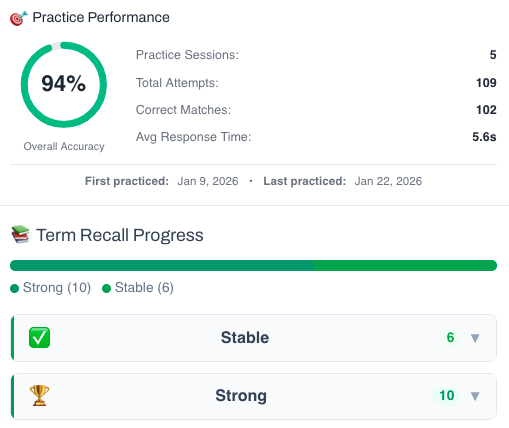
This isn’t a simple quiz — it’s a fully tracked learning system. You build knowledge through recognition, then recall, and your progress feeds directly into the Integrated Practice Bar (Writing tasks, AI Chat, and more).
- Practice sessions, accuracy, and response-time tracking
- Term strength levels (Learning → Stable → Strong)
- Personal progress history for each unit
This feature is available to YSP members.
Explore Membership Benefits