At The Doctor’s Yesterday: Past Tenses in Medical Contexts
Core PathWay
1 🌐 Introduction to ‘At The Doctor’s Yesterday’
Yesterday I went to the doctor because I felt terrible. I had been coughing for three days and my fever was getting worse. When I arrived at the clinic, I filled out some forms at reception. The waiting room was busy – other patients were waiting and some children were playing quietly. I had made an appointment the week before because my sore throat wasn’t getting better. While I was sitting there, I noticed my headache was really bad. The receptionist called my name and I went into the doctor’s office. The doctor was very kind and asked me many questions about my symptoms. She wanted to know if I had been feeling dizzy or if I had taken any medicine. After the examination, she gave me a prescription and told me to rest. I felt relieved to finally know what was wrong and how to get better.
Key Terms
💬 Dialogue 1: Talking to a Friend About Your Doctor’s Visit
Two friends meeting after one has been sick
2 🔬 The Key Phrases You Need
come down with – to become sick with an illness. This means you start to have an illness. *I came down with the flu last week and stayed home.*
get over – to feel better after being sick. This means you are healthy again after an illness. *It took me five days to get over my cold.*
check up – when a doctor examines you to see if you are healthy. This means a general health examination. *I went for a check up and the doctor said I was fine.*
fill out/fill in – to write information on a form. This means to complete a document with your details. *I had to fill out/fill in three forms before seeing the doctor.*
listen to – to hear something carefully, often with a stethoscope. This means the doctor uses a tool to hear your heart or lungs. *The doctor listened to my chest to check my breathing.*
look into – to examine or investigate something carefully. This means to check something to find the problem. *The doctor looked into my throat and saw it was very red.*
take medicine – to use medicine that a doctor gives you. This means to swallow pills or liquid to help you get better. *I took medicine three times a day for a week.*
feel better – to be less sick or in less pain. This means your health is improving. *After two days of rest, I started to feel better.*
get worse – to become more sick or more painful. This means your health is getting bad. *My cough got worse during the night.*
recover from – to get healthy again after an illness. This means to return to normal health after being sick. *I’m still recovering from my illness but I feel much better.*
call in sick – to phone your work to say you cannot come because you are ill. This means to tell your boss you are too sick to work. *I called in sick yesterday because I had a high fever.*
run a fever – to have a body temperature that is too high. This means your body is hotter than normal because of sickness. *I was running a fever of 39 degrees.*
💬 Dialogue 2: At the Pharmacy
Patient asking the pharmacist about medicine from a prescription
3 🔍 Other Key Terms for ‘At The Doctor’s’
cough – the sound and action when air comes quickly out of your throat. *My cough kept me awake all night.*
dizzy – feeling like everything is moving around you, like you might fall. *I felt dizzy when I stood up quickly.*
chest – the front part of your body between your neck and stomach. *The doctor listened to my chest with a stethoscope.*
breathe – to take air in and out of your body. *It was hard to breathe because my nose was blocked.*
temperature – how hot your body is, normal is about 37 degrees. *The nurse checked my temperature and it was 38.5 degrees.*
runny nose – when liquid comes out of your nose because you are sick. *I had a runny nose and used many tissues.*
ache – a continuous pain that is not very strong. *I had an ache in my back all day.*
pain – when part of your body hurts. *I had a sharp pain in my stomach.*
diagnosis – when a doctor tells you what illness you have. *The doctor’s diagnosis was that I had bronchitis.*
examine – when a doctor looks at your body to find what is wrong. *The doctor examined my throat and ears.*
antibiotics – strong medicine that kills bacteria and helps you get better. *The doctor gave me antibiotics for my infection.*
infection – when bacteria or a virus makes part of your body sick. *I had a throat infection.*
swallow – to make food or drink go down your throat. *It hurt to swallow because of my sore throat.*
sneeze – when air suddenly comes out of your nose and mouth. *I couldn’t stop sneezing because of my cold.*
💬 Dialogue 3: Calling in Sick to Work
Employee calling their manager to explain absence
4 🧠 Worth Thinking About
Did you know that doctors ask you to say ‘aaah’ when they look at your throat because it helps them see better? When you say this sound, your tongue goes down and your throat opens wide. Also, the stethoscope – the tool doctors use to listen to your heart and lungs – was invented in 1816 because a French doctor felt embarrassed putting his ear directly on a woman’s chest! Another interesting fact: your body temperature is usually higher in the evening than in the morning, so the time you check your fever matters. Finally, the common cold has no cure because there are over 200 different viruses that cause it!
5 📖 My Visit to the Doctor Yesterday
Yesterday was a difficult day because I had been feeling sick for almost a week. I woke up with a terrible headache and my fever was very high. I had tried to rest at home, but my symptoms were getting worse every day. I finally decided to visit the doctor.
When I arrived at the clinic at 10 o’clock, the waiting room was full of people. Some patients were reading magazines while others were waiting quietly. I went to the reception desk and filled out a form with my personal information. The receptionist was very helpful and told me to sit down. While I was waiting, I thought about all my symptoms. I had been coughing for five days, my throat was sore, and I had had a runny nose since Monday. I also felt dizzy when I stood up.
After twenty minutes, a nurse called my name. She took me to a small room and checked my temperature – it was 38.7 degrees. Then the doctor came in. She was a kind woman who smiled and asked me to sit down. This is when she started asking me discovery questions to understand my illness.
‘How long have you been feeling unwell?’ she asked. I told her I had been sick for about a week. Then she asked, ‘Had you been coughing before the fever started?’ I said yes, the cough had started first. She wanted to know if I had been in contact with anyone who was sick. I remembered that my colleague had had a bad cold two weeks before. The doctor continued with more questions: ‘Have you had any pain in your chest when you breathe?’ I nodded – yes, it hurt a little. ‘Had you taken any medicine before coming here?’ she asked. I explained that I had taken some paracetamol but it hadn’t helped much.
The doctor listened to my chest with her stethoscope and looked into my throat. She examined my ears too. After the examination, she gave me her diagnosis: I had a respiratory infection. She wrote a prescription for antibiotics and told me to rest for a few days. She explained that I needed to take the medicine three times a day and drink lots of water.
I left the clinic feeling relieved. I had been worrying about my health, but now I knew what was wrong and how to get better. I went to the pharmacy, bought my medicine, and went home to rest. By the evening, I was already feeling a little better because I had started the treatment. I was happy that I had finally gone to the doctor.
Key Terms
🔍 Grammar & Structure Focus
Past Simple
Form Explanation: For regular verbs, add -ed to the base verb (walk → walked, visit → visited). For irregular verbs, use the special past form (go → went, have → had, be → was/were). In questions and negatives, use ‘did’ + base verb.
Usage Notes: Use Past Simple when you want to talk about a completed action in the past. Often used with time words like yesterday, last week, ago, in 2020. The action is finished and we know when it happened.
Common Collocations: yesterday + Past Simple (I went yesterday), last + time word + Past Simple (last week I visited), time + ago + Past Simple (three days ago I felt)
- “I visited the doctor yesterday.”
- “The doctor examined my throat.”
- “I felt terrible last week.”
- Using present form instead of past: ‘I go yesterday’ → ‘I went yesterday’
- Using past form with ‘did’: ‘Did you went?’ → ‘Did you go?’
- Forgetting irregular forms: ‘I goed’ → ‘I went’
Past Continuous
Form Explanation: Use was/were + verb-ing. Use ‘was’ with I, he, she, it. Use ‘were’ with you, we, they. The verb always has -ing at the end.
Usage Notes: Use Past Continuous when you want to show an action was in progress at a specific time in the past. Often used with ‘while’ or ‘when’ to show two actions happening at the same time, or when one action interrupts another.
Common Collocations: while + Past Continuous (while I was waiting), when + Past Continuous (when I was sitting), at + time + Past Continuous (at 10 o’clock I was waiting)
- “I was waiting in the waiting room.”
- “While I was sitting there, the doctor called me.”
- “Other patients were reading magazines.”
- Using ‘was’ with plural: ‘They was waiting’ → ‘They were waiting’
- Forgetting -ing: ‘I was wait’ → ‘I was waiting’
- Confusing with Past Simple: ‘I was go’ → ‘I went’ or ‘I was going’
Past Perfect
Form Explanation: Use had + past participle. The past participle for regular verbs is the same as Past Simple (walked, visited). For irregular verbs, use the third form (go → gone, be → been, have → had). Use ‘had’ with all subjects.
Usage Notes: Use Past Perfect to show that one action in the past happened before another action in the past. It helps make the order of events clear. Often used with words like before, after, already, just, never.
Common Collocations: had + already + past participle (I had already taken medicine), had + just + past participle (I had just arrived), had + been + verb-ing (I had been coughing)
- “I had been feeling sick for a week before I visited the doctor.”
- “The doctor asked if I had taken any medicine.”
- “My colleague had had a cold two weeks before.”
- Using Past Simple instead: ‘I was sick for a week before I went’ → ‘I had been sick for a week before I went’
- Wrong past participle: ‘I had went’ → ‘I had gone’
- Overusing it: ‘Yesterday I had gone to the doctor’ → ‘Yesterday I went to the doctor’ (Past Simple is enough when the time is clear)
Use the VAS to build solid recognition and recall of the terms below.
✔ Every correct Match = +1 point
✔ Every correct Recall = +2 points
🎓 Reach 5 points with good accuracy and the term is automatically promoted to your Personal Dictionary.
Incorrect answers lower accuracy, meaning more correct Matches or Recalls may be needed to reach promotion.
Member-Exclusive Vocabulary Review & Acquisition System
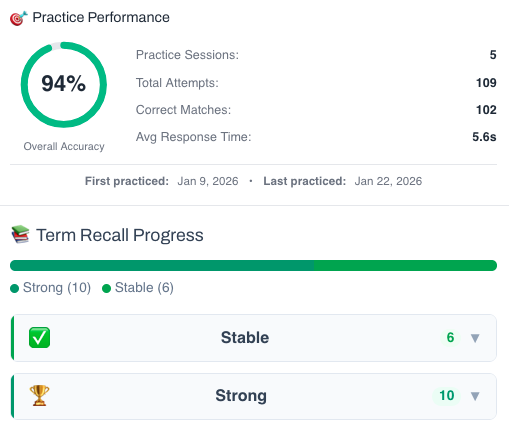
This isn’t a simple quiz — it’s a fully tracked learning system. You build knowledge through recognition, then recall, and your progress feeds directly into the Integrated Practice Bar (Writing tasks, AI Chat, and more).
- Practice sessions, accuracy, and response-time tracking
- Term strength levels (Learning → Stable → Strong)
- Personal progress history for each unit
This feature is available to YSP members.
Explore Membership BenefitsMember-Exclusive Practice Bar
Access a wide range of integrated practice for this unit — from Vocabulary and Grammar activities to AI-curated Writing tasks and Thematic Chat practice.
This feature is available to YSP members.
Explore Membership BenefitsMember-Exclusive Sentence Builder
Reconstruct scrambled sentences to practice word order and develop your grammar intuition.
This feature is available to YSP members.
Explore Membership Benefits