Numbers 2: Saying Numbers Correctly in English
Core PathWay
1 🌐 Introduction to ‘Numbers 2’
Numbers are everywhere in our daily lives. When you want to say a hundred or a thousand, British and American English are a little different. In British English, people say ‘one hundred and five’ but Americans say ‘one hundred five’ – they don’t use ‘and’ after hundreds. When you talk about big numbers like millions or billions, you need to know the place value – this means where each digit sits in the number. You also need to know how to say the decimal point in numbers like 3.5 (three point five) and fractions like 1/2 (one half). In shops, you add up prices to find the total. At work, you might round up or round down numbers to make calculations easier. Understanding numbers helps you talk about money, time, dates, and measurements every day.
Key Terms
💬 Dialogue 1: At the Shop
A customer is buying items and asking about the total price
2 🔬 The Key Phrases you need for ‘Numbers 2’
add up to – to make a total amount when you put numbers together. Example: The three prices add up to fifty pounds.
come to – to make a total (especially for money or prices). Example: The bill comes to thirty-five euros.
round up – to change a number to the next higher whole number. Example: We can round up 4.7 to 5.
round down – to change a number to the next lower whole number. Example: Let’s round down 3.2 to 3.
work out – to find the answer by doing a calculation. Example: Can you work out how much we need to pay?
go up to – to reach a higher number. Example: The price can go up to two hundred dollars.
go down to – to reach a lower number. Example: The temperature will go down to minus five tonight.
divide into – to separate a number into equal parts. Example: You need to divide twelve into three groups.
multiply by – to make a number bigger by a certain amount of times. Example: Multiply six by four to get twenty-four.
take away from – to remove one number from another (subtract). Example: Take three away from ten and you get seven.
add on – to put an extra amount to a number. Example: Don’t forget to add on the tax.
count up – to say numbers in order from low to high. Example: Let’s count up from zero to one hundred.
Key Terms
💬 Dialogue 2: Helping with Homework
Two friends are doing math homework together
3 🔍 Other Key Terms for ‘Numbers 2’
figure – a number or an amount. Example: The final figure was three thousand euros.
amount – how much of something (used with uncountable things). Example: What amount of money do you need?
sum – the total when you add numbers together, or a calculation. Example: The sum of five and seven is twelve.
percentage – an amount shown as a part of one hundred (%). Example: Twenty percentage of students walk to school.
numerator – the top number in a fraction. Example: In 3/4, the numerator is three.
denominator – the bottom number in a fraction. Example: In 3/4, the denominator is four.
operation – a mathematical action like adding or subtracting. Example: Addition is a basic mathematical operation.
approximately – about, not exactly. Example: The distance is approximately fifty kilometres.
exactly – the precise amount, not more or less. Example: The time is exactly three o’clock.
Key Terms
💬 Dialogue 3: Talking About Numbers
Friends discussing large numbers and how to say them
4 🧠 Worth Thinking About
Did you know that British and American people say big numbers differently? A British person says ‘one hundred and five’ but an American says ‘one hundred five’ – no ‘and’! Also, in British English, people say ‘nought’ or ‘zero’ for 0, but Americans usually say ‘zero’. When you say phone numbers, you can say each number separately: ‘oh seven nine’ not ‘seventy-nine’. For years, we say ‘nineteen eighty-five’ (1985) not ‘one thousand nine hundred and eighty-five’. English speakers also say ‘a hundred’ not ‘one hundred’ in everyday conversation. These small differences help you sound more natural when you speak English!
Member-Exclusive Vocabulary Review & Acquisition System
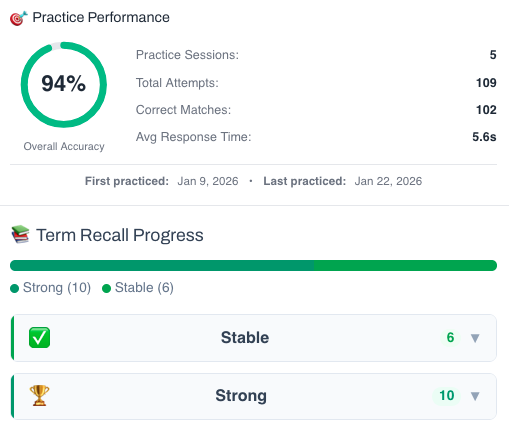
This isn’t a simple quiz — it’s a fully tracked learning system. You build knowledge through recognition, then recall, and your progress feeds directly into the Integrated Practice Bar (Writing tasks, AI Chat, and more).
- Practice sessions, accuracy, and response-time tracking
- Term strength levels (Learning → Stable → Strong)
- Personal progress history for each unit
This feature is available to YSP members.
Explore Membership Benefits