Laws, Rules, Regulations, Needs & Advice — What’s the Difference?
Core PathWay
1 🌐 Introduction to ‘Laws, Rules, Regulations, Needs & Advice’
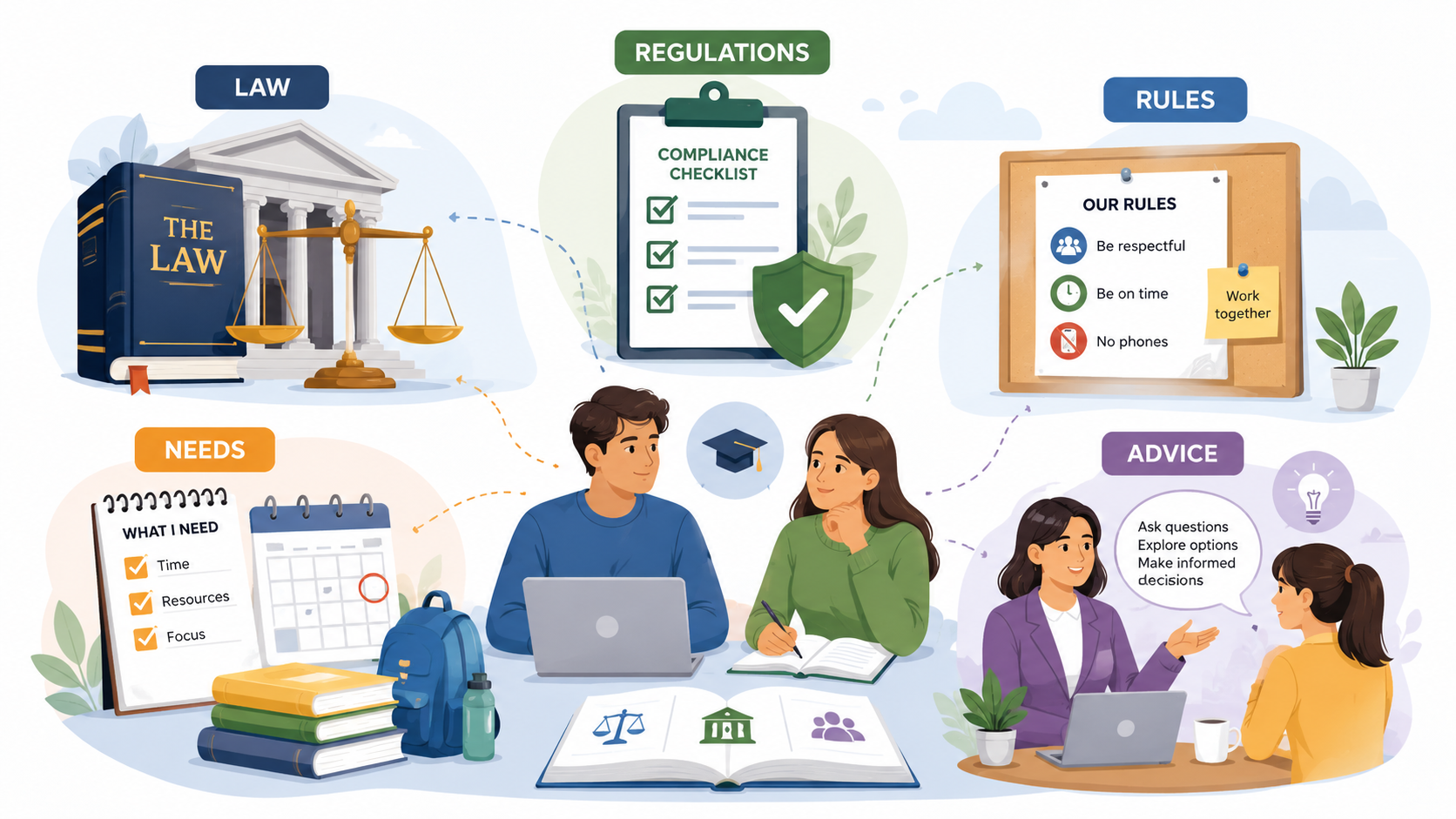
Every day, we live inside a complex web of laws, rules, regulations, needs, and advice — but do we really know the difference? A law is the strongest type. It comes from the government, it is written down, and breaking it has serious consequences — a fine, or even prison. A regulation is also official and written, but it usually comes from an organisation or industry body rather than the government. A rule can be formal or informal. Some rules are written down — like school or workplace rules. Others are unwritten rules — things people just know, like not talking with your mouth full. Needs are different again: they are about what is necessary, not what is commanded. And advice? That is the softest of all — a suggestion you are free to ignore. Understanding these differences is the first step to speaking about obligation with real precision.
Key Terms
💬 Dialogue 1 — Is It a Law or Just a Rule?
Two university friends, Maya and Dan, are talking on campus after a lecture about society and behaviour.
Maya: “So, I got told off for eating in the library today. But is that actually a law, or just a rule they made up?”
Dan: “It’s definitely just a rule — the library set the rules for their own building. It’s not like the government decided it. Laws come from parliament and apply to everyone in the country. A library rule only applies inside that one building.”
Maya: “Right, so if I ignore it, I’m not breaking the law — I’m just breaking their rule. The consequences are totally different, aren’t they?”
Dan: “Exactly! If you break the law, the consequences can be serious — a fine, or even a court case. But if you break a library rule, they might just ask you to leave. It’s a completely different level. That’s why the distinction really matters.”
Maya: “That’s a useful distinction. I wonder how many things I think are laws are actually just regulations or norms. Like, is it a law to queue at the bus stop?”
Dan: “Ha! Queuing is definitely a norm — there is no regulation that says you have to do it. But in Britain, it feels almost as powerful as a law, doesn’t it? The social pressure is enormous. People get very upset if you jump the queue.”
Maya: “So a norm is just what society expects, not something anyone officially set the rules for? And the only consequence of breaking a norm is… people looking at you strangely?”
Dan: “Pretty much! With a law, there are legal consequences — it is serious. With a regulation, an organisation can enforce it, like banning you from the library. But with a norm, the only consequence is social. People might judge you, but nobody can actually stop you. It is fascinating how much of our behaviour is controlled by norms rather than laws.”
2 🔬 The Key Phrases you need for ‘Laws, Rules, Regulations, Needs & Advice’
These phrases are very useful when you talk about rules and obligations. Learn them as complete phrases — that is how native speakers use them.
1. comply with — to follow or obey a rule, law, or instruction.
📌 All staff must comply with the company’s health and safety rules.
2. break the law — to do something that is not allowed by law.
📌 Driving without a seatbelt means you are breaking the law.
3. bend the rules — to do something in a slightly different way from what the rules say, without completely breaking them.
📌 The manager bent the rules and let her leave work an hour early.
4. lay down the rules — to clearly state what the rules are in a situation.
📌 On the first day, the teacher laid down the rules for the class.
5. go by the book — to follow all the rules very carefully and exactly.
📌 He always goes by the book — he never takes shortcuts.
6. be bound by — to be required to follow a rule, law, or agreement.
📌 Doctors are bound by a strict code of professional ethics.
7. enforce a rule / law — to make sure people follow a rule or law, often by punishing those who do not.
📌 The school decided to enforce the uniform rule more strictly.
8. set the rules — to decide what the rules will be in a situation.
📌 Parents often set the rules at home, but children sometimes push back.
9. face a penalty — to receive a punishment because you broke a rule or law.
📌 If you park here illegally, you will face a penalty of £100.
10. take someone’s advice — to do what someone suggests.
📌 She took her doctor’s advice and started exercising more regularly.
11. act on a guideline — to do something because a guideline tells you it is a good idea.
📌 The government asked people to act on the new health guidelines.
12. put rules in place — to create and start using a set of rules in an organisation or situation.
📌 The new manager put strict rules in place to improve punctuality.
💬 Dialogue 2 — Written Rules vs Unwritten Rules at Work
Priya is a new employee. She is talking to Tom, a colleague who has worked at the company for five years.
Priya: “Tom, I read the code of conduct before I started, but I feel like there are things nobody told me. Like, is it okay to eat lunch at my desk?”
Tom: “Ha! That is a classic unwritten rule situation. Officially, there is no regulation against eating at your desk. But most people go to the kitchen at lunchtime — it is just the norm here. Nobody decided it. It just happened that way over the years.”
Priya: “So it is not mandatory, but there is still social pressure to do it a certain way? That feels a bit strange to me.”
Tom: “Exactly. Nobody will enforce anything if you eat at your desk. You will not get in trouble. But you might get some strange looks, or people might think you are not very friendly. It is more about etiquette than rules — the polite way to behave in this particular workplace.”
Priya: “That is actually more complicated than the written rules! At least with regulations, you know exactly where you stand. The code of conduct tells you what is mandatory and what is not.”
Tom: “You are completely right. Written regulations are clear and easy to follow. The unwritten rules take time to learn. For example, another norm here is that you always make tea for the whole team if you are making some for yourself. Nobody told me that when I started — I just noticed it and followed it.”
Priya: “So how do I learn all these unwritten rules? I cannot exactly ask my manager — it might seem like I have no common sense!”
Tom: “Just watch what other people do and follow their lead. And honestly, asking a friendly colleague — like me — is the best way! The etiquette around asking is simple: just be casual about it, like you are doing now. Nobody expects a new person to know everything. The code of conduct covers the mandatory stuff. Everything else, you pick up as you go.”
3 🔍 Other Key Terms for ‘Laws, Rules, Regulations, Needs & Advice’
These words are important nouns and adjectives that you will see again and again when you read or talk about rules and obligations.
authority (noun) — a person or organisation that has the power to make rules and decisions.
📌 The local authority decided to close the road for repairs.
penalty (noun) — a punishment for breaking a rule or law. It can be a fine, a ban, or something else.
📌 There is a heavy penalty for not paying your taxes on time.
sanction (noun) — an official action taken against someone who breaks a rule or law.
📌 The company faced sanctions after it broke environmental regulations.
norm (noun) — the usual or expected way of behaving in a group or society.
📌 In many offices, it is the norm to arrive a few minutes before your start time.
social pressure (noun) — the feeling that you must do something because other people expect you to.
📌 There is a lot of social pressure to dress smartly at formal events.
guideline (noun) — a piece of advice that suggests how something should be done, but is not a strict rule.
📌 The government published new guidelines for healthy eating.
code of conduct (noun) — a set of rules about how people should behave in a particular organisation or profession.
📌 Every employee receives a copy of the company’s code of conduct.
etiquette (noun) — the set of polite and accepted ways of behaving in social situations.
📌 In Japan, there is a strong etiquette around removing your shoes before entering a home.
mandatory (adjective) — required by law or a rule; not optional. You have no choice.
📌 Wearing a helmet is mandatory for all cyclists in this city.
voluntary (adjective) — done by choice, not because you are forced to.
📌 Joining the company book club is completely voluntary — nobody is forced to attend.
💬 Dialogue 3 — Advice or Obligation? You Decide.
Friends Carla and Leo are having coffee. Leo is unsure about whether he needs to attend a colleague’s leaving party.
Leo: “My colleague is leaving and there is a party on Friday. I do not really want to go, but I feel like I have to. Is it mandatory?”
Carla: “Of course not! It is completely voluntary — nobody can force you to go to a party. But I would take my manager’s advice and at least show your face for a bit. If your manager thinks it matters, that is worth listening to.”
Leo: “So it is not a rule, but there is still social pressure? That feels like an unwritten rule to me. Like, everyone expects you to go, even if nobody says it directly.”
Carla: “Exactly — and those unwritten rules can feel just as strong as real rules sometimes, can’t they? But it is important to remember the difference. There is no obligation here. Think of it as a norm, not an obligation. Going to a leaving party is just what people in most workplaces tend to do.”
Leo: “But what if I really cannot stand the person who is leaving? Is there any advice for that situation? Do I still have to go?”
Carla: “Ha! My advice is simple: go anyway, stay for thirty minutes, say something nice, and leave. You are not going for that person — you are going for the team. It shows you are a good colleague. The social pressure is real, even if the obligation is not.”
Leo: “Okay, so I will go for an hour. I will take your advice — but I am not staying all night! Is there an unwritten rule about how long you have to stay?”
Carla: “Now you are looking for a written rule where there is only a norm! I would say an hour is perfectly fine. The norm is just to show up and be friendly. Nobody is going to enforce a minimum time limit. Go, smile, have a drink, and then you are free. No obligation, no law, no regulation — just good workplace etiquette.”
4 🧠 Worth Thinking About
Did you know that some of the most powerful ‘rules’ in society are never written down at all? Etiquette and social norms — like queuing in Britain or removing your shoes in Japan — have no legal force, but breaking them can damage your reputation more than breaking a minor regulation. In fact, researchers have found that people often feel more pressure to follow unwritten social rules than official written ones. And here is a strange thought: in some countries, there are still laws on the books that nobody enforces — like an old British law that technically makes it illegal to handle a salmon ‘suspiciously’. Rules are fascinating. They tell us a lot about who we are.
Member-Exclusive Practice Bar
Access a wide range of integrated practice for this unit — from Vocabulary and Grammar activities to AI-curated Writing tasks and Thematic Chat practice.
This feature is available to YSP members.
Explore Membership BenefitsMember-Exclusive Vocabulary Review & Acquisition System
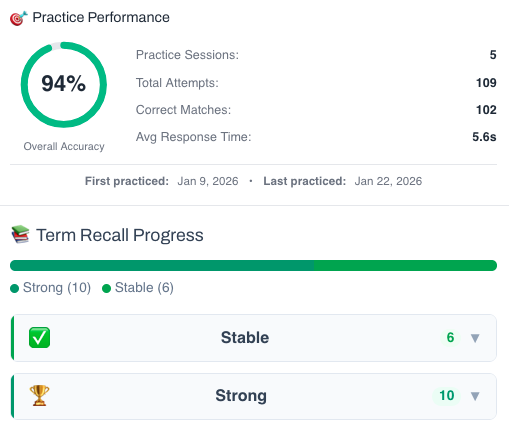
This isn’t a simple quiz — it’s a fully tracked learning system. You build knowledge through recognition, then recall, and your progress feeds directly into the Integrated Practice Bar (Writing tasks, AI Chat, and more).
- Practice sessions, accuracy, and response-time tracking
- Term strength levels (Learning → Stable → Strong)
- Personal progress history for each unit
This feature is available to YSP members.
Explore Membership Benefits🎮 Practice Games
Sentence Scrambler
Laws, Rules, Regulations, Needs & Advice – Sentence Scramble
Member-Exclusive Sentence Builder
Reconstruct scrambled sentences to practice word order and develop your grammar intuition.
This feature is available to YSP members.
Explore Membership Benefits