What Can You See?
Take a moment to study the photograph carefully before you do anything else — notice the colours, the shapes, and where different elements sit within the frame. You will then work through the key vocabulary, listen to three descriptions of increasing depth, and use what you have heard to complete the writing tasks below. Each listening builds on the last, so pay close attention to the detail each time.
📚 Key Vocabulary
Before you listen, study these words carefully — you will hear all of them in the descriptions.
🎧 Listen
Before: Look at the photograph for at least thirty seconds, paying attention to the colours of the water, the shape of the coastline, and the texture of the rock.
While listening: Listen for the key vocabulary terms and notice how each one is used to describe a specific part of the scene.
After: Read through the text on screen, locate each vocabulary term in context, and consider how the language builds a precise and layered picture of the place.
 ×
📖 1 · Short description 🎧
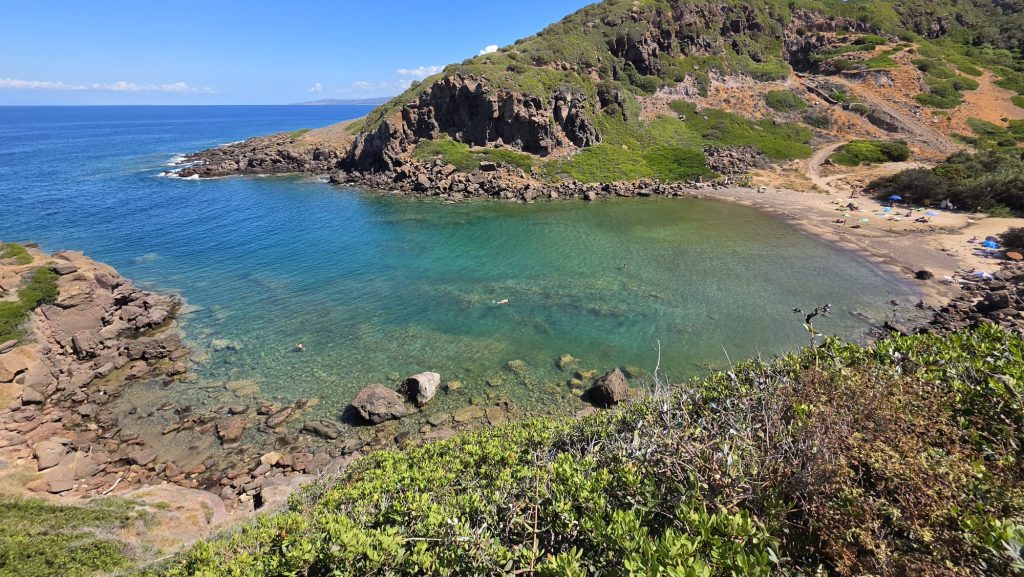
Photographed from an elevated rocky headland, this sheltered Mediterranean cove is enclosed on three sides by dark volcanic rock formations and scrub-covered hillsides. The water shifts from pale turquoise in the transparent shallows to a deeper teal at the centre, through which the submerged seabed is clearly visible. A narrow sandy beach curves along the right-hand margin of the cove, where scattered beachgoers and a single blue umbrella are just discernible. Beyond the jagged promontory at the upper left, the open sea extends in deep cobalt blue toward a hazy horizon.
📖 2 · Full description 🎧
The photograph is taken from a natural vantage point on a rocky headland, looking down into a small, secluded cove that appears almost entirely enclosed by dark basaltic rock and dense Mediterranean maquis. In the foreground, rough volcanic ledges and low-growing scrub vegetation frame the view, anchoring the image in the rugged coastal terrain from which it was captured. Below, the cove's water is strikingly transparent: pale aquamarine in the shallows near the rocky margins, it deepens to a rich teal toward the centre, where submerged rocks and patches of sandy seabed remain clearly visible through the surface. Three large exposed boulders sit at the waterline in the lower frame, their dark, rounded forms contrasting sharply with the luminous water behind them. Two swimmers are just discernible as small pale shapes on the water's surface. Along the right-hand arc of the cove, a narrow golden beach curves toward the hillside, where scattered beachgoers and a solitary blue parasol indicate the site's modest but real appeal to visitors. A steep, scrub-covered hillside rises above the beach, its reddish-ochre soil exposed in eroded gullies, and a narrow dirt track descends diagonally toward the shore. To the upper left, a jagged promontory with columnar rock faces projects into the open sea, separating the sheltered bay from the deeper cobalt-blue Mediterranean beyond. A thin strip of bright sky and wispy horizon clouds completes the scene, suggesting strong midday light and settled summer conditions.
📖 3 · The story behind the picture 🎧
The dirt track descending the hillside toward the beach implies an approach on foot or by a rough vehicle, and the small number of visitors suggests this is not a beach that announces itself easily. Those already in the water — their figures barely registering at this distance — would have had to pick their way across the volcanic rock to reach the shallows, or perhaps slipped in from the boulders at the waterline. Later in the afternoon, as the sun shifts and the shadow of the headland begins to creep across the cove, the water's colour will change register entirely, losing its turquoise brilliance and deepening toward grey-green. The beachgoers will pack up their umbrella, retrace the track up the hillside, and leave the cove to whatever it was before they arrived.
📝 Short description
Photographed from an elevated rocky headland, this sheltered Mediterranean cove is enclosed on three sides by dark volcanic rock formations and scrub-covered hillsides. The water shifts from pale turquoise in the transparent shallows to a deeper teal at the centre, through which the submerged seabed is clearly visible. A narrow sandy beach curves along the right-hand margin of the cove, where scattered beachgoers and a single blue umbrella are just discernible. Beyond the jagged promontory at the upper left, the open sea extends in deep cobalt blue toward a hazy horizon.
📖 Full description
The photograph is taken from a natural vantage point on a rocky headland, looking down into a small, secluded cove that appears almost entirely enclosed by dark basaltic rock and dense Mediterranean maquis. In the foreground, rough volcanic ledges and low-growing scrub vegetation frame the view, anchoring the image in the rugged coastal terrain from which it was captured. Below, the cove’s water is strikingly transparent: pale aquamarine in the shallows near the rocky margins, it deepens to a rich teal toward the centre, where submerged rocks and patches of sandy seabed remain clearly visible through the surface. Three large exposed boulders sit at the waterline in the lower frame, their dark, rounded forms contrasting sharply with the luminous water behind them. Two swimmers are just discernible as small pale shapes on the water’s surface. Along the right-hand arc of the cove, a narrow golden beach curves toward the hillside, where scattered beachgoers and a solitary blue parasol indicate the site’s modest but real appeal to visitors. A steep, scrub-covered hillside rises above the beach, its reddish-ochre soil exposed in eroded gullies, and a narrow dirt track descends diagonally toward the shore. To the upper left, a jagged promontory with columnar rock faces projects into the open sea, separating the sheltered bay from the deeper cobalt-blue Mediterranean beyond. A thin strip of bright sky and wispy horizon clouds completes the scene, suggesting strong midday light and settled summer conditions.
💬 The story behind the picture
The dirt track descending the hillside toward the beach implies an approach on foot or by a rough vehicle, and the small number of visitors suggests this is not a beach that announces itself easily. Those already in the water — their figures barely registering at this distance — would have had to pick their way across the volcanic rock to reach the shallows, or perhaps slipped in from the boulders at the waterline. Later in the afternoon, as the sun shifts and the shadow of the headland begins to creep across the cove, the water’s colour will change register entirely, losing its turquoise brilliance and deepening toward grey-green. The beachgoers will pack up their umbrella, retrace the track up the hillside, and leave the cove to whatever it was before they arrived.
🧰 Look closer
Open any box for the words and phrases you need to describe this picture. Everything here was found in the image.
📚 Word bank
All the target words for this picture. Tap a word to hear it.
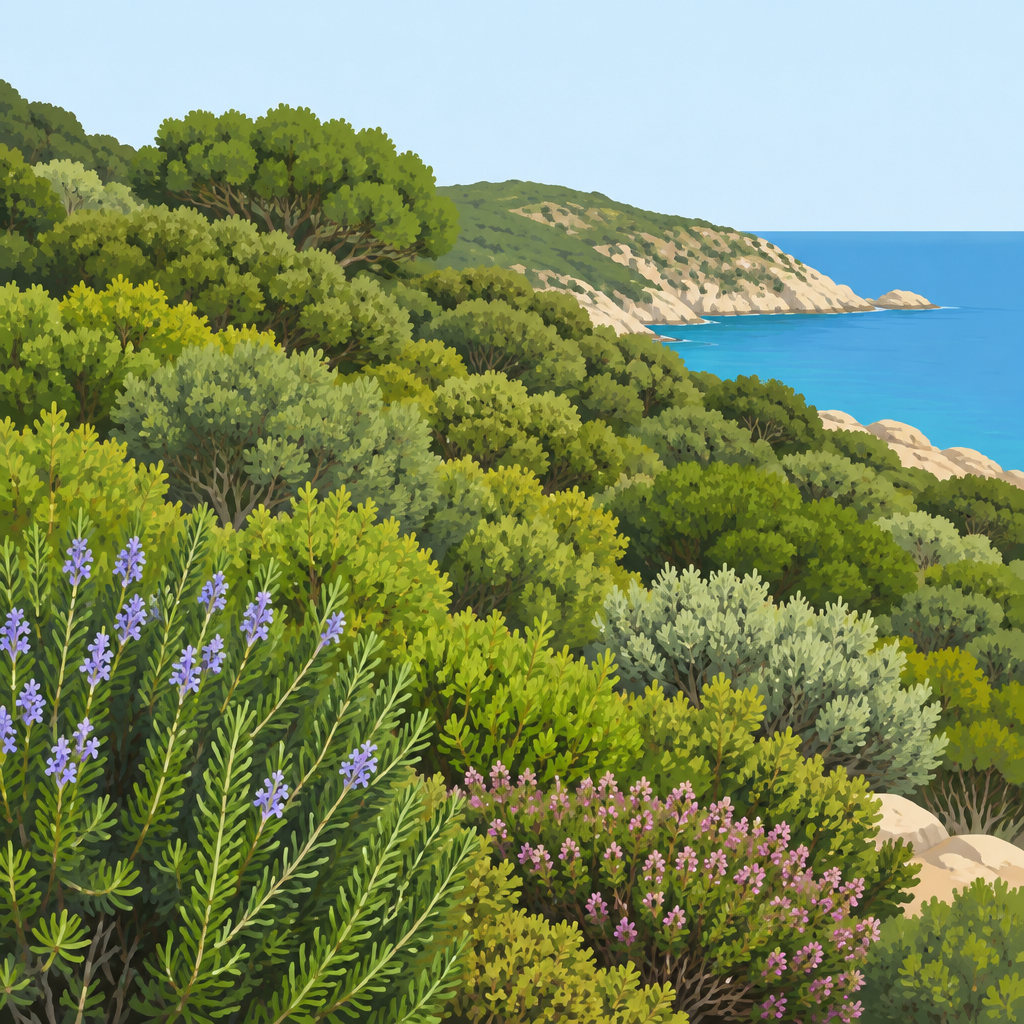
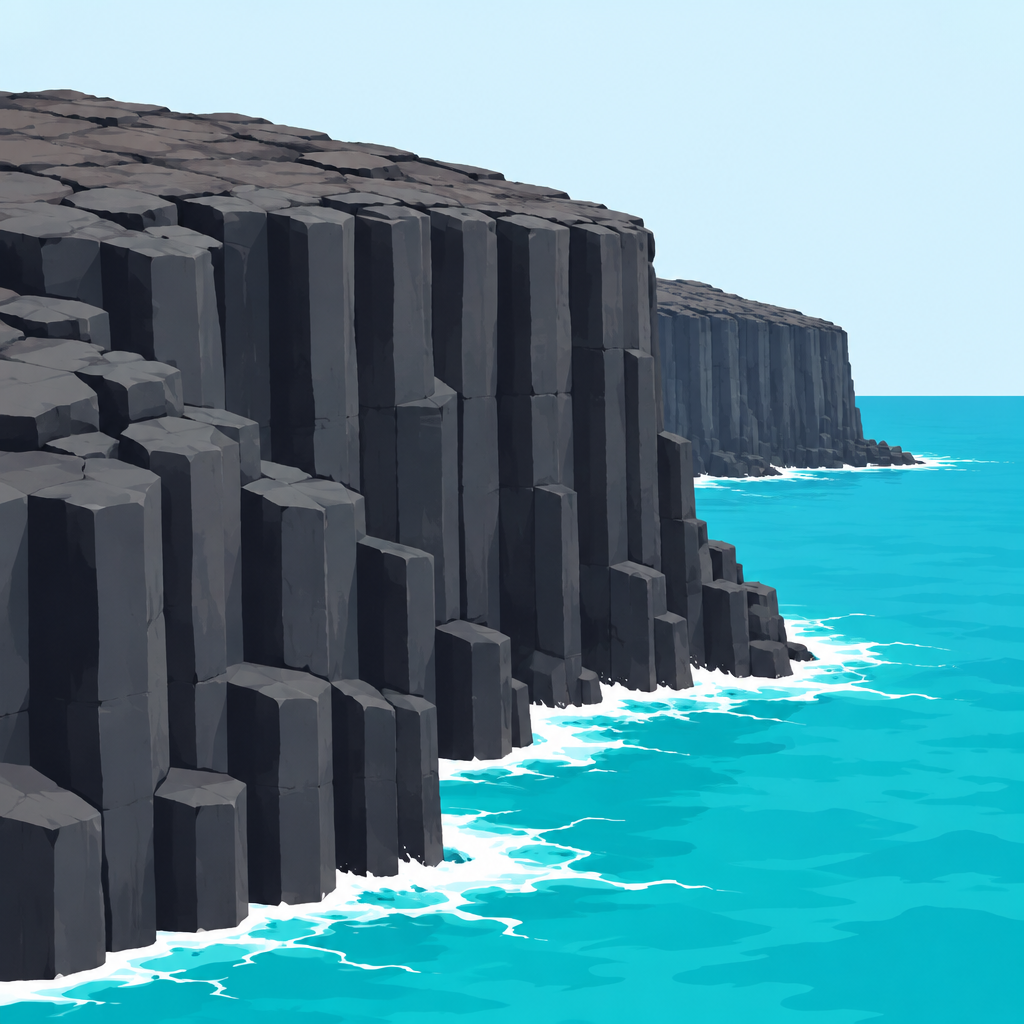
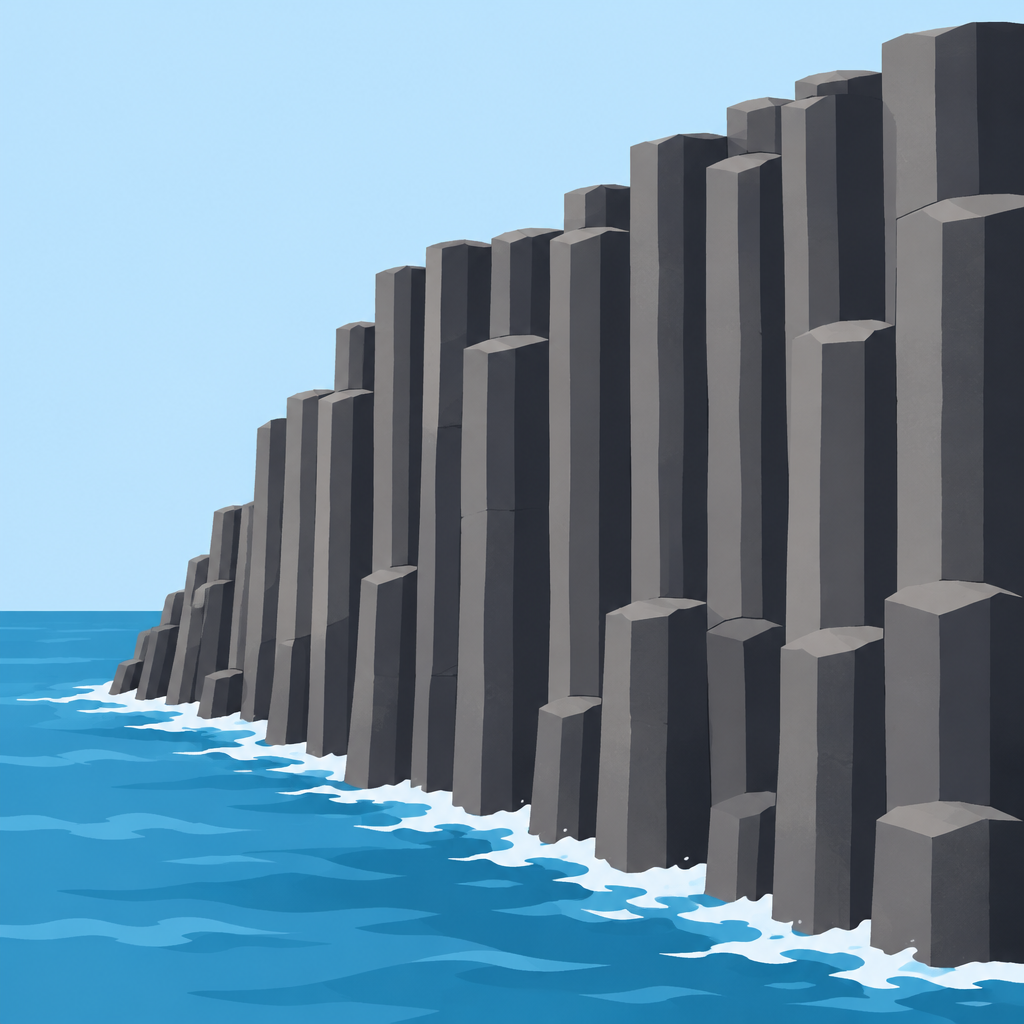
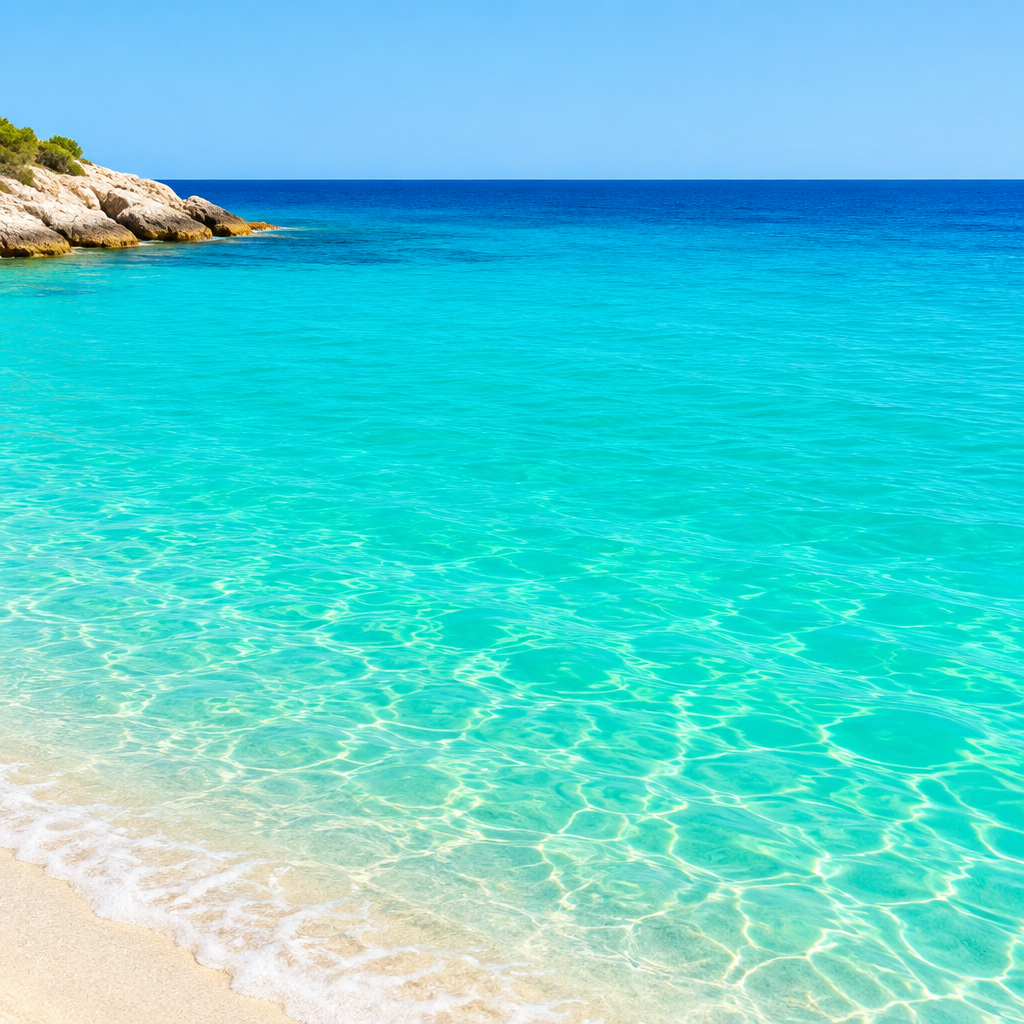




🎨 Language palette
A small, rocky-rimmed Mediterranean cove with strikingly clear turquoise water, viewed from an elevated headland position, surrounded by volcanic rock and low scrub vegetation.
The things you must name
Useful supporting words
In the background
Describing words — Colour
Describing words — Size and shape
Describing words — Texture and material
Describing words — Condition
Describing words — Overall feel
Saying where things are
More position phrases
Layers: in front of / behind / framed by
What things are doing
Words that go together
Compound nouns
🔎 What you can see
| Object | Where | Describing words |
|---|---|---|
| cove | centre and left-centre of the image, enclosed by rock on three sides | sheltered, small, semi-circular |
| sea water | filling the cove from lower-centre to upper-centre, extending to open sea at upper left | transparent, turquoise, teal |
| rocky headland / promontory | upper centre-left, projecting into the open sea | dark, jagged, columnar |
| hillside | upper right, sloping down from top-right corner toward the beach | steep, scrub-covered, reddish-brown |
| sandy beach | right side and upper-right of frame, curving along the back of the cove | narrow, pale golden, partly shaded |
| submerged rocks | visible through the water across the cove floor, concentrated in lower-centre and shallows | dark, irregular, partially exposed in shallows |
| exposed boulders ×3 | lower-centre of frame, sitting at the water's edge and just above the waterline | large, dark brown, rounded |
| Mediterranean scrub vegetation | foreground (lower third of frame) and covering hillsides in middle and upper ground | low-growing, dense, dark green |
| rocky foreground ledge | lower-left, forming the vantage point from which the photo is taken | brown, rough, volcanic |
| open sea | upper-left quadrant, beyond the promontory | deep blue, calm, open |
| sky | top edge of frame, narrow strip | bright blue, mostly clear, thin clouds on horizon |
| swimmer ×2 | one in the lower-left area of the cove water, one nearer the centre | small, distant, barely visible |
| beachgoers | along the sandy beach on the right side, very small in scale | distant, small, scattered |
| beach umbrella | upper right, on the beach, blue-coloured | blue, open, small at this distance |
| dirt path / track | upper right, descending diagonally along the hillside toward the beach | narrow, unpaved, pale orange-brown |
| thin cloud | on the horizon, upper-left strip of sky | wispy, white, low on horizon |
📍 Where things are
- A rocky ledge covered in low scrub vegetation occupies the lower third of the frame, forming the elevated vantage point.
- The sheltered cove lies directly below and beyond the foreground ledge, filling the centre of the image.
- Pale turquoise shallows extend around the edges of the cove where the water is shallowest.
- The water deepens to a richer teal toward the centre of the cove.
- Submerged rocks and patches of sandy seabed are clearly visible beneath the transparent water surface.
- A dark, jagged rocky promontory sits at the upper left, projecting outward into the open sea.
- The deep blue open sea stretches beyond the promontory toward the horizon.
- A narrow sandy beach curves along the right side and back of the cove.
- Scattered beachgoers and a single blue umbrella are visible on the sandy beach.
- A steep, scrub-covered hillside rises above the beach on the right side of the frame.
- A narrow dirt track descends diagonally down the hillside toward the beach.
- Several large exposed boulders sit at the water's edge in the lower-centre of the frame.
- At least one swimmer is visible in the cove water near the lower-left area.
- A bright blue sky with thin horizon clouds sits above the headland and open sea.
- Dark volcanic rock formations stand between the open sea and the sheltered cove, acting as a natural barrier.
- Dense low scrub vegetation spreads across the foreground ledge and up the surrounding hillsides.
- Columnar, vertically jointed rock faces are visible within the cliff structure of the headland.
- A faint distant landmass or coastline is just visible on the horizon at the upper left.
🧱 Colours and materials
Ready-made phrases
| Object | Colour | Material | Texture |
|---|---|---|---|
| cove water — shallows | pale turquoise / aquamarine | seawater | smooth, glassy surface with visible seabed |
| cove water — deeper centre | teal / deep turquoise-green | seawater | slightly rippled, transparent |
| open sea | deep cobalt blue | seawater | slightly textured at surface |
| rocky promontory and foreground rocks | dark brown to near-black | volcanic basalt or similar igneous rock | rough, fractured, columnar-jointed |
| sandy beach | pale golden-beige | sand | fine, flat |
| hillside scrub vegetation | dark green to olive green | plant matter — low shrubs | dense, irregular, bushy |
| hillside exposed soil and rock | reddish-orange to ochre | laterite or iron-rich soil / weathered rock | rough, eroded |
| sky | bright blue, paling toward horizon | — | — |
| beach umbrella | blue | fabric — indeterminate | — |
| foreground scrub leaves | bright green | plant matter | waxy, small-leaved |
🧍 Who is doing what
- A swimmer is visible in the lower-left area of the cove, appearing as a small pale shape on the water surface.
- A second small figure appears to be in the water nearer the centre of the cove.
- Several small figures are scattered along the sandy beach at the right of the cove, their individual actions indistinct at this distance.
👁️ Look closer: how the picture is built
Where to look
- Start here: the turquoise-teal water of the cove, occupying the centre of the frame and drawing the eye immediately through its colour contrast with the surrounding rocks and vegetation
- The camera is: from above — elevated position on a cliff or headland looking down into the cove
- In front: dark volcanic rock ledge and dense low scrub vegetation, lower third of frame
- In the middle: the enclosed cove with its clear water, rocky margins, and narrow sandy beach
- At the back: the rocky headland promontory, open sea, distant coastline on the horizon, and sky
- Lines and shapes: The cove forms a roughly oval or D-shaped pool of colour, creating a strong curved shape at the centre; The promontory provides a diagonal line from upper-centre-left down to the waterline, separating the cove from the open sea; The hillside on the right provides a diagonal slope descending from upper-right to lower-right; The dirt track on the hillside creates a secondary diagonal line; Vertical columnar jointing in the cliff face of the headland provides short vertical accents; The horizon line is a thin horizontal band at the very top
- Framing: The foreground scrub and rock frame the bottom of the image, acting as a natural border. The headland and hillside frame the cove on the left and right respectively, creating a frame-within-frame effect that isolates the cove water as the visual centrepiece.
- Balance: asymmetrical — the open sea and headland weight the left side; the beach and hillside weight the right; the cove water bridges the two
Light and colour
Light: natural — full sun · From: from above, slightly from the left based on shadow positions on rock faces · Quality: hard — strong midday-type sunlight with clear shadows · Contrast: high — strong contrast between the vivid turquoise water and the dark surrounding rocks · Warm/cool: warm — overall warm light with the cool blues of sea and sky providing counterpoint
Notice: The transparency of the cove water allows the seabed to show through, creating a layered colour gradient from pale aquamarine in the shallows to deep teal at depth; The colour contrast between the turquoise cove and the deep blue open sea clearly delineates the boundary of the sheltered bay; The reddish-ochre of the hillside soil creates a warm accent against the greens and blues
Now it's your turn
Having listened to how the photograph is described — from its broad composition down to the smallest telling detail — you are now in a position to engage with the scene in your own words. The tasks below invite you to draw on both the vocabulary you have studied and the descriptive strategies you have heard at work.
💬 Discussion
• Have you ever found yourself at a secluded cove or similarly hidden stretch of coastline — and if so, what made the experience of reaching it feel worthwhile?
• The photograph is taken from an elevated vantage point looking down into the bay: how does a bird's-eye perspective change the way you read or feel about a landscape compared with standing at ground level?
• The rugged, jagged terrain of volcanic coastlines like this one tends to attract a very particular kind of visitor — would you describe yourself as someone drawn to wild, unspoiled places, or do you prefer somewhere more accessible and developed?
Member-Exclusive Practice Bar
Access a wide range of integrated practice for this unit — from Vocabulary and Grammar activities to AI-curated Writing tasks and Thematic Chat practice.
This feature is available to YSP members.
Explore Membership BenefitsMember-Exclusive Vocabulary Review & Acquisition System

This isn’t a simple quiz — it’s a fully tracked learning system. You build knowledge through recognition, then recall, and your progress feeds directly into the Integrated Practice Bar (Writing tasks, AI Chat, and more).
- Practice sessions, accuracy, and response-time tracking
- Term strength levels (Learning → Stable → Strong)
- Personal progress history for each unit
This feature is available to YSP members.
Explore Membership Benefits