26 Really Common Adjectives for Everyday Use
Core PathWay1 Quality and Size
Let’s get you fluent in the language of everyday description. We start with words you use every day to say what you like and what you don’t like. When something works well or you like it, we say it is good. Your coffee is good. Your day is good. Your friend is good at football. When something does not work well or you do not like it, we say it is bad. Bad weather. Bad news. A bad idea. These two words are the most common opinion words in English. Now let’s talk about size. When something is large, we say it is big. A big house. A big problem. A big smile. When something is not large, we say it is small. A small car. A small coffee. A small mistake. Big and small are opposites. You use them to describe the size of almost anything.
2 Age and Feelings
We use different words to talk about age. When something has existed for a long time, or when a person has lived many years, we say old. An old building. An old man. Old friends. When a person or animal has lived only a short time, we say young. A young child. A young dog. Young people. Notice we use ‘old’ for things and people, but ‘young’ only for people and animals. When something was made or bought a short time ago, we say new. A new phone. A new car. New shoes. New is the opposite of old for things. Now let’s look at feelings. When you feel good because something nice happened, you are happy. I am happy today. She looks happy. Happy birthday! When you feel bad because something not nice happened, you are sad. He is sad. I feel sad. A sad story. Happy and sad are the most basic feeling words.
3 Difficulty, Temperature, and Length
Some things are simple to do. When something is not difficult to do or understand, we say it is easy. An easy question. Easy homework. This game is easy. When something is not easy to do or understand, we say it is difficult. A difficult test. Difficult work. This is difficult for me. Some people say ‘hard’ instead of difficult. Now let’s talk about temperature. When something has a very high temperature, it is hot. Hot weather. Hot coffee. I am hot. When something has a very low temperature, it is cold. Cold water. A cold day. My hands are cold. We also use words to describe length. When something measures a large distance from one end to the other, it is long. A long road. Long hair. A long film. When something measures a small distance from one end to the other, it is short. A short street. Short hair. A short break.
4 Speed, Cost, and Fullness
Things move at different speeds. When something moves or happens quickly, it is fast. A fast car. A fast runner. Fast internet. When something moves or happens without speed, it is slow. A slow bus. Slow music. This computer is slow. Fast and slow are opposites. We also talk about how much things cost. When something costs a lot of money, it is expensive. An expensive restaurant. Expensive shoes. That hotel is expensive. When something costs only a little money, it is cheap. A cheap ticket. Cheap food. These T-shirts are cheap. Now let’s look at how full something is. When something contains as much or as many as possible, it is full. A full glass. The bus is full. My bag is full. When something contains nothing, it is empty. An empty bottle. An empty room. The box is empty.
5 Correctness, Similarity, and Importance
We need words to talk about answers and information. When something is correct and has no mistakes, it is right. The right answer. You are right. Is this right? When something is not correct and has mistakes, it is wrong. A wrong number. Wrong information. That is wrong. Right and wrong are opposites. We also compare things. When something is not the same as something else, it is different. A different colour. Different ideas. This is different from that. When something is exactly like something else and not different, it is the same. The same price. The same size. We have the same phone. Finally, we talk about what matters. When something matters a lot or you must pay attention to it, it is important. An important meeting. Important news. This is important. These 26 adjectives help you describe almost everything in your daily life.
Member-Exclusive Practice Bar
Access a wide range of integrated practice for this unit — from Vocabulary and Grammar activities to AI-curated Writing tasks and Thematic Chat practice.
This feature is available to YSP members.
Explore Membership BenefitsMember-Exclusive Vocabulary Review & Acquisition System
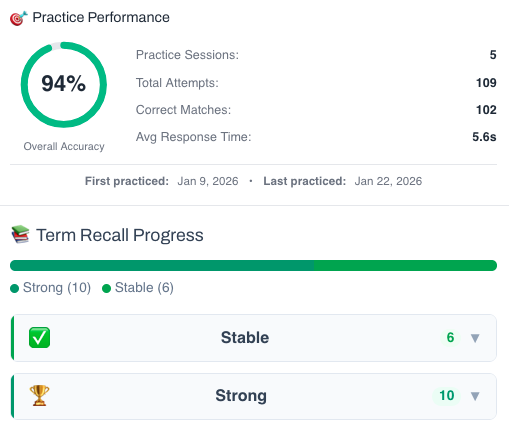
This isn’t a simple quiz — it’s a fully tracked learning system. You build knowledge through recognition, then recall, and your progress feeds directly into the Integrated Practice Bar (Writing tasks, AI Chat, and more).
- Practice sessions, accuracy, and response-time tracking
- Term strength levels (Learning → Stable → Strong)
- Personal progress history for each unit
This feature is available to YSP members.
Explore Membership BenefitsMember-Exclusive Practice Bar
Access a wide range of integrated practice for this unit — from Vocabulary and Grammar activities to AI-curated Writing tasks and Thematic Chat practice.
This feature is available to YSP members.
Explore Membership Benefits🎧 Audio Review – Module 1383 – Essential Adjectives
Use the VAS to build solid recognition and recall of the terms below.
✔ Every correct Match = +1 point
✔ Every correct Recall = +2 points
🎓 Reach 5 points with good accuracy and the term is automatically promoted to your Personal Dictionary.
Incorrect answers lower accuracy, meaning more correct Matches or Recalls may be needed to reach promotion.
Member-Exclusive Vocabulary Review & Acquisition System
This isn’t a simple quiz — it’s a fully tracked learning system. You build knowledge through recognition, then recall, and your progress feeds directly into the Integrated Practice Bar (Writing tasks, AI Chat, and more).
- Practice sessions, accuracy, and response-time tracking
- Term strength levels (Learning → Stable → Strong)
- Personal progress history for each unit
This feature is available to YSP members.
Explore Membership Benefits🎮 Practice Games
Member-Exclusive Sentence Builder
Reconstruct scrambled sentences to practice word order and develop your grammar intuition.
This feature is available to YSP members.
Explore Membership Benefits