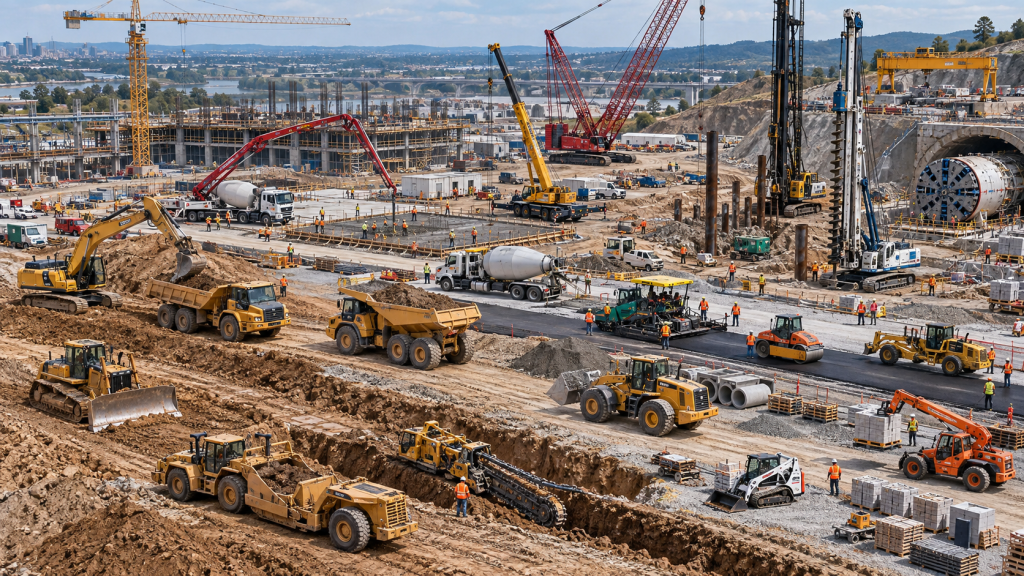
Heavy Construction Equipment | Pack 1: The Machines That Build Our World
Core PathWay
1 Section 1. The Machines That Move the Earth
Ready to build your vocabulary for heavy construction equipment? Here is where we start.
On any large construction site, the first job is moving earth. Machines dig, push, cut, and carry huge amounts of soil and rock before any building can begin.
The most common digging machine is the excavator. It sits on tracks or wheels and has a long hydraulic arm with a bucket on the end. The arm reaches down, digs into the ground, and lifts the material out. You will see excavators on almost every major site.
Next to the excavator, you will often find a bulldozer. This is a powerful tracked machine with a wide, flat metal blade at the front. The blade pushes large amounts of soil, rubble, or debris across the site. Think of it as a giant plough.
When the ground has been cleared, a motor grader shapes and levels the surface. It has a long, adjustable blade under its body that creates a precise, flat gradient — important for roads and foundations.
A scraper does a different job. It cuts into the ground surface, collects the material in a large bowl-shaped container, carries it across the site, and then spreads it somewhere else. One machine, four jobs.
Finally, a trencher cuts narrow, deep channels into the ground. It uses a rotating chain or wheel with cutting teeth. Workers use trenches to lay pipes, cables, or drainage systems underground.
2 Section 2. Carrying and Compacting: Moving Material Around the Site
Once the earth has been moved, it needs to go somewhere — and then the ground needs to be made solid and stable.
A dump truck is the workhorse of the site. It is a large, heavy truck with an open bed at the back. When it arrives at the right spot, the bed rises hydraulically and tips the load out. Dump trucks carry soil, gravel, and demolition material.
On rough or steep ground, a standard dump truck cannot always manage. That is where the articulated hauler comes in. This off-road truck has a joint in the middle of its body. That joint lets the machine bend, so it can navigate terrain that a rigid truck cannot handle.
After the material is in place, the ground must be compressed. A compactor does this job. It applies heavy pressure or vibration to soil, asphalt, or gravel to create a dense, stable layer.
One important type of compactor is the vibratory roller. It has a heavy rotating drum that also vibrates rapidly. This combination is very effective for compressing asphalt or soil on roads and large paved surfaces.
A wheel loader is also useful at this stage. It is a wheeled machine with a large bucket at the front, used to scoop up and move loose materials — soil, gravel, or crushed stone — around the site quickly.
For very tight spaces, workers use a skid steer loader. This is a small, compact machine that turns by driving its left and right wheels at different speeds. It is highly manoeuvrable, which makes it useful where larger machines cannot fit.
3 Section 3. Building Up: Cranes and Lifting Machines
When construction moves upward — building floors, placing beams, or lifting heavy sections into position — lifting machines become essential.
The most familiar lifting machine is the crane. A crane has a tall structure and a long horizontal arm. It lifts and moves very heavy materials — such as steel beams or concrete sections — to high positions on a site.
On tall building sites, you will see a tower crane. This is a fixed, vertical crane anchored to the ground. It rises high above the site and lifts heavy loads to the upper floors of structures under construction. Tower cranes are a familiar sight in city skylines.
A crawler crane is different. It is mounted on a tracked undercarriage — similar to a bulldozer’s tracks — which allows it to move slowly across soft or uneven ground while carrying heavy loads. This makes it useful on sites where the ground is not firm.
A mobile crane is mounted on a wheeled truck or all-terrain vehicle. It can drive under its own power between locations, which makes it flexible for projects that need lifting in several different places.
For very long distances or extremely heavy loads on major infrastructure projects, engineers use a lattice boom crane. Its arm is built from an open framework of steel members — like a metal grid — which makes it strong but not too heavy.
A telehandler is not strictly a crane, but it does a similar job on many sites. It has an extendable, telescoping arm that can reach up and forward to lift and place materials — such as pallets of bricks — at height or distance.
4 Section 4. Concrete and Foundations: Machines That Build Below and Above
Some of the most important work on a construction site happens underground — creating the foundations that hold everything up. Other machines handle concrete, which is the material that holds structures together.
A pile driver forces long structural columns — called piles — deep into the ground. These piles create a stable foundation for bridges, buildings, or other heavy structures. Without a solid foundation, nothing can be built safely above.
A drilling rig bores deep, precise holes into rock or soil. These holes are used for foundation piles, tunnels, or geotechnical investigation — which means checking what the ground is made of before building begins.
For the largest underground projects, engineers use a tunnel boring machine. This is a massive cylindrical machine that cuts through rock or soil to create a tunnel. As it moves forward, it also lines the tunnel walls with concrete segments. It is one of the largest machines in the world.
Above ground, concrete must be mixed and delivered. A concrete mixer truck has a large rotating drum fitted to the truck body. The drum keeps the concrete in a liquid, workable state during transport from the batching plant to the site.
Once the concrete arrives, a concrete pump forces the liquid concrete through pipes or a long extendable boom. This delivers the concrete precisely to locations that a mixer truck cannot reach directly — for example, the top floor of a tall building or a confined space.
A gantry crane is often used in large industrial or infrastructure sites. It runs on rails or tracks at ground level, with its lifting mechanism suspended from a horizontal beam supported by two tall legs. You will often see gantry cranes in shipyards and precast concrete factories.
5 Section 5. Finishing the Surface: Paving and Road Machines
After the foundations and structures are in place, the surface must be finished — especially for roads, car parks, and large paved areas.
An asphalt paver is a self-propelled machine that spreads hot asphalt mix across a road surface as it moves forward. It lays a continuous, even layer and partially compacts it at the same time. A vibratory roller usually follows behind to finish the compaction.
Before the asphalt is laid, the surface must be perfectly level. A motor grader — which you met in Section 1 — often does this preparation work. Notice how some machines appear at more than one stage of a project.
A hydraulic breaker is used when old surfaces need to be removed first. It is a powerful chisel-like attachment fitted to an excavator arm. It uses hydraulic pressure to deliver rapid hammer blows and break apart concrete, rock, or hard pavement. Think of it as a very large pneumatic drill.
Here is a useful pattern to notice. Many of these machines are not standalone — they are attachments or variants of machines you already know. The hydraulic breaker fits onto an excavator. The vibratory roller is a type of compactor. Knowing the base machine helps you understand the attachment.
This is also a good moment to notice some word patterns. Several machine names tell you exactly what the machine does: a pile driver drives piles, a tunnel boring machine bores tunnels, a concrete mixer mixes concrete, and a concrete pump pumps concrete. The name is the description.
6 Section 6. Putting It All Together: How the Machines Work as a Team
Construction projects use many different machines, and each one has a specific role. But the machines also work together in a sequence.
At the start, excavators dig and bulldozers clear. Dump trucks and articulated haulers carry the material away. Motor graders and scrapers shape the ground. Compactors and vibratory rollers make the surface stable.
Then pile drivers and drilling rigs prepare the foundations. Concrete mixer trucks bring the concrete. Concrete pumps deliver it to the right place. Tower cranes and crawler cranes lift the heavy structural elements into position.
On the surface, asphalt pavers lay the road. Hydraulic breakers remove anything that needs to come out. Telehandlers and wheel loader machines keep materials moving around the site. Skid steer loaders work in the tight spaces.
For the biggest projects — bridges, tunnels, skyscrapers — lattice boom cranes and gantry cranes handle the heaviest lifts. Tunnel boring machines cut through the ground far below the surface.
Every machine has a job. Every job fits into the larger sequence. When you know the name of a machine, you also know where it fits in the story of how a building or road gets made.
You have now met all 25 machines in this pack. Take a moment to think about which ones you found most interesting or most surprising. In the next section, you will hear these terms working in a real conversation.
7 Section 7. Now Hear It in Use
You have met all 25 machines. Now hear them working in a real conversation. Listen to how two site professionals use these terms naturally — and notice which machines they mention and why.
💬 Dialogue 1: On Site: Choosing the Right Machine for the Job
Priya is a site manager. Dan is an equipment supervisor. They are walking around a large construction site in the morning, planning which machines they need for the day’s work and dealing with a problem that came up overnight.
Priya: “Dan, I’ve just come from the north end of the site. The excavator has broken down and we’ve got a full day of digging scheduled. What are our options?”
Dan: “We can bring in the second excavator from the east section — it finished the drainage trench yesterday. And if we need to clear the surface debris first, I can get the bulldozer moved over in about an hour. It’s been pushing rubble on the south side, but that work is nearly done.”
Priya: “Good. What about the concrete pour this afternoon? The mixer trucks are booked for two o’clock, but I’m not sure the concrete pump can reach the back wall from where it’s currently positioned.”
Dan: “You’re right, it can’t reach from there. We’ll need to reposition the pump before midday. Also, once the mixer trucks finish unloading, we should get the dump truck in to clear the leftover spoil near the back wall. It’s been sitting there since Tuesday and it’s blocking the access route.”
Priya: “Agreed. And what about the grading work on the western access road? The surface is really uneven after all the rain. Can we get the motor grader out there this morning?”
Dan: “Yes, the motor grader is free until eleven. I’ll send it to the western road first thing. After it finishes grading, we should run the compactor over the surface so it’s firm enough for the heavy vehicles. Otherwise the trucks will just churn it up again.”
Priya: “Good thinking. Now, the steel frame delivery is coming tomorrow. Are we ready on the lifting side? I want to make sure the tower crane is operational — we’ll need it for the upper floors.”
Dan: “The tower crane had its inspection last week and it’s fully cleared. However, the delivery includes some very long steel beams, and the ground near the storage area is still soft from the rain. We might need the crawler crane to move those beams across site before the tower crane lifts them into position.”
Priya: “That makes sense. What about the foundation work on Block C? I thought the drilling rig was supposed to start there today.”
Dan: “The drilling rig is on site and ready. Once it finishes the bore holes, the pile driver can go in to drive the foundation piles. That should take most of the afternoon. I’ve scheduled both machines for Block C from nine o’clock.”
Priya: “Perfect. So to confirm — second excavator to the north, bulldozer to clear debris, pump repositioned before two, motor grader and compactor on the western road, drilling rig and pile driver on Block C, and the crawler crane on standby for the beam delivery tomorrow. Does that cover everything?”
Dan: “That covers it. I’ll brief the operators at the morning meeting and make sure everyone knows where they need to be. If the dump truck finishes the spoil clearance early, I’ll send it to support the excavator team at the north end. We should be in good shape by the time the mixer trucks arrive.”
Member-Exclusive Practice Bar
Access a wide range of integrated practice for this unit — from Vocabulary and Grammar activities to AI-curated Writing tasks and Thematic Chat practice.
This feature is available to YSP members.
Explore Membership BenefitsMember-Exclusive Vocabulary Review & Acquisition System

This isn’t a simple quiz — it’s a fully tracked learning system. You build knowledge through recognition, then recall, and your progress feeds directly into the Integrated Practice Bar (Writing tasks, AI Chat, and more).
- Practice sessions, accuracy, and response-time tracking
- Term strength levels (Learning → Stable → Strong)
- Personal progress history for each unit
This feature is available to YSP members.
Explore Membership Benefits