Understanding the Balance Sheet: Core Financial Terms
Core PathWay
1 What is a Balance Sheet?
You have chosen to learn about the balance sheet, so let’s get started. A balance sheet is an important financial statement. Companies use it to show their money situation. The balance sheet has three main parts. It shows assets, liabilities, and equity. Companies prepare this document every fiscal year. A fiscal year is twelve months for accounting. The balance sheet helps people understand a company’s net worth. Net worth means total assets minus total liabilities.
2 Assets: What a Company Owns
An asset is something the company owns with value. There are two main types of assets. Current assets can become cash within one year. Cash is money in hand or bank. Inventory is goods the company wants to sell. Accounts receivable is money customers owe to the company. Fixed assets are things the company keeps long-term. Tangible assets are physical things you can touch. Buildings and machines are tangible assets. Intangible assets are non-physical things like patents. All assets help determine company valuation.
3 Liabilities and Obligations
A liability is money or obligation the company owes. Accounts payable is money owed to suppliers. Debt is money borrowed from creditors. A creditor is a person or company owed money. Companies must show their liquidity. Liquidity is the ability to convert assets to cash. They also show solvency. Solvency means ability to meet long-term debts. Working capital is current assets minus current liabilities. This number shows short-term financial health.
4 Equity and Ownership
Equity is the owner’s stake in the company. Shareholders are people who own company shares. They invest capital in the business. Capital is money put into the company. Retained earnings are accumulated profits not given to shareholders. Companies keep retained earnings to grow the business. Equity grows when the company makes profit. Profit happens when revenue is more than expenses. Revenue is income from business activities. Expenses are costs of business operations.
5 Financial Performance
Companies track their financial results carefully. Revenue comes from selling products or services. Expenses include salaries, rent, and supplies. When revenue is higher than expenses, there is profit. When expenses exceed revenue, there is a loss. Depreciation is decrease in asset value over time. Machines and buildings lose value as they age. Companies use accrual accounting methods. Accrual means recording revenue when earned, not received. This gives a true picture of company performance.
6 Understanding Company Value
The balance sheet shows total company value. Valuation is the process of determining company worth. Investors look at assets and liabilities together. They calculate net worth to understand real value. Strong companies have more assets than liabilities. They maintain good liquidity and solvency. The fiscal year period helps compare performance. Financial statements give shareholders important information. All these terms help people make business decisions.
Member-Exclusive Practice Bar
Access a wide range of integrated practice for this unit — from Vocabulary and Grammar activities to AI-curated Writing tasks and Thematic Chat practice.
This feature is available to YSP members.
Explore Membership BenefitsMember-Exclusive Vocabulary Review & Acquisition System
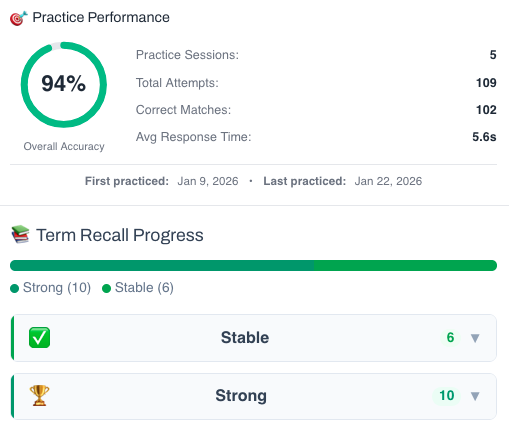
This isn’t a simple quiz — it’s a fully tracked learning system. You build knowledge through recognition, then recall, and your progress feeds directly into the Integrated Practice Bar (Writing tasks, AI Chat, and more).
- Practice sessions, accuracy, and response-time tracking
- Term strength levels (Learning → Stable → Strong)
- Personal progress history for each unit
This feature is available to YSP members.
Explore Membership Benefits🎮 Practice Games
Sentence Scrambler
The Balance Sheet – Primer – Sentence Scramble
Member-Exclusive Sentence Builder
Reconstruct scrambled sentences to practice word order and develop your grammar intuition.
This feature is available to YSP members.
Explore Membership Benefits| financial position | snapshot of company's finances at specific date |
| statement of financial position | formal name for balance sheet document |
| long-term liabilities | debts payable after one year |
| short-term liabilities | debts due within one year |
| non-current assets | assets held for over one year |
| current liabilities | obligations due within twelve months |
| total assets | sum of all company resources |
| total liabilities | sum of all company obligations |
| shareholders' equity | owners' residual interest in company |
| accumulated depreciation | total depreciation recorded over asset's life |
| prepaid expenses | payments made in advance for future |
| notes payable | formal written promises to pay |
| long-term debt | borrowing repayable beyond one year |
| share capital | money received from issuing shares |
| reserves | profits kept in business not distributed |
| contra account | account that reduces related account balance |
| asset turnover | efficiency ratio measuring asset use |
| current ratio | current assets divided by current liabilities |
| quick ratio | liquidity measure excluding inventory |
| debt-to-equity ratio | comparison of debt to shareholder equity |
| leverage | using borrowed money to increase returns |
| gearing | proportion of debt in capital structure |
| financial leverage | extent company uses borrowed funds |
| operating cycle | time to convert inventory to cash |
| cash flow | movement of money in and out |
| insolvency | inability to pay debts when due |
| going concern | assumption business will continue operating |
| materiality | significance of financial information to decisions |
| conservatism principle | reporting cautiously avoiding overstatement |
| matching principle | matching expenses to related revenues |