Investigating ‘Get’ in Everyday Contexts: A Comprehensive Exploration
Core PathWay
1 🌐 Introduction Section
The verb ‘get’ is one of the most polysemous words in English, which means it has many different meanings. This versatile verb appears in countless everyday situations, from buying things to understanding ideas, from arriving somewhere to becoming something new. Native speakers use it constantly, but its ambiguity can confuse learners. The same word can mean obtain, receive, understand, fetch, or earn depending on context. Additionally, ‘get’ creates powerful causative structures and shows transformation through combinations with adjectives. Understanding these patterns helps you sound more natural and decode what native speakers actually mean when they use this essential verb in different registers and contexts.
Key Terms Defined:
Polysemous: A word that has many different meanings.
Versatile: Useful in many different situations or for many purposes.
Ambiguity: When something can have more than one meaning and is not clear.
Obtain: To get something, especially by making an effort.
Receive: To get something that someone gives or sends to you.
Understand: To know the meaning of something or why something happens.
Fetch: To go to another place to get something or someone and bring them back.
Earn: To get money by working.
Causative: Grammar structures that show one person making another person do something, or arranging for something to be done.
Transformation: A complete change from one state or form to another.
Register: The level of formality in language, such as formal, informal, or neutral.
💬 Making Weekend Plans
Two friends are texting about meeting up this weekend
2 🔍 Lexical Breakdown
GET = BUY/OBTAIN/ACQUIRE
Definition: To buy something or make something yours.
Example: I need to get some milk from the shop.
Example: Where did you get that beautiful jacket?
Register: Informal to neutral. In formal writing, prefer ‘purchase’, ‘obtain’, or ‘acquire’.
—
GET = RECEIVE
Definition: To be given something or to have something arrive for you.
Example: I got your email yesterday, thanks!
Example: She gets lots of birthday cards every year.
Register: Neutral. Common in both spoken and written English.
—
GET = UNDERSTAND/COMPREHEND
Definition: To understand something, especially a joke, idea, or instruction.
Example: Do you get what I mean?
Example: Sorry, I don’t get the joke. Can you explain it?
Register: Informal. More common in spoken English. In formal contexts, use ‘understand’ or ‘comprehend’.
—
GET = FETCH/RETRIEVE
Definition: To go to another place, pick something up, and bring it back.
Example: Could you get my glasses from the bedroom?
Example: I’ll get the kids from school at 3pm.
Register: Neutral. Common in everyday spoken English.
—
GET = EARN
Definition: To receive money for work you do.
Example: How much do you get per hour in your new job?
Example: She gets a good salary as a software engineer.
Register: Informal to neutral. In formal contexts, prefer ‘earn’ or ‘receive a salary’.
—
GET TO = ARRIVE AT/REACH
Definition: To arrive at a place or reach a destination.
Example: What time did you get to the airport?
Example: We got to London at midnight.
Register: Neutral. Very common in spoken English. ‘Arrive at’ is more formal.
—
GET + ADJECTIVE = BECOME
Definition: To change and become different, usually with an adjective that shows the new state.
Example: It’s getting dark outside – let’s go home.
Example: I’m getting tired. Can we take a break?
Example: They got married last summer.
Register: Neutral. This pattern is extremely common in everyday English for describing changes.
—
GET SOMEONE TO DO SOMETHING (CAUSATIVE)
Definition: To persuade, ask, or make another person do something for you.
Example: I got my brother to help me move the furniture.
Example: Can you get John to call me back?
Register: Neutral. Common in everyday situations. Shows that you influenced someone’s action.
—
GET SOMETHING DONE (CAUSATIVE PASSIVE)
Definition: To arrange for someone else to do a service or task for you.
Example: I need to get my hair cut this weekend.
Example: We’re getting the house painted next month.
Example: Did you get your car repaired?
Register: Neutral. Very common for talking about services and repairs. The focus is on the result, not who does the action.
💬 At the Shop
A customer is trying to buy something but there’s a problem with understanding
3 📚 Word Family and Variants
‘Get’ is primarily a verb and doesn’t have the typical word family extensions (noun, adjective, adverb forms) that many other English words possess. However, it creates meaning through combinations and patterns rather than through traditional derivations.
Core Verb Forms:
– Base form: get
– Past simple: got
– Past participle: got (British English) / gotten (American English)
– Present participle: getting
– Third person singular: gets
American vs British Usage:
In American English, ‘gotten’ is the standard past participle: ‘I’ve gotten better at tennis.’
In British English, ‘got’ serves as both past simple and past participle: ‘I’ve got better at tennis.’
Both are correct in their respective varieties of English.
Common Prefixes and Combinations:
While ‘get’ doesn’t take traditional prefixes, it forms numerous phrasal verbs by combining with prepositions and particles:
– get up (to rise from bed)
– get on (to enter a bus/train, or to have a good relationship)
– get off (to leave a bus/train)
– get in (to enter a car/building, or to arrive home)
– get out (to leave or exit)
– get away (to escape or go on holiday)
– get back (to return)
– get over (to recover from illness or sadness)
– get through (to finish something difficult, or to contact by phone)
– get along (to have a friendly relationship)
These combinations create entirely new meanings and are essential for natural English communication.
Key Terms Defined:
Verb: A word that describes an action, state, or experience.
Combinations: When two or more words are used together to create meaning.
Patterns: Regular ways that words are used together in a language.
Derivations: New words formed by adding prefixes or suffixes to a base word.
Past participle: The verb form used with ‘have’ to make perfect tenses, or used as an adjective.
Past simple: The verb form used to talk about finished actions in the past.
Varieties: Different forms of English used in different countries or regions.
Phrasal verbs: Verbs made from a main verb plus a preposition or particle, creating new meaning.
Particles: Small words like ‘up’, ‘down’, ‘in’, ‘out’ that combine with verbs to change their meaning.
💬 Office Task Discussion
A manager is discussing tasks with an employee and things are getting busy
4 🔗 Collocations and Combinations
GET + COMMON NOUNS (Receiving/Obtaining):
Get a job: To find employment and start working.
– She finally got a job at the local hospital after months of searching.
Get a degree: To complete university studies and receive your qualification.
– He got his degree in engineering last year.
Get permission: To receive approval to do something.
– You need to get permission from your manager before leaving early.
Get results: To receive the outcome of tests or efforts.
– We should get the exam results next week.
Get experience: To gain knowledge or skill through doing something.
– I’m volunteering to get experience in social work.
Get advice: To receive suggestions or recommendations from someone.
– You should get advice from a lawyer before signing anything.
—
GET + ADJECTIVE (State Changes):
Get tired: To become tired.
– I always get tired after lunch.
Get angry: To become angry.
– Try not to get angry when he says silly things.
Get ready: To prepare yourself for something.
– Get ready quickly – the taxi is coming in five minutes!
Get married: To have a wedding ceremony and become husband and wife.
– They’re getting married in June.
Get lost: To not know where you are; to become lost.
– We got lost trying to find the restaurant.
Get dressed: To put your clothes on.
– I’ll get dressed and meet you downstairs in ten minutes.
—
GET TO + PLACE (Arrival):
Get home: To arrive at your house.
– What time do you usually get home from work?
Get there: To arrive at a place you’ve been talking about.
– The meeting starts at 9am, so we need to get there by 8:45.
Get to work: To arrive at your workplace.
– I normally get to work around 8:30am.
Get to the point: To start talking about the main subject (idiomatic).
– Stop talking about other things and get to the point!
—
GET + SOMEONE/SOMETHING (Understanding):
Get the message: To understand what someone means, especially a hint.
– He kept looking at his watch – I got the message and left.
Get the idea: To understand a concept or plan.
– Do you get the idea, or should I explain again?
Get the joke: To understand why something is funny.
– Everyone laughed but I didn’t get the joke.
—
CAUSATIVE COLLOCATIONS:
Get my hair cut: To arrange for a hairdresser to cut your hair.
– I’m getting my hair cut on Saturday.
Get the car repaired: To arrange for a mechanic to fix your car.
– We need to get the car repaired before our trip.
Get the house painted: To pay someone to paint your house.
– They’re getting the house painted this summer.
Get him to help: To persuade or ask him to give assistance.
– Can you get him to help us move these boxes?
Get her to call: To arrange or persuade her to make a phone call.
– Please get her to call me when she has time.
5 🤔 Metaphors & Idioms
English speakers use ‘get’ in many figurative expressions that go beyond its literal meaning. These idioms are extremely common in native speaker conversation, but learners should be careful about using them until they fully understand the context. It’s important to remember that receptive skills (understanding when you hear or read these expressions) should develop before productive skills (using them yourself in speaking or writing). Using idioms inappropriately can sound strange or even rude, so listen carefully to how native speakers use them before trying them yourself.
Here are some common idiomatic expressions with ‘get’:
Get across: To successfully communicate an idea so others understand it.
– The teacher tried to get across the importance of studying regularly.
Get along (with someone): To have a friendly relationship with someone.
– Do you get along with your colleagues?
Get away with something: To do something wrong without being punished.
– He got away with cheating because the teacher didn’t notice.
Get over something: To recover from an illness, sadness, or difficult experience.
– It took her months to get over the breakup.
Get through something: To survive or complete a difficult period or task.
– I don’t know how I got through that terrible winter.
Get by: To manage to live or survive with limited resources.
– We don’t earn much, but we get by.
Get ahead: To become successful or make progress in your career.
– If you want to get ahead in business, you need to work hard and network.
Key Terms Defined:
Figurative: Language that uses words in non-literal ways to create special meaning or effect.
Literal meaning: The basic, direct meaning of words without metaphor or special interpretation.
Idioms: Fixed expressions whose meaning cannot be understood from the individual words.
Native speaker: Someone who learned a language as their first language from birth.
Receptive skills: The ability to understand language when you hear or read it.
Productive skills: The ability to create language yourself when speaking or writing.
Appropriately: In a way that is suitable or correct for a particular situation.
Idiomatic: Using expressions and phrases that are natural to native speakers.
Metaphorical: Using words or phrases to represent something else, not their literal meaning.
Context: The situation, background, or setting in which language is used.
Member-Exclusive Vocabulary Review & Acquisition System
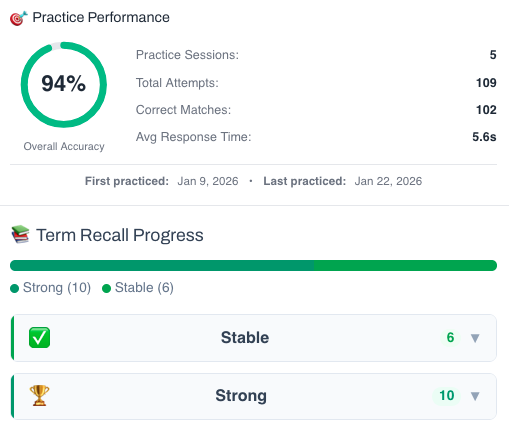
This isn’t a simple quiz — it’s a fully tracked learning system. You build knowledge through recognition, then recall, and your progress feeds directly into the Integrated Practice Bar (Writing tasks, AI Chat, and more).
- Practice sessions, accuracy, and response-time tracking
- Term strength levels (Learning → Stable → Strong)
- Personal progress history for each unit
This feature is available to YSP members.
Explore Membership Benefits