Account and Accountability: A Complete Investigation
Core PathWay
1 🌐 Introduction Section
The word account is one of those tricky terms that deserves your full attention because it changes meaning dramatically depending on context. In business, an account might be where you keep your money, but to account for something means to explain it or take responsibility. Meanwhile, accountability is a crucial concept in professional environments – it’s about who is responsible when things go wrong or right. This investigation will help you navigate these different meanings confidently, so you can understand financial discussions, take responsibility appropriately, and explain situations clearly in English.
💬 Dialogue 1: Monthly Financial Review
Lisa (accountant) is meeting with Sarah (manager) to discuss the monthly accounts
2 🔍 Lexical Breakdown
Let’s explore the core meanings of account and related terms:
1. Account (noun) – financial meaning
An account is a place (usually at a bank) where you keep your money.
– *I opened a new bank account last week.*
– *She transferred money from her savings account to her business account.*
Register: Neutral – used in both formal and informal contexts.
2. Account (noun) – explanation meaning
An account is a description or explanation of something that happened.
– *He gave a detailed account of the meeting to his manager.*
– *According to her account, the project was delayed because of technical problems.*
Register: Slightly formal – common in professional and written contexts.
3. To do the accounts (expression)
To do the accounts means to organize and check all the financial records of a business.
– *Lisa does the accounts every month to make sure everything is correct.*
– *We need to do the accounts before the end of the financial year.*
Register: Business/professional – this is what accountants and bookkeepers do.
4. To account (verb)
To account means to give an explanation or reason for something.
– *How do you account for the sudden increase in sales?*
– *The manager couldn’t account for the missing inventory.*
Register: Formal – more common in professional or academic contexts.
5. To account for (phrasal verb)
To account for has two main meanings:
a) To explain or give reasons for something:
– *Can you account for your absence yesterday?*
– *The report accounts for all the expenses from last quarter.*
b) To represent a particular amount or part of something:
– *Sales to Europe account for 30% of our total revenue.*
– *Small businesses account for most of the jobs in this area.*
Register: Professional/neutral – very common in business and academic writing.
6. To be accountable (adjective + verb)
To be accountable means to be responsible for your actions and ready to explain them.
– *Every manager is accountable for their team’s performance.*
– *As a professional, you need to be accountable for your decisions.*
Register: Professional/formal – essential in business contexts.
7. To be accountable for (expression)
To be accountable for means to be responsible for something specific and ready to explain or justify it.
– *The finance director is accountable for the company’s budget.*
– *Team leaders are accountable for meeting their targets.*
Register: Professional/formal – shows clear responsibility.
8. Accountability (noun)
Accountability is the state of being responsible for something and having to explain your actions.
– *There needs to be greater accountability in how public money is spent.*
– *The new system ensures accountability at every level of management.*
Register: Formal/professional – key concept in business and governance.
Key Terms
💬 Dialogue 2: Discussing Team Accountability
Tom and Mark are discussing a problem with project deadlines in their office
3 📚 Word Family and Variants
Here’s the complete word family for account:
Noun forms:
– account – the financial place or the explanation
– accounting – the profession or activity of keeping financial records
– accountant – a person whose job is to keep or check financial records
– accountability – the quality of being responsible
Verb forms:
– to account – to explain or give reasons
– to account for – to explain or represent an amount (phrasal verb)
Adjective form:
– accountable – responsible and ready to explain your actions
Usage differences:
Notice that accountable is always followed by for when you mention what someone is responsible for: *She’s accountable FOR the budget* (not *accountable OF*).
The noun account changes meaning completely depending on context – a bank account is very different from giving an account of something.
Common prefixes and suffixes:
– unaccountable (prefix: un-) – not having to explain your actions, or impossible to explain
– unaccounted for – missing or not explained (*Three boxes are still unaccounted for.*)
4 🔗 Collocations and Combinations
Here are the most common word partnerships with account and related terms:
With ‘account’ (financial):
– bank account – *I need to open a bank account when I move to London.*
– savings account – *She puts money into her savings account every month.*
– business account – *The company has a separate business account for all expenses.*
– joint account – *My wife and I have a joint account for household bills.*
– to open an account – *You can open an account online in just a few minutes.*
– to close an account – *He closed his account when he moved to another bank.*
With ‘account for’:
– account for the difference – *Can anyone account for the difference between these two figures?*
– account for the delay – *The manager needs to account for the delay in delivery.*
– account for a large part – *Tourism accounts for a large part of the country’s income.*
With ‘accountable’:
– to be held accountable – *Senior managers will be held accountable for any mistakes.*
– to hold someone accountable – *We need to hold people accountable for their decisions.*
– fully accountable – *The director is fully accountable to the board.*
– directly accountable – *Team leaders are directly accountable to the project manager.*
With ‘accountability’:
– personal accountability – *The company culture emphasizes personal accountability.*
– financial accountability – *There are strict rules about financial accountability in public organizations.*
– lack of accountability – *The scandal revealed a serious lack of accountability.*
Other useful expressions:
– to take into account – *We need to take into account the current economic situation.*
– on account of – *The meeting was cancelled on account of bad weather.*
– on no account – *On no account should you share your password with anyone.*
– by all accounts – *By all accounts, the conference was a great success.*
5 🤔 Metaphors & Idioms
Account appears in several idiomatic expressions that native speakers use regularly:
By all accounts means ‘according to what everyone says’ – *By all accounts, she’s an excellent teacher.*
On no account is a strong way to say ‘never’ or ‘definitely not’ – *On no account should you leave the door unlocked.*
To settle accounts can mean to pay money you owe, but metaphorically it means to resolve a problem or disagreement with someone – *They finally settled their accounts after years of not speaking.*
To call someone to account means to demand an explanation from someone for their actions – *The CEO was called to account by shareholders.*
These idioms are common in native speech and useful for comprehension. However, learners should remember that receptive skills (understanding when you hear them) come before productive skills (using them yourself). It’s perfectly fine to recognize these expressions without using them immediately – in fact, it’s safer to master the basic meanings first before experimenting with idiomatic uses. Listen for them, understand them, and gradually introduce them into your own speech when you feel confident about the context.
Member-Exclusive Vocabulary Review & Acquisition System
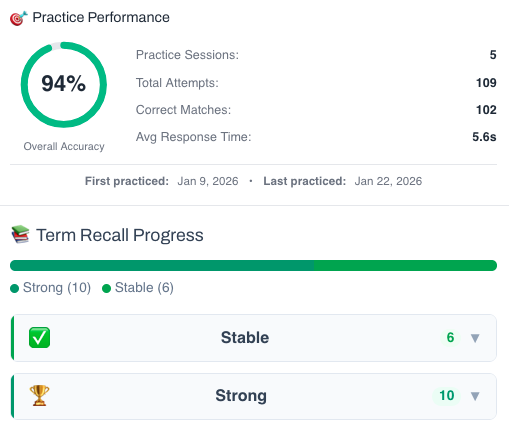
This isn’t a simple quiz — it’s a fully tracked learning system. You build knowledge through recognition, then recall, and your progress feeds directly into the Integrated Practice Bar (Writing tasks, AI Chat, and more).
- Practice sessions, accuracy, and response-time tracking
- Term strength levels (Learning → Stable → Strong)
- Personal progress history for each unit
This feature is available to YSP members.
Explore Membership BenefitsMember-Exclusive Practice Bar
Access a wide range of integrated practice for this unit — from Vocabulary and Grammar activities to AI-curated Writing tasks and Thematic Chat practice.
This feature is available to YSP members.
Explore Membership BenefitsMember-Exclusive Cloze Test
Fill in the gaps to complete authentic passages and reinforce your vocabulary in context.
This feature is available to YSP members.
Explore Membership BenefitsMember-Exclusive Cloze Test
Fill in the gaps to complete authentic passages and reinforce your vocabulary in context.
This feature is available to YSP members.
Explore Membership BenefitsMember-Exclusive Sentence Builder
Reconstruct scrambled sentences to practice word order and develop your grammar intuition.
This feature is available to YSP members.
Explore Membership BenefitsMember-Exclusive Sentence Builder
Reconstruct scrambled sentences to practice word order and develop your grammar intuition.
This feature is available to YSP members.
Explore Membership Benefits