Understanding ‘Some’ in Different Contexts
Core PathWay
1 Three Ways to Use ‘Some’
You already know how to use some for quantity. This means talking about a number of things.
For example: ‘There were some people in the room.’ This means there were people, but we don’t know exactly how many. Maybe five people, maybe ten people. We use some because we don’t need to say the exact number.
But some has other uses too! Today you will learn three important ways to use some. First, you will learn the classic rules for some and any with different types of nouns. Second, you will learn how some works with clothing that comes in pairs, like trousers and shoes. Third, you will learn special expressions with some, like ‘That was some film!’ This means the film was really good or really bad.
These three uses are different, but they are all very common in English. Let’s start!
Key Terms
2 Classic Rules: Some and Any
Now you will learn the traditional grammar rules for some and any. These rules help you choose the right word in different sentences.
The rules are different for countable nouns and uncountable nouns. Countable nouns are things you can count, like apples. Uncountable nouns are things you cannot count, like water. Understanding this difference is very important!
some
- some people
- some water
- some time
- some money
- some apples
- I have some friends in London.
- There is some milk in the fridge.
any
- any questions
- any problems
- any time
- any money
- not any
- Do you have any brothers or sisters?
- I don’t have any money today.
countable nouns
- countable nouns
- plural countable nouns
- I bought some apples. (You can count apples: 1, 2, 3…)
- She has some books on her desk.
uncountable nouns
- uncountable nouns
- some uncountable noun
- I need some water. (You cannot say ‘one water, two waters’)
- There is some rice in the bowl.
3 At the Food Shop
Let’s see how people use some and any in a real situation. Two customers are shopping for food.
Customer 1: Hello! Do you have any apples today?
Shopkeeper: Yes, we have some apples. They are very fresh!
Customer 1: Great! And do you have any bread?
Shopkeeper: Sorry, we don’t have any bread today.
Customer 1: OK. I need some milk and some eggs too.
Shopkeeper: We have some milk, but we don’t have many eggs. We have some eggs, but not many.
Customer 2: Excuse me, do you have any chicken?
Shopkeeper: Yes, we have some chicken. Do you want some cheese too?
Customer 2: Yes, please! And do you have any tomatoes?
Shopkeeper: We have some tomatoes. We also have some carrots and some potatoes.
Customer 2: Perfect! I also need some rice and some pasta.
Shopkeeper: We have some rice, but not much. We have some pasta too.
Customer 1: Do you have any coffee?
Shopkeeper: We don’t have any coffee today. But we have some tea.
Customer 1: That’s fine. I’ll take some tea. Do you have any orange juice?
Shopkeeper: Yes! We have some orange juice and some water too.
Customer 2: And do you have any bananas?
Shopkeeper: We have some bananas, but not many. And we have some strawberries too!
Notice how the shopkeeper uses some in positive sentences and any in questions and negatives!
Key Terms
4 Some with Clothing in Pairs
Now we learn a special use of some with clothing. This is very important!
When you say ‘I need some trousers‘, you don’t mean several trousers. You mean one pair of trousers. This is different from the quantity meaning!
We use some this way with clothing and things that come in pairs (two things together). Here are the important items: socks, shoes, trousers, jeans, pants, underpants, pyjamas, glasses, sunglasses, and ear-rings.
Look at these examples:
– ‘I’m wearing some jeans.’ = I’m wearing one pair of jeans.
– ‘I need some new shoes.’ = I need one pair of new shoes.
– ‘She bought some glasses.’ = She bought one pair of glasses.
– ‘He’s wearing some pyjamas.’ = He’s wearing one pair of pyjamas.
But be careful! ‘I need some hats‘ means several hats, not one hat. Why? Because hats don’t come in pairs. Only use some for ‘one pair’ with items that have two parts!
Sometimes the context makes it clear you mean several pairs:
– ‘I bought some jeans at the shop. I got three pairs!’ Here, some means several pairs because you say ‘three pairs’ after.
But usually, when you say ‘some jeans’ or ‘some shoes’, you mean just one pair.
Key Terms
5 Special Expressions with Some
Finally, let’s look at special expressions with some. You hear these in films and books all the time!
When people say ‘That was some film!’, they mean the film was really, really good. Or sometimes really, really bad! The some makes the feeling stronger.
Look at these examples:
– ‘That was some party!’ = The party was amazing!
– ‘That was some meal!’ = The meal was excellent!
– ‘That was some game!’ = The game was incredible!
But be careful! Sometimes people use this in a negative way:
– ‘That was some mistake you made!’ = You made a really big mistake.
– ‘Some friend you are!’ = You are not a good friend at all.
Now let’s learn ‘some kind of‘. This means ‘a type of’ but you don’t know exactly what type.
Examples:
– ‘I need some kind of tool to fix this.’ = I need a tool, but I don’t know which tool.
– ‘She’s some kind of doctor.’ = She’s a doctor, but I don’t know what type of doctor.
– ‘He works in some kind of office.’ = He works in an office, but I don’t know exactly what office.
– ‘There was some kind of problem with the computer.’ = There was a problem, but I don’t know what problem.
– ‘I want some kind of sandwich for lunch.’ = I want a sandwich, but I haven’t decided which type.
– ‘She’s wearing some kind of hat.’ = She’s wearing a hat, but I don’t know what style.
These expressions are very common in everyday English. Now you can understand them!
Key Terms
6 Recap: Your New Skills with Some
Well done! Now you understand some in many different ways.
You learned the classic rules: use some in positive sentences and any in questions and negatives. You learned that some with countable nouns means more than three things, and some with uncountable nouns means an unknown amount.
You learned the special clothing use: ‘some trousers’ means one pair of trousers, not several trousers. This works with all clothing that comes in pairs.
You learned expressions like ‘That was some film!’ and ‘some kind of’. These are very common in everyday English.
Now you can use some correctly in many different situations. Practice using these new skills when you speak and write!
Member-Exclusive Vocabulary Review & Acquisition System
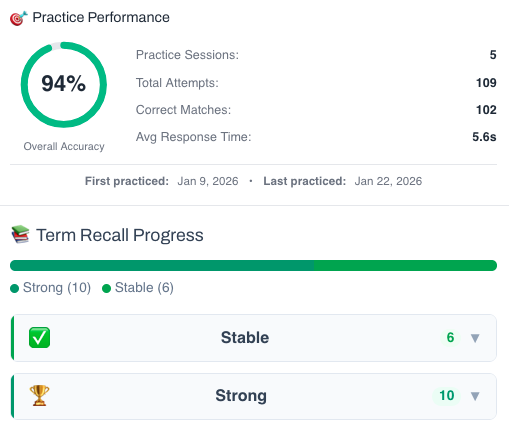
This isn’t a simple quiz — it’s a fully tracked learning system. You build knowledge through recognition, then recall, and your progress feeds directly into the Integrated Practice Bar (Writing tasks, AI Chat, and more).
- Practice sessions, accuracy, and response-time tracking
- Term strength levels (Learning → Stable → Strong)
- Personal progress history for each unit
This feature is available to YSP members.
Explore Membership BenefitsMember-Exclusive Practice Bar
Access a wide range of integrated practice for this unit — from Vocabulary and Grammar activities to AI-curated Writing tasks and Thematic Chat practice.
This feature is available to YSP members.
Explore Membership BenefitsMember-Exclusive Cloze Test
Fill in the gaps to complete authentic passages and reinforce your vocabulary in context.
This feature is available to YSP members.
Explore Membership BenefitsMember-Exclusive Cloze Test
Fill in the gaps to complete authentic passages and reinforce your vocabulary in context.
This feature is available to YSP members.
Explore Membership BenefitsMember-Exclusive Sentence Builder
Reconstruct scrambled sentences to practice word order and develop your grammar intuition.
This feature is available to YSP members.
Explore Membership BenefitsMember-Exclusive Sentence Builder
Reconstruct scrambled sentences to practice word order and develop your grammar intuition.
This feature is available to YSP members.
Explore Membership Benefits