The Continuous Aspect: Understanding Actions in Progress
Core PathWay
1 Simple vs Continuous: Understanding the Difference
Why do we say ‘I work’ sometimes and ‘I’m working’ at other times? The answer lies in understanding aspect in English grammar.
The simple aspect describes facts, habits, and completed actions. When you say ‘I work in an office’, you’re talking about your job in general. The continuous aspect (also called progressive) describes actions that are in progress or temporary. When you say ‘I’m working on a report’, you’re talking about something happening right now or around now. This difference is important because it changes the meaning completely.
Action verbs (like work, eat, run, write) can be used in both simple and continuous forms. However, state verbs (like know, like, understand, belong) are generally only used in simple tenses because they describe states, not actions. You can say ‘I know the answer’ but not ‘I’m knowing the answer’.
Let’s look at examples in different time frames:
Present: ‘I live in London’ (fact) vs ‘I’m living in London’ (temporary situation)
Past: ‘I worked yesterday’ (completed) vs ‘I was working at 3pm yesterday’ (in progress at that time)
Future: ‘I’ll work tomorrow’ (simple fact) vs ‘I’ll be working at 9am tomorrow’ (in progress at that time)
Now let’s see what happens when someone uses the wrong aspect:
Dialogue 1 (Present misunderstanding)
A: What do you do?
B: I’m cooking.
A: No, I mean… what’s your job?
B: Oh! I’m a teacher. Sorry, I thought you were asking about right now!
Dialogue 2 (Past misunderstanding)
A: What did you do last night?
B: I was watching TV.
A: All night? Nothing else?
B: No, I also cooked dinner and called my sister. I thought you meant at 8pm!
Dialogue 3 (Future misunderstanding)
A: Will you help me move house on Saturday?
B: Sorry, I’ll be working.
A: All day?
B: Well, I work on Saturdays, but I finish at 2pm. I can help after that!
2 The Continuous Trinity: Present, Past, and Future
The three basic continuous tenses are connected like a family. They all show actions in progress, but each one works in a different time frame.
Imagine someone asks you these three questions:
‘What are you doing?’ (right now)
‘What were you doing this time yesterday?’ (at this exact time in the past)
‘What will you be doing at this time tomorrow?’ (at this exact time in the future)
Your answers might be:
‘I’m studying English.’
‘I was having lunch with a colleague.’
‘I’ll be sitting in a meeting.’
Notice how the structure changes (am/was/will be + verb-ing), but the idea stays the same: an action in progress at a specific moment.
Present Continuous has several important uses:
– Actions happening right now: ‘She’s talking on the phone.’
– Temporary situations: ‘I’m staying with friends this week.’
– Changing situations: ‘The economy is improving.’
– Future arrangements: ‘We’re meeting the client tomorrow at 10am.’
Past Continuous is used for:
– Actions in progress at a specific past time: ‘At midnight, I was still working.’
– Background actions when something else happened: ‘I was driving home when it started to rain.’
– Two actions happening at the same time in the past: ‘While I was cooking, my husband was helping the kids with homework.’
– Describing atmosphere or setting a scene: ‘The sun was shining and birds were singing.’
Future Continuous shows:
– Actions in progress at a specific future time: ‘This time next week, I’ll be lying on a beach!’
– Future actions that are already planned: ‘Don’t call at 6pm – I’ll be driving.’
– Polite questions about someone’s plans: ‘Will you be going past the post office?’ (This sounds more polite than ‘Will you go…’)
– Actions that will happen naturally as part of a routine: ‘I’ll be seeing John tomorrow anyway, so I can give him the message.’
3 Present Perfect Continuous: Duration and Recent Actions
The Present Perfect Continuous connects the past with now. It’s one of the most useful tenses in English, but many learners find it challenging at first.
Let’s build your understanding step by step. Imagine this situation:
You are working NOW. You started working 2 hours ago. There was no interruption in your work – you worked continuously. This means ‘You have been working for 2 hours.’
The structure is: have/has + been + verb-ing
The main use is to show duration of actions that started in the past and continue now:
– ‘I’ve been learning English for three years.’ (I started three years ago and I’m still learning)
– ‘How long have you been waiting?’ (You started waiting in the past and you’re still waiting now)
– ‘She’s been working here since January.’ (She started in January and still works here)
Notice we use for with periods of time (for two hours, for three years) and since with starting points (since Monday, since 2020, since I was a child).
However, we also use this tense to explain current states when we can see evidence of a recent continuous action:
– ‘The road is wet.’ (It isn’t raining NOW, but it has been raining – the wet road is evidence)
– ‘You look tired.’ ‘Yes, I’ve been running.’
– ‘Why are your hands dirty?’ ‘I’ve been working in the garden.’
A third important use is to talk about temporary situations around now that are different from our usual habits:
– ‘I don’t usually drink much coffee, but I’ve been drinking a lot recently.’ (This is temporary – it’s not my normal habit)
– ‘He normally works from home, but he’s been going to the office this week.’
– ‘I’ve been thinking about changing jobs lately.’ (This is a current temporary thought process)
Compare these sentences:
‘I’ve worked here for five years.’ (Present Perfect Simple – focuses on the completed time period)
‘I’ve been working here for five years.’ (Present Perfect Continuous – emphasizes the ongoing nature of the work)
Both are correct, but the continuous form makes the action feel more alive and ongoing.
4 Past and Future Perfect Continuous: Before Another Time
The Past Perfect Continuous and Future Perfect Continuous work exactly like Present Perfect Continuous, but in different time frames. They both show duration up to a reference point.
Past Perfect Continuous shows duration before another past event or past time. The structure is: had + been + verb-ing
This tense answers the question: ‘How long had something been happening before another past moment?’
Five clear examples:
1. ‘When I finally found my keys, I had been looking for them for an hour.’ (The searching lasted one hour before the moment of finding)
2. ‘She was tired because she had been working all day.’ (The work happened before the moment of being tired)
3. ‘They had been living in Paris for three years when they decided to move to London.’ (Three years of living happened before the decision)
4. ‘The ground was wet because it had been raining.’ (The rain happened before the observation of wet ground)
5. ‘I had been waiting for 30 minutes when the bus finally arrived.’ (30 minutes of waiting before the arrival)
Future Perfect Continuous shows duration before another future event or future time. The structure is: will + have + been + verb-ing
This tense answers the question: ‘How long will something have been happening by a future moment?’
Five clear examples:
1. ‘By next month, I will have been working here for ten years.’ (Ten years of work by that future date)
2. ‘When you arrive, I’ll have been cooking for two hours.’ (Two hours of cooking before your arrival)
3. ‘By the time she retires, she will have been teaching for 40 years.’ (40 years of teaching before retirement)
4. ‘Next week, we’ll have been living in this house for five years.’ (Five years of living by that future date)
5. ‘By 6pm, they will have been travelling for 12 hours.’ (12 hours of travel by that future time)
Dialogue showing both tenses:
Maria: You look exhausted!
John: I am. I’d been preparing the presentation for three hours when my computer crashed. I lost everything.
Maria: Oh no! When’s the presentation?
John: Tomorrow at 2pm. By then, I’ll have been working on it for two whole days with almost no sleep.
Maria: Can I help?
John: That would be great. I’d been hoping someone would offer! If we work together tonight, we’ll have been working for about six hours by midnight. That should be enough time to finish it.
Maria: No problem. I’d only been planning to watch TV anyway, but this is more important.
⚖️ Time Markers: Past Perfect Continuous vs Future Perfect Continuous
5 The Long Working Day: A Story
Sarah looked at her watch: 10am. She had been working on the Anderson project for three weeks, and today was the deadline. She walked into the office where her team was already busy.
‘Morning everyone,’ she said. ‘How long have you been here?’
‘I’ve been working since 8am,’ replied Tom, not looking up from his screen. ‘I’ll have been staring at this spreadsheet for two hours by the time we have our team meeting.’
Maria was on the phone. She’d been chasing suppliers since 9am, trying to confirm the final details.
By midday, everyone was feeling the pressure. ‘We’ve been working non-stop for four hours,’ said Tom. ‘Should we take a break?’
‘No time,’ Sarah replied. ‘The client will be arriving at 6pm. By then, we’ll have been working for ten hours, but we need to finish.’
The afternoon was difficult. At 3pm, Sarah noticed that Tom was staring at his screen without typing. ‘Tom, are you okay? You’ve been looking at that same page for twenty minutes.’
‘Sorry,’ he said. ‘I’m just tired. It’s not only this week,I’d been working late every night until Friday last week too. By the end of today, I’ll have been working overtime for ten days straight.’
Maria brought coffee for everyone. ‘I’ve been thinking,’ she said. ‘If we divide the final tasks, we’ll finish faster. Sarah, you’ve been coordinating everything – can you prepare the presentation? Tom’s been working on the numbers, so he should check all the calculations. I’ll have been handling the supplier contacts all day anyway, so I’ll write that section.’
‘Good idea,’ said Sarah. ‘Let’s do it.’
By 5:30pm, they were nearly ready. ‘We’ve been working on this all day’ said Sarah, ‘but we’ve done it! The presentation looks great.’
At 6.30pm, the client arrived. ‘Sorry we’re late,’ they said. ‘it’s had been raining heavily until we left our office, so the traffic was terrible”
Sarah smiled. She’d been preparing for this moment all day. ‘No problem. We’ve been looking forward to showing you what we’ve created.
The presentation went perfectly. By 7.30pm, the client was signing the contract. As they left the office at 8pm, Tom laughed. ‘We’ve been here for over twelve hours today. I’ll be sleeping for twelve hours tonight!’
‘Me too,’ said Maria. ‘But it was worth it. We’d been working towards this deadline for weeks, and we did it.’
Sarah felt proud of her team. They’d been working incredibly hard, and their effort had paid off. Tomorrow would be easier, but tonight, they all deserved to rest.
Key Terms
6 Recap: Mastering the Continuous Aspect
You’ve now explored the complete system of continuous tenses in English. Let’s review the key concepts.
The continuous aspect shows actions in progress, while the simple aspect shows facts, habits, and completed actions. Remember that action verbs work in both forms, but state verbs typically only use simple tenses.
The three basic continuous tenses (Present, Past, and Future Continuous) all show ongoing actions at specific moments in their time frames. Present Continuous describes what’s happening now or around now, Past Continuous shows what was in progress at a past moment, and Future Continuous indicates what will be happening at a future time.
The Perfect Continuous tenses add the concept of duration leading up to a reference point. Present Perfect Continuous connects past duration to now (‘I’ve been working for two hours’). Past Perfect Continuous shows duration before another past moment (‘I had been waiting for an hour when the bus arrived’). Future Perfect Continuous indicates duration up to a future point (‘By next year, I’ll have been studying English for five years’).
These tenses help you communicate with precision about when actions happen, how long they last, and how they connect to other moments in time. With practice, you’ll use them naturally in your everyday English communication.
Use the VAS to build solid recognition and recall of the terms below.
✔ Every correct Match = +1 point
✔ Every correct Recall = +2 points
🎓 Reach 5 points with good accuracy and the term is automatically promoted to your Personal Dictionary.
Incorrect answers lower accuracy, meaning more correct Matches or Recalls may be needed to reach promotion.
Member-Exclusive Vocabulary Review & Acquisition System
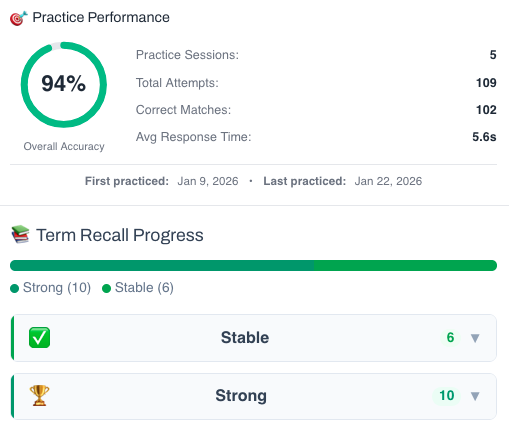
This isn’t a simple quiz — it’s a fully tracked learning system. You build knowledge through recognition, then recall, and your progress feeds directly into the Integrated Practice Bar (Writing tasks, AI Chat, and more).
- Practice sessions, accuracy, and response-time tracking
- Term strength levels (Learning → Stable → Strong)
- Personal progress history for each unit
This feature is available to YSP members.
Explore Membership BenefitsMember-Exclusive Practice Bar
Access a wide range of integrated practice for this unit — from Vocabulary and Grammar activities to AI-curated Writing tasks and Thematic Chat practice.
This feature is available to YSP members.
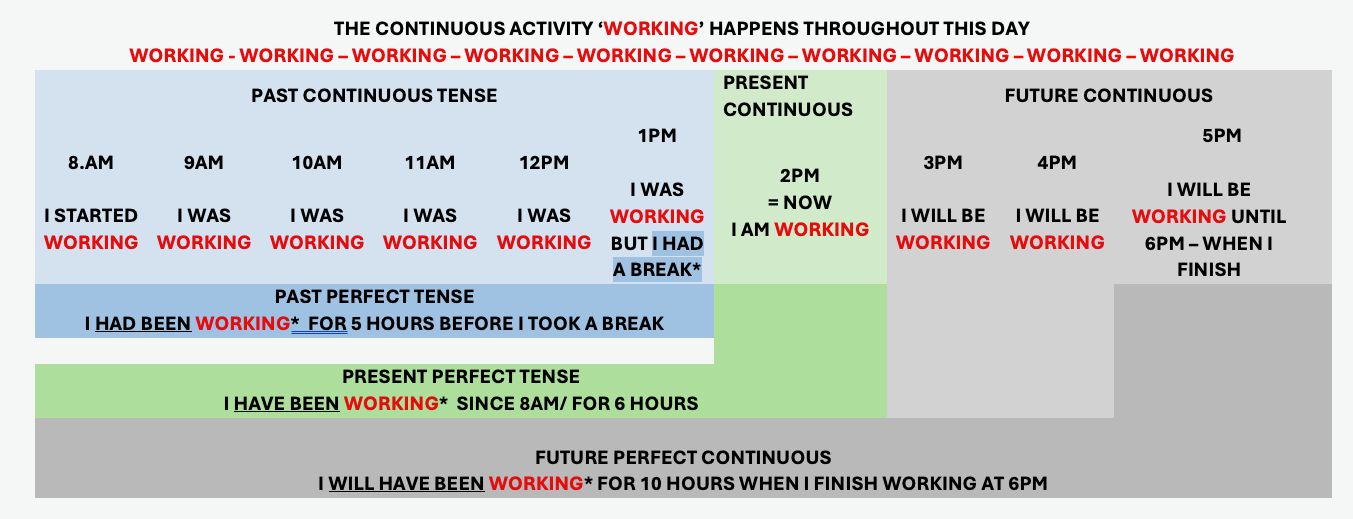
Explore Membership BenefitsStudy the image. Notice how the continuous verb ‘working‘ tells us nothing about WHEN, i.e. the ‘time’ element, it just indicates ‘activity in progress’. The auxiliary verbs, ‘was/am/will be/have been/had been & will have been‘ give us the information about time