Module code: 908

📚 The Novelist

Module image

The Novelist: Narrative Tenses

🎧 Emma's Novel – Chapter 2

📖 The Novel That Wouldn’t Come – Part Two: The Bookshop Discovery (B1/B2)

Emma walked through the rain to the bookshop on the corner. She had been working too hard, and she needed a break. As she opened the door, she noticed something she had never seen before: a small reading room at the back of the shop.

Emma walked through the rain to the bookshop on the corner. She had been working too hard, and she needed a break. As she opened the door, she noticed something she had never seen before: a small reading room at the back of the shop.

The room was quiet and warm. Three people were sitting at a long wooden table. They were writing in notebooks. Emma recognized one of them. It was Michael, her old colleague from the newspaper. She had not seen him since she had quit her job in January.

Michael looked up and smiled. He explained that the bookshop had started a writers’ group three months ago. Writers met there every Tuesday afternoon. They used to meet in a café, but the café had closed. Michael asked if Emma wanted to join them.

Emma sat down at the table. She felt nervous at first. She had been working alone for so long. She had forgotten what it was like to write near other people. But slowly, she began to relax. The other writers were working quietly. Nobody was talking. The only sound was rain falling on the windows.

Michael told Emma about his current project. He had been writing a collection of short stories. He had been working on it for eight months. He had already finished twelve stories, but he still needed to write three more. Emma felt surprised. She had thought that Michael used to write only journalism. She had never known that he wrote fiction too.

One of the other writers introduced herself. Her name was Lisa. She had been coming to the group since it had started. She explained that she used to feel exactly like Emma. She used to work alone at home. She used to feel stuck and frustrated. But everything had changed when she had joined the group. Now she was writing every day.

Emma opened her laptop and looked at her novel. She had been staring at the same three pages all morning. But now, in this quiet room, the words started to come. She wrote a new paragraph. Then she wrote another one. The other writers were working around her. She could hear their fingers typing on keyboards. She could hear pages turning. The sounds were comforting.

After an hour, Emma had written two full pages. She felt amazed. At home, she had been sitting at her desk for six hours, but she had only written three pages. Here, in just one hour, she had written almost as much. She realized something important. She had been pushing herself too hard. She had been expecting perfection. But writing was not about perfection. It was about showing up and doing the work.

Michael suggested that they take a short break. The group went downstairs to the café area of the bookshop. Emma bought a coffee and a sandwich. She had not eaten lunch, and she was hungry. The writers talked about their projects. They shared their problems and their successes. Emma felt happy. She had been living like a prisoner in her apartment. She had not been seeing anyone. She had forgotten that other writers struggled too.

Lisa told Emma about a writing challenge the group had done last month. Each writer had to write a complete short story in one week. Lisa had been worried that she could not do it. She had never written a story so quickly before. But she had managed to finish it. The deadline had helped her. She had stopped worrying about making everything perfect.

Emma thought about what Lisa had said. She had been planning her novel for two years before she had started writing it. She had created detailed character profiles. She had drawn maps. She had written outlines. But maybe all that planning had been a problem. Maybe she needed to write more freely. Maybe she needed to discover the story as she wrote it.

When the break ended, Emma went back upstairs to the reading room. She opened a new document on her laptop. She started writing a short story. She had been working on her novel for months, but perhaps she needed a break from it. The short story was about a woman who visited a bookshop in the rain. The words came easily. Emma smiled. She was writing again. She had found her way back.

Grammar Investigation

Answer each question to reveal the grammar explanation:

Emma walked through the rain to the bookshop on the corner.

In the sentence ‘Emma walked through the rain to the bookshop on the corner’, why do we use Past Simple?

As she opened the door, she noticed something she had never seen before: a small reading room at the back of the shop.

Why do we use Past Perfect in ‘she noticed something she had never seen before’?

She had been working too hard, and she needed a break.

Why does the story say ‘She had been working too hard’ and not ‘She had worked too hard’?

Three people were sitting at a long wooden table.

In the sentence ‘Three people were sitting at a long wooden table’, the Past Continuous is used to…

They used to meet in a café, but the café had closed.

What does ‘used to’ show in ‘They used to meet in a café, but the café had closed’?

📚 Grammar Reference

PAST SIMPLE

Structure: regular verbs: base + -ed; irregular verbs: specific past forms

Pattern: subject + past form of verb

What it expresses: Completed actions and events in the past that happened at a specific time

When to use: For main narrative events in sequence; for actions that started and finished in the past

Why this form: Creates the backbone of past narratives, showing what happened step by step

Examples in story: 18

PAST PERFECT SIMPLE

Structure: had + past participle

Pattern: subject + had + past participle

What it expresses: An action completed before another past action or before a specific past time

When to use: To show which of two past actions happened first; to give background information about what happened before the main story time

Why this form: Creates clear time relationships in past narratives, showing ‘the earlier past’

Examples in story: 14

PAST PERFECT CONTINUOUS

Structure: had been + present participle (-ing)

Pattern: subject + had been + verb-ing

What it expresses: An ongoing action or state that continued for a period of time before a past moment; emphasizes duration and the continuous nature

When to use: To show how long something had been happening before a past point; to emphasize the ongoing nature of a past action

Why this form: Focuses on the duration and continuity of an action up to a past reference point

Examples in story: 14

PAST CONTINUOUS

Structure: was/were + present participle (-ing)

Pattern: subject + was/were + verb-ing

What it expresses: An action in progress at a specific moment in the past; background actions and descriptions in narratives

When to use: For actions happening at a specific past moment; for background/scene-setting in stories; for interrupted actions

Why this form: Creates atmosphere and shows what was in progress when something else happened

Examples in story: 12

USED TO

Structure: used to + base verb

Pattern: subject + used to + base verb

What it expresses: Past habits or states that are no longer true; emphasizes the contrast between past and present

When to use: For repeated actions or states in the past that have changed; when emphasizing ‘this was true before, but not now’

Why this form: Specifically shows discontinuity between past and present situations

Examples in story: 10

🧩 1. VAS
Vocabulary Acquisition System
🎯 Main event Vocabulary Acquisition System Build recognition and recall using Matching & Recall practice modes

Use the VAS to build solid recognition and recall of the terms below.

✔ Every correct Match = +1 point
✔ Every correct Recall = +2 points

🎓 Reach 5 points with good accuracy and the term is automatically promoted to your Personal Dictionary.

Incorrect answers lower accuracy, meaning more correct Matches or Recalls may be needed to reach promotion.

🔒

Member-Exclusive Vocabulary Review & Acquisition System
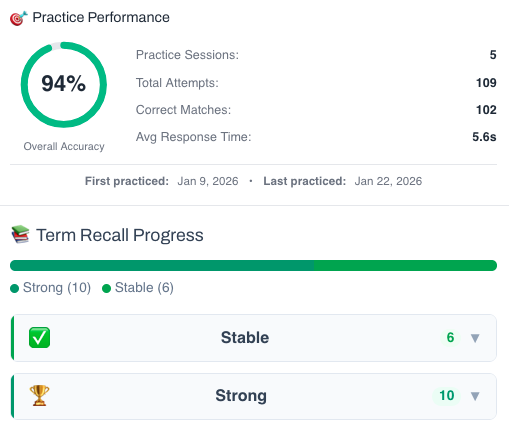
Vocabulary practice stats and progress dashboard preview

This isn’t a simple quiz — it’s a fully tracked learning system. You build knowledge through recognition, then recall, and your progress feeds directly into the Integrated Practice Bar (Writing tasks, AI Chat, and more).

  • Practice sessions, accuracy, and response-time tracking
  • Term strength levels (Learning → Stable → Strong)
  • Personal progress history for each unit

This feature is available to YSP members.

Explore Membership Benefits