To Happen: The Essential Verb for Events and Occurrences
Core PathWay
1 🎯 Why This Word Is Your Secret Weapon
Imagine you’re late for an important meeting. Your colleague asks why. Do you say “An accident was on the road” or “An accident happened on the road”? The second one sounds natural, and that’s the power of happen.
This verb is your go-to word for describing any event, situation, or occurrence – whether it’s planned or unexpected. Native speakers use it constantly because it works in almost any context: “What happened at work today?” “It just happened” “These things happen.” It’s simple, versatile, and absolutely essential.
Mastering happen transforms your English in three key ways. First, it helps you talk about events naturally without awkward constructions. Second, it’s perfect for asking questions about situations – “What happened?” is one of the most common questions in English. Third, it lets you describe coincidences and surprises smoothly: “It happens that I know her” or “I happened to see him yesterday.”
Whether you’re explaining a delay at work, telling a story to friends, or describing how something turned out, this verb makes your English sound natural and fluent. It’s the difference between sounding like a textbook and sounding like a real person sharing their day.
💬 Dialogue 1: Discussing Weekend Plans Gone Wrong
Two colleagues, Anna and Tom, chatting on Monday morning about their weekend at the office coffee machine
2 🧠 The Full Picture: Meanings That Matter
Meaning 1: To take place or occur (events)
When something happens, it takes place or occurs at a particular time. This is the most common use.
*Example:* “The meeting happened yesterday afternoon.”
*Context note:* Used in all contexts – spoken and written, formal and informal. This is neutral and works everywhere.
Meaning 2: To occur by chance or unexpectedly
Happen often describes things that occur without planning, by accident, or by chance.
*Example:* “I happened to meet an old friend at the café – what a coincidence!”
*Context note:* Very common in spoken English. The pattern “happen to + verb” suggests something wasn’t planned.
Meaning 3: To be the situation or outcome
We use happen to describe what the result or outcome of a situation is.
*Example:* “It happens that we have a free room available tonight.”
*Context note:* Often used with “it happens that…” in more formal or written contexts.
Meaning 4: What occurred (in questions)
In questions, happen asks about events or situations, especially problems.
*Example:* “What happened to your car? It looks damaged.”
*Context note:* “What happened?” is one of the most frequent questions in English – informal and direct.
These meanings connect through the core idea of events occurring. The verb evolved from simply describing any event to specifically highlighting unexpected or chance occurrences. Key expressions include “as it happens” (by the way/coincidentally), “it so happens that” (introducing a relevant fact), and “whatever happens” (regardless of the outcome).
💬 Dialogue 2: Explaining a Work Situation
A project manager, Sarah, is on a video call with a client, Mr. Chen, updating him about a project delay
3 🎬 See It In Action: Real Communication
Professional Context: Explaining a delay
*Setup:* Sarah is updating her team about a project delay during a meeting.
*Utterance:* “Unfortunately, a problem happened with our supplier, so the delivery will be late. These things happen in business, but we’ve found a solution.”
*Why it works:* Happen is perfect here because it’s neutral and professional. It describes the incident without being too dramatic, and “these things happen” is a natural way to acknowledge that problems occur sometimes.
Social Context: Sharing a surprise
*Setup:* Two friends are chatting at a café about their weekend.
*Utterance:* “You won’t believe what happened! I was walking in the park and I happened to see that actor from the TV show we love. It was completely unexpected!”
*Why it works:* “What happened” is the natural way to start telling a story. “Happened to see” shows it was by chance, not planned. This is how native speakers build excitement in casual conversation.
Academic Context: Discussing historical events
*Setup:* Professor Chen is lecturing about historical causes and effects.
*Utterance:* “The revolution didn’t just happen suddenly. It came about because several events happened at the same time – economic problems, political tensions, and social changes.”
*Why it works:* Happen works in formal academic English too. The professor uses it to describe when and how events took place, showing cause and effect clearly.
Creative Use: Expressing possibility
*Setup:* A manager is discussing backup plans with their team.
*Utterance:* “If it happens that the client cancels, we’ll use that time for training instead. Whatever happens, we’ll be prepared.”
*Why it works:* “If it happens that” introduces a possible future situation. This shows happen can express hypothetical events, not just past ones. It’s sophisticated but still clear.
4 ⚠️ Danger Zones & Safe Passages
Error 1: Wrong word order in questions
❌ *”What did happen?”* (in normal questions)
Memory trick: In simple past questions with happen, we don’t need “did” in normal situations. Only use “did” for emphasis: “What DID happen?” (when you’re really surprised).
Error 2: Confusing “happen” and “occur”
❌ *”An accident was happened yesterday.”*
The rule: Never use happen in passive voice. It can’t be “was happened” or “is happened.” The event just happens – it’s not made to happen by someone. Occur is more formal but works the same way.
Error 3: Using the wrong preposition
❌ *”What happened with your phone?”*
Memory trick: Use happen TO when asking about what affected someone or something. Think of it as the event coming TO that person or thing. “What happened with” sounds like you’re asking about a relationship or situation involving the phone, not what went wrong with it.
Register warning: “Happen” is perfectly fine in all situations, but in very formal writing, you might choose “occur” or “take place” instead for variety. However, in speech and normal writing, happen is always appropriate and natural.
5 🔧 Grammar Mechanics & Power Patterns
Pattern 1: happen + to + infinitive (chance events)
This pattern shows something occurred by chance or coincidence.
*Structure:* Subject + happen + to + base verb
*Examples:*
– “I happened to hear their conversation.”
– “Do you happen to know her phone number?”
*Special note:* “Do you happen to…” is a polite way to ask if someone knows something. It’s softer than “Do you know…”
Pattern 2: What happened + to/with (questions about outcomes)
Use this to ask about events or changes, especially problems.
*Structure:* What + happened + to + person/thing
*Examples:*
– “What happened to the old manager? I haven’t seen him.”
– “What’s happening with the new project?”
*Restriction:* Use “to” for asking about someone/something specific. Use “with” when asking about the status or progress of something ongoing.
Pattern 3: It happens that (formal introduction of facts)
This pattern introduces a relevant or coincidental fact.
*Structure:* It happens that + clause
*Examples:*
– “It happens that I’m free this evening, so I can help you.”
– “It just so happens that we’re going to the same conference.”
*Advanced use:* Add “just so” before “happens” to emphasize the coincidence even more.
Pro Tip Box:
💡 Native Speaker Secret: When something goes wrong and you want to sound philosophical about it, say “These things happen” or “It happens.” This phrase shows acceptance and maturity – it’s very common in professional settings when acknowledging problems without blaming anyone. You’ll sound calm and experienced!
6 💡 The Story Behind the Word
The word happen has a fascinating journey that reveals why it feels so natural and flexible today. It comes from the old word “hap,” which meant “luck” or “chance” in Middle English. This is why we still have words like “happy” (originally meaning “lucky”) and “perhaps” (“by chance”).
In the 1300s, “happen” specifically meant “to occur by chance.” Over time, it expanded to describe any event, whether planned or not. This evolution explains why happen still carries a slight sense of randomness – when we say “it happened,” there’s often an implication that we didn’t fully control it.
Interestingly, happen became more common than its formal cousin “occur” precisely because it sounds more natural and human. While “occur” feels scientific and detached, happen connects to our everyday experience of life’s surprises and unexpected moments.
Here’s a memorable fact: “What happened?” is one of the top 50 most frequent questions in spoken English. It appears in movies, TV shows, and conversations millions of times daily. The famous quote “Life is what happens when you’re busy making other plans” (often attributed to John Lennon) captures the word’s essence perfectly.
Takeaway: Every time you use happen, you’re tapping into centuries of English speakers describing life’s events – both the planned and the surprising. It’s a word that acknowledges life’s unpredictability while keeping communication simple and direct.
Use the VAS to build solid recognition and recall of the terms below.
✔ Every correct Match = +1 point
✔ Every correct Recall = +2 points
🎓 Reach 5 points with good accuracy and the term is automatically promoted to your Personal Dictionary.
Incorrect answers lower accuracy, meaning more correct Matches or Recalls may be needed to reach promotion.
Member-Exclusive Vocabulary Review & Acquisition System
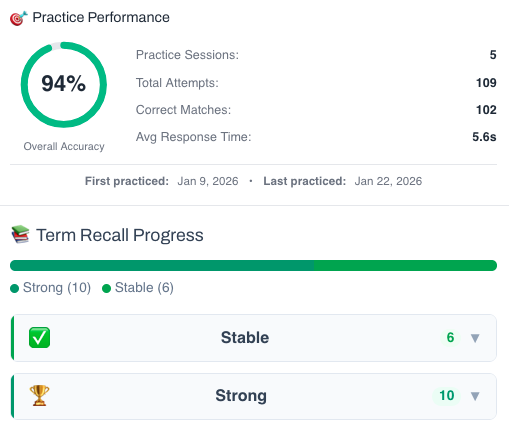
This isn’t a simple quiz — it’s a fully tracked learning system. You build knowledge through recognition, then recall, and your progress feeds directly into the Integrated Practice Bar (Writing tasks, AI Chat, and more).
- Practice sessions, accuracy, and response-time tracking
- Term strength levels (Learning → Stable → Strong)
- Personal progress history for each unit
This feature is available to YSP members.
Explore Membership BenefitsMember-Exclusive Practice Bar
Access a wide range of integrated practice for this unit — from Vocabulary and Grammar activities to AI-curated Writing tasks and Thematic Chat practice.
This feature is available to YSP members.
Explore Membership BenefitsMember-Exclusive Sentence Builder
Reconstruct scrambled sentences to practice word order and develop your grammar intuition.
This feature is available to YSP members.
Explore Membership Benefits