All about Happen (3): Advanced Usage for Near-Native Competence
Core PathWay
1 🌐 Introduction
You already know that happen means ‘to take place or occur’, but native speakers use this word family in remarkably sophisticated ways. They soften requests with ‘should you happen to’, create suspense in stories with ‘it just so happens’, and offer comfort with ‘these things happen’. Mastering these advanced patterns transforms your English from functionally correct to genuinely fluent. This lesson explores how happen functions in formal hedging, narrative discovery, idiomatic commentary, and strategic contexts—plus when to replace it with formal alternatives like occur or transpire. Understanding this semantic field is fundamental because these expressions appear constantly in professional emails, storytelling, and everyday evaluation of events.
💬 Dialogue 1: Professional Request
Emma and James are colleagues working on quarterly financial reports. Emma needs information urgently, and they exchange polite professional emails that gradually turn into an instant messaging conversation.
2 📋 Lexical Categories
POLITE HEDGING & FORMAL CONDITIONALS
These expressions add politeness or contingency to formal speech and writing. They make requests less direct and acknowledge uncertainty.
Should you happen to = if by chance you (very formal way to make a polite request)
*Should you happen to see Maria, could you ask her to call me?*
If you happen to = if by chance you (polite conditional, less formal than ‘should’)
*If you happen to be in the area, please drop by for coffee.*
Happen to know = do you by any chance know (softens a direct question)
*Do you happen to know what time the meeting starts?*
If anything should happen to me = if something bad occurs to me (formal expression for planning contingencies)
*If anything should happen to me, my sister will take care of the children.*
In the event that something happens = if something occurs (very formal conditional)
*In the event that the flight is cancelled, we’ll provide accommodation.*
Should the need happen to arise = if the need comes up by chance (extremely formal)
*Should the need happen to arise, we have backup generators available.*
Contingency = a future event that might happen but is not certain
*We need a contingency plan in case the weather turns bad.*
Hedge = to avoid giving a direct answer or making a firm commitment
*He hedged when I asked if he’d support the proposal.*
Soften a request = to make a request sound less direct or demanding
*Using ‘could you possibly’ softens a request more than ‘can you’.*
NARRATIVE & DISCOVERY USAGE
These expressions describe coincidence or unexpected discovery in storytelling and reflective narration.
Happen upon = to find or discover something by chance
*I happened upon a beautiful antique shop while walking through the old town.*
As it happens = actually, by coincidence (introduces surprising information)
*I was planning to call you—as it happens, I need your advice on something.*
It just so happens (that) = by a remarkable coincidence (emphasizes the surprising nature)
*It just so happens that I went to university with your brother.*
As often happens = as frequently occurs, as is typical (reflects on patterns)
*As often happens with new technology, the early versions had problems.*
It so happened that = by chance, it occurred that (narrative past tense)
*It so happened that we both arrived at exactly the same moment.*
Coincidence = when two things happen at the same time by chance, not because they are connected
*What a coincidence—I was just thinking about you when you called!*
By coincidence = by chance, not planned
*By coincidence, we both wore the same colour dress to the party.*
A fortunate coincidence = a lucky chance occurrence
*Meeting him at the conference was a fortunate coincidence for my career.*
A lucky coincidence = a chance event that brings good fortune
*It was a lucky coincidence that the doctor was there when she collapsed.*
Discovery = the act of finding something unexpected or previously unknown
*The discovery of the old letters revealed family secrets.*
Stumble across = to find something unexpectedly while doing something else
*I stumbled across some old photos while cleaning the attic.*
IDIOMATIC COMMENTARY
These expressions evaluate events rather than simply describe them. Speakers use them to offer perspective or comfort.
These things happen = unfortunate events occur in life (used to comfort or accept)
*I’m sorry you didn’t get the job, but these things happen.*
It happens to the best of us = even very capable people make this mistake (reassuring)
*Don’t worry about forgetting the appointment—it happens to the best of us.*
Whatever happens = regardless of what occurs in the future (expressing determination)
*Whatever happens, I’ll always support you.*
It’s bound to happen = it will definitely occur at some point (expressing certainty)
*If you keep driving so fast, an accident is bound to happen.*
An accident waiting to happen = a dangerous situation that will inevitably cause problems
*That loose stair is an accident waiting to happen—someone will trip.*
What’s done is done = you cannot change the past, so accept it
*I know you regret it, but what’s done is done.*
That’s life = this is how things are, we must accept it
*Sometimes plans don’t work out—that’s life.*
Evaluate an event = to judge or assess what happened
*We need time to evaluate the event before making any decisions.*
Offer perspective = to provide a different way of looking at a situation
*Let me offer some perspective—this setback might actually help you in the long run.*
STRATEGIC OR AGENCY USE
These expressions contrast passive events with deliberate action, showing human control versus waiting.
Make it happen = to take action to ensure something occurs (showing agency)
*If you want to change careers, you need to make it happen yourself.*
Wait for it to happen = to remain passive and hope something occurs naturally
*You can’t just wait for opportunities to happen—you have to create them.*
Nothing happened = no event or change occurred (often expressing disappointment)
*I reported the problem weeks ago, but nothing happened.*
Force the issue = to take action to make something happen rather than waiting
*After months of delays, we decided to force the issue by setting a deadline.*
Take the initiative = to be the first to take action without waiting for others
*Don’t wait to be asked—take the initiative and volunteer.*
Passive event = something that happens without anyone causing it deliberately
*The tree falling was a passive event—no one made it happen.*
Deliberate action = something done intentionally and with planning
*His apology was a deliberate action to repair the relationship.*
Agency = the power or ability to take action and make things happen
*The training programme gives employees more agency over their development.*
FORMAL ALTERNATIVES TO ‘HAPPEN’
These verbs replace happen in academic, professional, or narrative contexts where more formal register is required.
Occur = to happen, especially of specific events (more formal than ‘happen’)
*The accident occurred at approximately 3:15 p.m.*
Transpire = to happen or become known, especially gradually (very formal, sometimes literary)
*It later transpired that the document had been forged.*
Take place = to happen at a particular time or location (neutral formal)
*The ceremony will take place in the main hall.*
Come about = to happen or develop, especially of situations (slightly formal)
*How did this misunderstanding come about?*
Arise = to happen or start to exist, especially of problems or opportunities (formal)
*Several complications arose during the negotiations.*
Ensue = to happen as a result of something (formal, literary)
*A heated debate ensued after his controversial statement.*
Unfold = to develop or happen gradually (slightly formal, often narrative)
*We watched the drama unfold over several weeks.*
Register = the level of formality in language (formal, informal, academic, etc.)
*Academic writing requires a formal register.*
Formal alternative = a more formal word or phrase that can replace a common one
*’Purchase’ is a formal alternative to ‘buy’.*
Narrative context = the storytelling situation where language is used
*In narrative contexts, ‘transpire’ sounds more literary than ‘happen’.*
Happenstance = chance or coincidence (formal, literary noun)
*By pure happenstance, they met again twenty years later.*
By happenstance = by chance (formal adverbial phrase)
*I discovered the error by happenstance while reviewing old files.*
💬 Dialogue 2: Comforting a Friend
Lisa and Rachel are close friends meeting for lunch. Lisa has just missed an important work deadline and is feeling anxious about the consequences. Rachel tries to put things in perspective and offer emotional support.
3 🔗 Common Collocations & Idioms
It’s bound to happen = something will definitely occur eventually, it’s inevitable
*If you never back up your files, you’re bound to lose important data one day.*
An accident waiting to happen = a dangerous situation that will inevitably cause harm or problems
*Storing chemicals next to the heater is an accident waiting to happen.*
As luck would have it = by good or bad fortune, as chance determined (similar to ‘as it happens’)
*I forgot my wallet, but as luck would have it, my friend offered to pay.*
Out of happenstance = purely by chance, through coincidence (very formal/literary)
*Out of happenstance, the two researchers made the same discovery simultaneously.*
Come what may = whatever happens in the future, regardless of difficulties (similar to ‘whatever happens’)
*We’ve committed to this project, and we’ll see it through come what may.*
In the event of = if something happens (formal, often in instructions or policies)
*In the event of a fire, please use the emergency exits.*
💬 Dialogue 3: Telling a Story
Tom and Sarah are flatmates catching up over dinner. Tom has just returned from an afternoon walk and is excited to share an unexpected discovery he made in their neighborhood. Sarah is curious and asks questions about his adventure.
Start your response like this: Dear readers, You’ll never guess what happened to me yesterday…
4 👀 Grammar Spotlight
Advanced happen expressions often involve specific grammatical structures. Formal conditionals with inversion use ‘should’ at the start: ‘Should you happen to see him’ instead of ‘If you should happen to see him’—this creates a very polite, formal tone. *Should the situation happen to change, please inform me immediately.* Perfect aspects combine with happen to show timing: ‘What has happened?’ (present perfect for recent events), ‘What had happened before we arrived?’ (past perfect for earlier events). *It has happened several times this month.* Modal verbs express probability: ‘It’s bound to happen’ (certain), ‘It might happen’ (possible), ‘It could happen’ (potential). *This was bound to happen sooner or later.* The causative ‘make’ shows agency: ‘make it happen’ versus passive ‘let it happen’. *We need to make things happen rather than waiting for them to happen naturally.*
5 😊 Expressive Range
Mastering this rich vocabulary transforms your ability to navigate different social and professional contexts with confidence. When you hedge a request with ‘should you happen to’, you demonstrate cultural awareness and politeness that native speakers immediately recognize. Using as it happens or it just so happens in conversation adds narrative colour and creates engaging stories. Idiomatic expressions like these things happen and it happens to the best of us allow you to offer genuine comfort naturally. Distinguishing between make it happen and wait for it to happen shows sophisticated understanding of agency and strategy. Finally, knowing when to replace ‘happen’ with formal alternatives like occur, transpire, or take place enables you to adjust your register appropriately for academic writing, professional reports, or literary contexts. This expressive range marks the difference between intermediate competence and advanced fluency.
Use the VAS to build solid recognition and recall of the terms below.
✔ Every correct Match = +1 point
✔ Every correct Recall = +2 points
🎓 Reach 5 points with good accuracy and the term is automatically promoted to your Personal Dictionary.
Incorrect answers lower accuracy, meaning more correct Matches or Recalls may be needed to reach promotion.
Member-Exclusive Vocabulary Review & Acquisition System
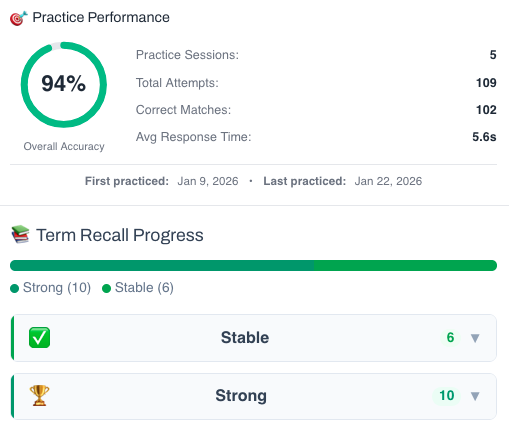
This isn’t a simple quiz — it’s a fully tracked learning system. You build knowledge through recognition, then recall, and your progress feeds directly into the Integrated Practice Bar (Writing tasks, AI Chat, and more).
- Practice sessions, accuracy, and response-time tracking
- Term strength levels (Learning → Stable → Strong)
- Personal progress history for each unit
This feature is available to YSP members.
Explore Membership BenefitsMember-Exclusive Practice Bar
Access a wide range of integrated practice for this unit — from Vocabulary and Grammar activities to AI-curated Writing tasks and Thematic Chat practice.
This feature is available to YSP members.
Explore Membership BenefitsMember-Exclusive Sentence Builder
Reconstruct scrambled sentences to practice word order and develop your grammar intuition.
This feature is available to YSP members.
Explore Membership Benefits