Present Perfect Simple with For & Since: Talking About Duration
Core PathWay
1 From Two Sentences to One: Building the Duration Form
You have already studied Present Perfect Simple. You know it works with open time periods that include now. You know it announces news and talks about life experience. Now we add something new: duration.
Look at these two sentences: I moved to this house 5 years ago. That sentence uses Past Simple. It marks the start of the situation. Now look at this: I still live here. That sentence uses Present Simple. It says the situation is true now. We can join these two ideas into one sentence: I have lived here for 5 years. This is Present Perfect Simple — duration form.
This form tells us how long a situation or state exists. The Colosseum in Rome exists today. It is not new. How do we talk about its lifespan? We say: The Colosseum has stood in Rome for 2,000 years. The building started in the past. It still stands now. We use Present Perfect Simple to show the duration — the time from past to present.
This is different from the Present Perfect you studied before. I have visited Rome means life experience — maybe you went once, maybe five times, maybe last year, maybe ten years ago. But I have lived in Rome for three years means something continuing right now. The first sentence talks about completed experience. The second sentence talks about ongoing duration. This difference is critical.
Key Terms
2 Grammar Overview: For, Since, and the Duration Meaning
Present Perfect Simple for duration shows situations and states that started in the past and are still true now. This is a completely different use from the Present Perfect you have already studied.
Compare these two sentences carefully: I have been married means life experience — you got married at some point in your life. The marriage might be finished now or it might continue. We don’t know. But I have been married for 5 years means the marriage started 5 years ago and continues now. The first sentence is about experience. The second sentence is about duration. This difference changes everything.
Focus
- Use have/has + past participle + for/since to show duration from past to present
- FOR answers 'how long?' — use it with periods of time (for 10 years, for three months, for a week)
- SINCE answers 'from when?' — use it with starting points (since 2020, since January, since Monday, since 10 minutes ago)
- The situation or state must still be true NOW — if it finished, use Past Simple instead
Rules
- FOR + period of time: for 10 years, for six months, for three weeks, for a few days, for ages
- SINCE + point in time: since 2020, since last January, since Monday, since 9 o'clock, since I was a child
- SINCE + time + ago: since 10 minutes ago, since three days ago, since a week ago (this is standard English)
- If the situation finished, do NOT use Present Perfect: ✗ I have lived there for 5 years (but I moved away in 2022)
Examples
- She has worked at the company for 15 years. (She still works there now.)
- They have known each other since university. (They still know each other now.)
- I have had this laptop since 2021. (I still have it now.)
- We have been in this meeting for two hours. (The meeting is still happening.)
- He has lived in three countries. (Life experience — no duration word.)
- He has lived in Japan for five years. (Duration — he lives there now.)
Common mistake
3 State Verbs and the Simple Form
Why do we say I have had this car for 5 years and not I have been having this car for 5 years? The answer is simple: state verbs do not usually have an -ing form for duration.
State verbs describe situations, not actions. They include: have (possession), know, believe, own, belong, understand, seem, need, want, love, hate, and many others. These verbs describe states that exist. They do not describe actions that happen. When you talk about duration with state verbs, use Present Perfect Simple, not Present Perfect Continuous.
Some action verbs can also use Present Perfect Simple for duration, especially when the time period is long. The verbs live, work, and study are good examples. You can say I have lived here for 10 years or I have been living here for 10 years. Both are correct. When the time period is very long, native speakers often prefer the Simple form because the situation feels more like a permanent state than a temporary action. You will study Present Perfect Continuous for duration on the next page. For now, focus on the Simple form with state verbs and long-term situations.
4 Jordan's Career Journey
Jordan Chen sat in the interview room and smiled. ‘Tell me about your career so far,’ the interviewer said.
‘Well, I graduated from university in 2015,’ Jordan began. ‘I studied business and marketing. After that, I worked for a small advertising agency in Toronto for two years. It was a great first job, but I wanted to move into tech.’
The interviewer nodded. ‘And when did you join your current company?’
‘I joined DataFlow in 2018,’ Jordan said. ‘So I have worked there for six years now. I started as a junior marketing manager, but I have been the head of digital marketing since 2021. It has been an amazing experience.’
‘What about your technical skills?’ the interviewer asked.
‘I have known how to use analytics platforms since my first job,’ Jordan explained. ‘But I have learned Python and data visualisation since I joined DataFlow. I have completed three professional certifications in the last two years.’
The interviewer looked impressed. ‘And why do you want to leave?’
Jordan paused. ‘I don’t want to leave because there is a problem. I have had wonderful opportunities at DataFlow. But I have been ready for a bigger challenge for a while now. Your company works on projects I have always wanted to be part of. That is why I am here today.’
Jordan left the interview feeling confident. The company called back the next day with an offer.
5 Practice: Your Professional Journey
Now write about your own work or study situation. Use Present Perfect Simple with for and since to describe ongoing situations, and Past Simple to describe when things started.
6 Recap: Duration from Past to Present
You have learned a new use of Present Perfect Simple. This form shows duration — situations and states that started in the past and continue now.
Remember the key difference: I have been married (life experience) is completely different from I have been married for 10 years (ongoing duration). The first sentence talks about something you have experienced. The second sentence tells us how long a current situation exists.
Use for with periods of time (for 10 years, for three months, for a week). Use since with starting points (since 2020, since Monday, since 10 minutes ago). If the situation finished, use Past Simple instead: I worked there for five years (but I don’t work there now).
State verbs (have, know, own, believe) always use the Simple form for duration. Some action verbs like live, work, and study can also use Present Perfect Simple, especially for long time periods. You will study Present Perfect Continuous for duration next.
This structure is essential for talking about your current job, your current home, your current relationships, and any situation that continues from the past into the present. Master it, and you can describe your life accurately and naturally.
Member-Exclusive Practice Bar
Access a wide range of integrated practice for this unit — from Vocabulary and Grammar activities to AI-curated Writing tasks and Thematic Chat practice.
This feature is available to YSP members.
Explore Membership BenefitsMember-Exclusive Vocabulary Review & Acquisition System
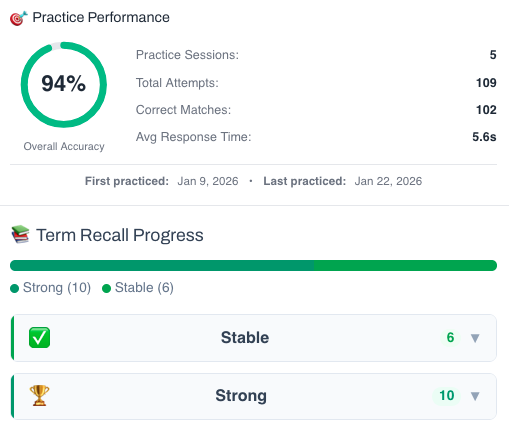
This isn’t a simple quiz — it’s a fully tracked learning system. You build knowledge through recognition, then recall, and your progress feeds directly into the Integrated Practice Bar (Writing tasks, AI Chat, and more).
- Practice sessions, accuracy, and response-time tracking
- Term strength levels (Learning → Stable → Strong)
- Personal progress history for each unit
This feature is available to YSP members.
Explore Membership Benefits🎮 Practice Games
Sentence Scrambler
Present Perfect Simple – For & Since – Sentence Scramble
Member-Exclusive Sentence Builder
Reconstruct scrambled sentences to practice word order and develop your grammar intuition.
This feature is available to YSP members.
Explore Membership Benefits