How to Learn at A2 Level: Your Learning Journey
Core PathWay
1 You at A2 Level: What Can You Do?
You are at A2 level. This is band 3.0, or about 130 points. What does this mean?
You can do many things well now. You can talk about your daily life. You can describe your work, your family, and your plans. You can write simple emails. You can understand clear, slow English. You can read short texts about familiar topics. These are real skills!
But you also have problems. Grammar sometimes stops you. You know present simple and past simple, but other tenses are difficult. You forget to use ‘the’ or ‘a’ correctly. Word order confuses you sometimes. You want to say something, but the grammar stops you.
Vocabulary is your biggest problem. You know many words, but not enough. You read a text and see too many new words. You want to say something, but you don’t know the word. You learn a new word today, but you forget it next week. This happens to all A2 learners. You need to learn more words, and you need to remember them.
You also make mistakes with pronunciation. You can speak, but people sometimes don’t understand you. You don’t hear the difference between some sounds. When people speak fast, you can’t follow.
Does this sound like you? Good! You are in the right place. This page will help you learn better.
2 How to Learn Grammar at A2
Grammar is important at A2. You need to practise grammar every week. But how?
First, decide: one long session or short sessions? Some learners study grammar for one hour every Sunday. Other learners study for 15 minutes every day. What is better?
Short sessions are better! Your brain remembers more when you study a little bit every day. One hour once a week is less effective than 15 minutes four times a week. This is called spaced practice. It works because your brain needs time between practice sessions.
Here is a good plan: Study grammar for 15-20 minutes, four times a week. Monday, Tuesday, Thursday, Friday. This is only 60-80 minutes total, but it works much better than one 60-minute session.
Next, use different activities. Don’t just read grammar rules. That’s boring, and you forget quickly. Do this instead:
Read the grammar rule. Look at examples. This takes 5 minutes.
Listen to sentences with the grammar. Use the audio modules on YouSpeakPlus. Listen and read at the same time. This takes 5 minutes.
Write your own sentences. Use the grammar you just learned. Write 5-10 sentences. This takes 5-10 minutes.
This is multi-sensory learning. You read, you listen, you write. Your brain learns from three different ways. This creates stronger memory.
Finally, do the MCQ Practice Sets on YouSpeakPlus. These test your grammar. When you make a mistake, you see why. This helps you learn from errors. Do 10-15 questions after each grammar session.
Remember: little and often! Four short sessions beat one long session every time.
Key Terms
3 How to Learn Vocabulary and Remember It
Vocabulary is the most important thing at A2. You need more words. But learning words is not enough. You must remember them.
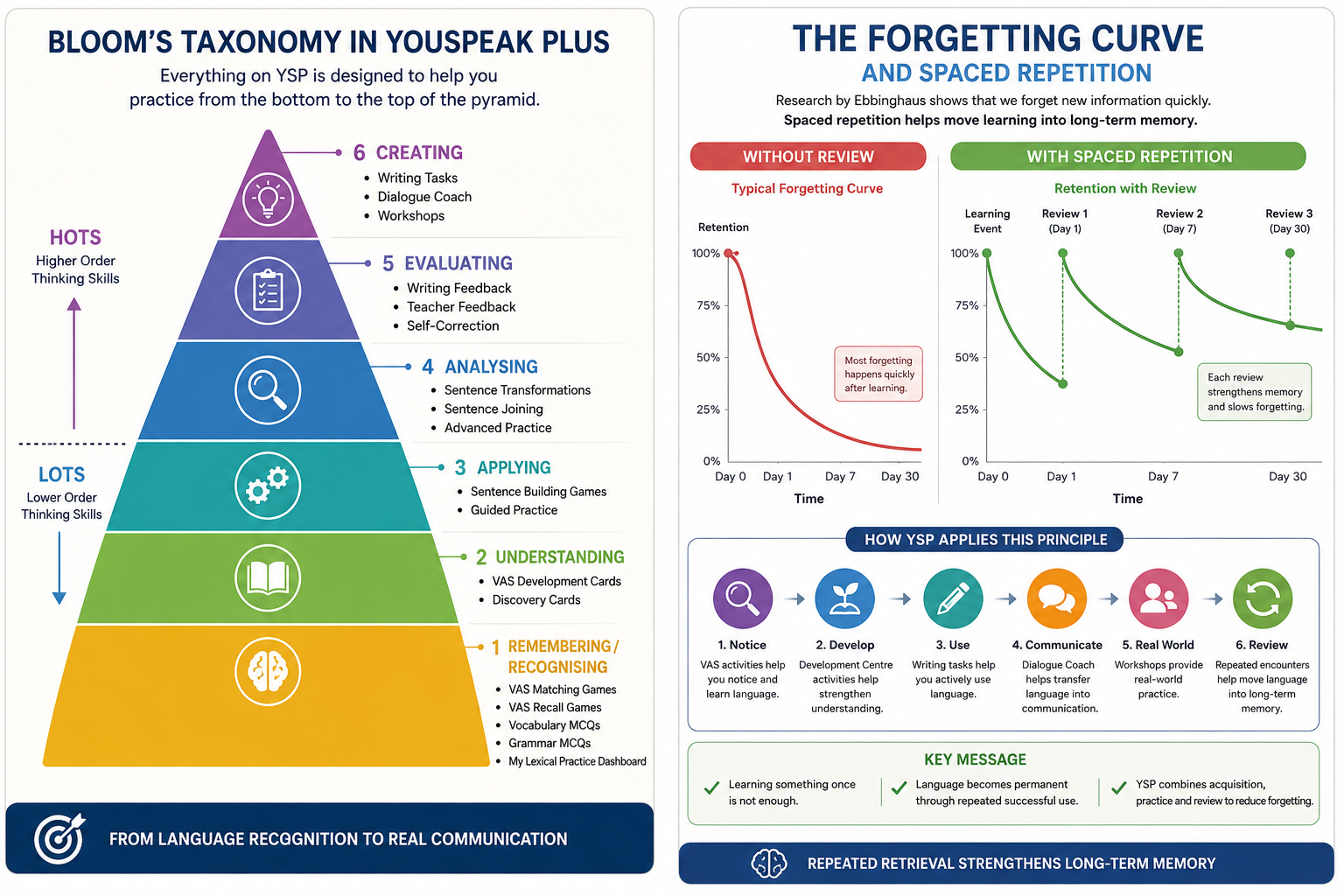
There is a big problem: you forget! A German scientist called Hermann Ebbinghaus studied this in 1885. He found the forgetting curve. This shows that we forget very fast.
Here is what happens: You learn 20 new words today. Tomorrow, you remember 12 words. After one week, you remember only 5 words. After one month, you remember 2 words. This is normal! Your brain forgets.
So how can you remember? The answer is spaced repetition. This means you practise the same words again and again, with time between each practice.
Here is how it works: You learn 20 new words on Monday. You practise them again on Tuesday. You practise them again on Thursday. You practise them again next Monday. Each time, you remember more. After 4-5 practice sessions, the words stay in your long-term memory. Now you know them!
The YouSpeakPlus VAS (Vocabulary Acquisition System) does this for you. When you study a content page, the vocabulary goes into your VAS. The system shows you each word at the right time. Words you know well appear less often. Words you forget appear more often. The system uses spaced repetition automatically.
But you must do more than just see the words. You must retrieve them. This means you must remember the word without help. The VAS has three games:
Matching Game: Match the word to the meaning. Fast! This tests if you recognise the word.
Cloze Tasks: Complete the sentence with the missing word. This is harder. You must produce the word.
Sinking Ship: See the meaning, write the word letter by letter. This is the hardest! You must remember the whole word and spell it correctly.
Do all three games. Don’t just do the easy one! The hard games make stronger memory.
Also use multi-modal learning for vocabulary. This means: read the word, listen to the word, use the word. When you study vocabulary on YouSpeakPlus, you see the word in a sentence (read), you can hear it in audio modules (listen), and you can write it in VAS writing tasks (use). Three ways = strong memory.
Finally, practise vocabulary every day. Just 10 minutes. The VAS Dashboard shows all your vocabulary from all modules. Go there every day. Do 20-30 words. This daily practice stops the forgetting curve.
Remember: Learning words is easy. Remembering words is hard. Use spaced repetition, retrieval practice, and multi-modal learning. Then you will remember!
Key Terms
4 Why Writing Helps You Learn
Many learners don’t like writing. They think: ‘I want to speak English, not write it!’ But writing is one of the best ways to learn. Why?
First, writing uses muscle memory. When you write a word by hand or type it, your hand remembers. Your fingers remember the movements. This creates a physical memory, not just a mental memory. Later, when you need the word, your hand helps your brain remember it.
Second, writing is multi-modal. When you write, you think about the word (mental), you say it in your head (audio), and you write it (physical). Three types of memory work together. This makes very strong memory.
Third, writing makes you slow down. When you speak, you speak fast. You don’t have time to think about grammar. But when you write, you think carefully. You check: Is this grammar correct? Is this word correct? This careful thinking helps you learn.
Fourth, writing shows you your mistakes. When you do writing tasks on YouSpeakPlus, you get AI evaluation. The system shows you exactly what is wrong. You learn from your errors. This is called corrective feedback. Research shows this is very powerful for learning.
So use writing as a learning tool! Here is what to do:
After you study a grammar point, write 5-10 sentences using that grammar. Use the grammar-practice writing tasks on YouSpeakPlus.
After you learn new vocabulary, write sentences with those words. Use the VAS writing tasks. This moves words from passive knowledge (you recognise them) to active knowledge (you can use them).
Write a short paragraph every day about your life. Use the freestyle writing tasks. Don’t worry about mistakes. Just write! This builds fluency.
Keep a learning journal. Every Friday, write: What did I learn this week? What was difficult? What do I want to practise next week? This is metacognitive practice – thinking about your own learning. It helps you learn better.
Remember: writing is not just for exams. Writing is a powerful learning tool. Use it every week!
5 Learning Story: From A2 to C1
Maria and Chen sat in the office kitchen during their break. Maria was new to the company. She was studying English at A2 level. Chen was her manager. His English was C1 now, but he remembered being A2 five years ago.
‘How did you improve so much?’ Maria asked. ‘Your English is amazing now!’
Chen smiled. ‘Thanks! But it was hard work. When I was A2, I made a lot of mistakes. I studied grammar for hours, but I forgot everything. I learned vocabulary, but I couldn’t remember the words.’
‘That’s my problem too!’ Maria said. ‘I study, but I forget.’
‘Yes, exactly,’ Chen said. ‘Then I changed my method. I learned about spaced repetition. I stopped studying for two hours on Sunday. I started studying for 20 minutes every day instead. That was the first big change.’
‘Every day?’ Maria asked.
‘Yes. Every single day. Monday to Friday, 20 minutes of grammar or vocabulary. I used the VAS system here on YouSpeakPlus. The system showed me the same words again and again, but with time between. After two weeks, I could remember the words! Before, I forgot them after two days.’
Maria was listening carefully. ‘What else did you do?’
‘I wrote a lot,’ Chen said. ‘I did the writing tasks after every lesson. I wrote sentences with the new grammar. I wrote sentences with the new vocabulary. At first, I made many mistakes. But the AI feedback showed me my errors. I learned from them.’
‘And speaking?’ Maria asked. ‘How did you improve your speaking?’
‘I practiced speaking about specific topics with my tutor,’ Chen said. ‘I thought about what I wanted to say on the classroom topics the evening before, I made a list of my words and some grammar points I needed to clarify. At first, it was very difficult. But after three months, I could speak more easily. The important thing was: I practised a little bit every day. Not a lot once a week. A little bit every day.’
Maria smiled. ‘So the secret is: study every day, use spaced repetition, write a lot, and practise speaking regularly?’
‘Exactly!’ Chen said. ‘And be patient. It took me two years to get to B2. Then another year to get to C1. But every week, I could see my progress. That motivated me to continue.’
Maria felt motivated now too. ‘I’m going to start today,’ she said. ‘Twenty minutes every day!’
6 Your Learning Plan: What to Do Now
You now know what works. You know about spaced practice, spaced repetition, multi-modal learning, and writing. But what should you do?
Here is a simple plan:
Every day (Monday to Friday): Study for 20 minutes. Choose grammar OR vocabulary each day. Monday and Wednesday: grammar. Tuesday and Thursday: vocabulary. Friday: review.
Use the VAS: Go to your VAS Dashboard every day. Practise 20-30 words. Do different games. Don’t just do the easy game!
Write three times a week: After grammar study, write sentences. After vocabulary study, write sentences. Use the writing tasks on YouSpeakPlus.
Listen to English every day: Use the audio modules. Listen while you read. This is multi-sensory learning.
Speak once a week in class, but always rehearse what you want to say before class!
Review on Sunday: Look at what you learned this week. Write in your learning journal: What was easy? What was difficult? What do I need to practise more?
This plan takes about 2 hours per week. But it is much more effective than studying for 2 hours on Sunday!
Remember: You are A2 now. This is good! You can already do many things. Now you need to build your vocabulary, strengthen your grammar, and practise every day. Use spaced repetition. Use multi-modal learning. Write to learn. Be patient.
Your English will improve. You will see progress every week. Good luck!
Member-Exclusive Practice Bar
Access a wide range of integrated practice for this unit — from Vocabulary and Grammar activities to AI-curated Writing tasks and Thematic Chat practice.
This feature is available to YSP members.
Explore Membership Benefits
Member-Exclusive Vocabulary Review & Acquisition System
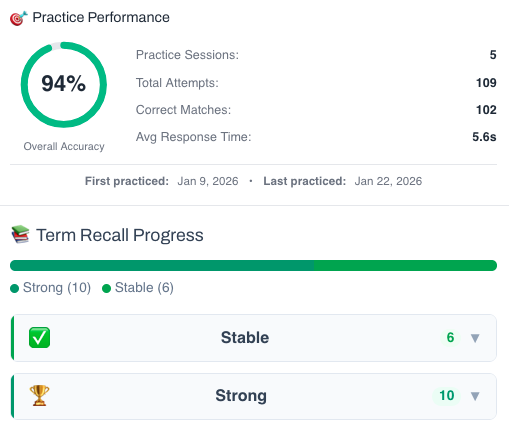
This isn’t a simple quiz — it’s a fully tracked learning system. You build knowledge through recognition, then recall, and your progress feeds directly into the Integrated Practice Bar (Writing tasks, AI Chat, and more).
- Practice sessions, accuracy, and response-time tracking
- Term strength levels (Learning → Stable → Strong)
- Personal progress history for each unit
This feature is available to YSP members.
Explore Membership Benefits🎮 Practice Games
Sentence Scrambler
How to learn at A2 level – Sentence Scramble
Member-Exclusive Sentence Builder
Reconstruct scrambled sentences to practice word order and develop your grammar intuition.
This feature is available to YSP members.
Explore Membership Benefits