How to Learn Again: A Fresh Start for B2 and Low C1 Learners
Core PathWay
1 Your English Profile: Where You Stand
You’ve studied English for years — maybe at school, in courses, or through your work — and somewhere along the way you reached a level where English actually works for you. You can read an article, follow a meeting, write a professional email. But speaking still catches you off guard. You know the word; it just vanishes when you need it. You reach for challenging and say difficult. You know exactly what you want to say; getting it out quickly and naturally is the problem.
Maybe you understand a film but lose a fast conversation. You know many grammar rules well — and then say the wrong thing anyway. This isn’t a knowledge problem. Your English is bigger than it feels from the inside.
At B2 and low C1, you’re in what’s called the independent user band. You can handle most everyday and professional situations without major breakdowns. You’ve probably had significant exposure to English at work — emails, presentations, international calls. But here’s the thing: exposure alone doesn’t fix errors that have become fossilised (stuck in place, repeated so often they feel correct). You might overuse will for future plans when going to or the present continuous would sound more natural. You might avoid the passive because it still feels awkward, even though you understand it perfectly well when you read it.
Do you still need to study? Yes. Not to learn English from scratch, but to consolidate what you know, eliminate the errors that have settled in, and extend your range into more nuanced, flexible language. Think of it as upgrading from a solid foundation to a polished, confident performance.
2 The Grammar Profile: Consolidation and Nuance
At your level, grammar isn’t about learning new rules from a textbook. You already know the core structures. The challenge now is twofold: first, rooting out the small, persistent errors that have become automatic; second, adding natural nuance — the subtle shifts in meaning that native speakers make without thinking.
English grammar can feel messy at this level because, honestly, it is. For every rule, there’s an exception. You know you should say I wish I had known, but in casual speech you hear I wish I knew used for past regrets too. You’ve learned that despite takes a noun, but then you encounter despite the fact that with a full clause. This isn’t you getting it wrong — this is English being English.
So how do you keep improving? Little and often beats long and rarely. Spend 15–20 minutes three or four times a week on focused grammar practice rather than cramming an hour once a week. Your brain consolidates learning during rest periods between study sessions, so spacing your practice out actually makes it stick better.
Use the MCQ Practice Sets on YouSpeakPlus to target specific structures where you know you’re shaky — conditionals, passives, reporting verbs, whatever trips you up. Read the rationale feedback carefully when you get something wrong; that’s where the learning happens. Then — and this is crucial — use the Writing Tasks to produce those structures yourself. Recognising correct grammar in a multiple-choice question is one thing; generating it under pressure is another. Write short paragraphs using your target structure, get the AI feedback, and write again. That’s how accuracy becomes automatic.
3 Words, Words, and More Words: Building Your Lexical House
Here’s a truth that might surprise you: communication happens through lexis (vocabulary), not grammar. Grammar is the mortar that holds the house together, but words are the bricks. Without lexis, there is no house.
At B2 and low C1, you probably have quite good lexical breadth — you know a lot of words. But that knowledge might be concentrated in familiar territory: your job, your hobbies, everyday routines. Step outside that comfort zone and suddenly you’re hunting for words. Phrasal verbs are still tricky; you understand put up with and come across when you hear them, but you don’t use them naturally in your own speech. Idioms remain an issue — you get the general sense, but you’re not confident enough to deploy them yourself.
The good news: you don’t need to learn vocabulary in isolation anymore. That’s a beginner strategy. At your level, learn lexis in topic clusters. If you’re working on ‘negotiation vocabulary,’ learn compromise, concession, deadlock, reach an agreement, and walk away from a deal together, because that’s how they live in real communication. They keep each other company.
Use multi-modal learning — this is essential. Don’t just read a new term. Listen to it in the Audio Modules so you know how it actually sounds. Write it in a sentence in a VAS Writing Task so your hand learns the spelling. Say it out loud — yes, even if you’re alone — so your mouth learns the shape. Then repeat it. Not once. Many times, across several days.
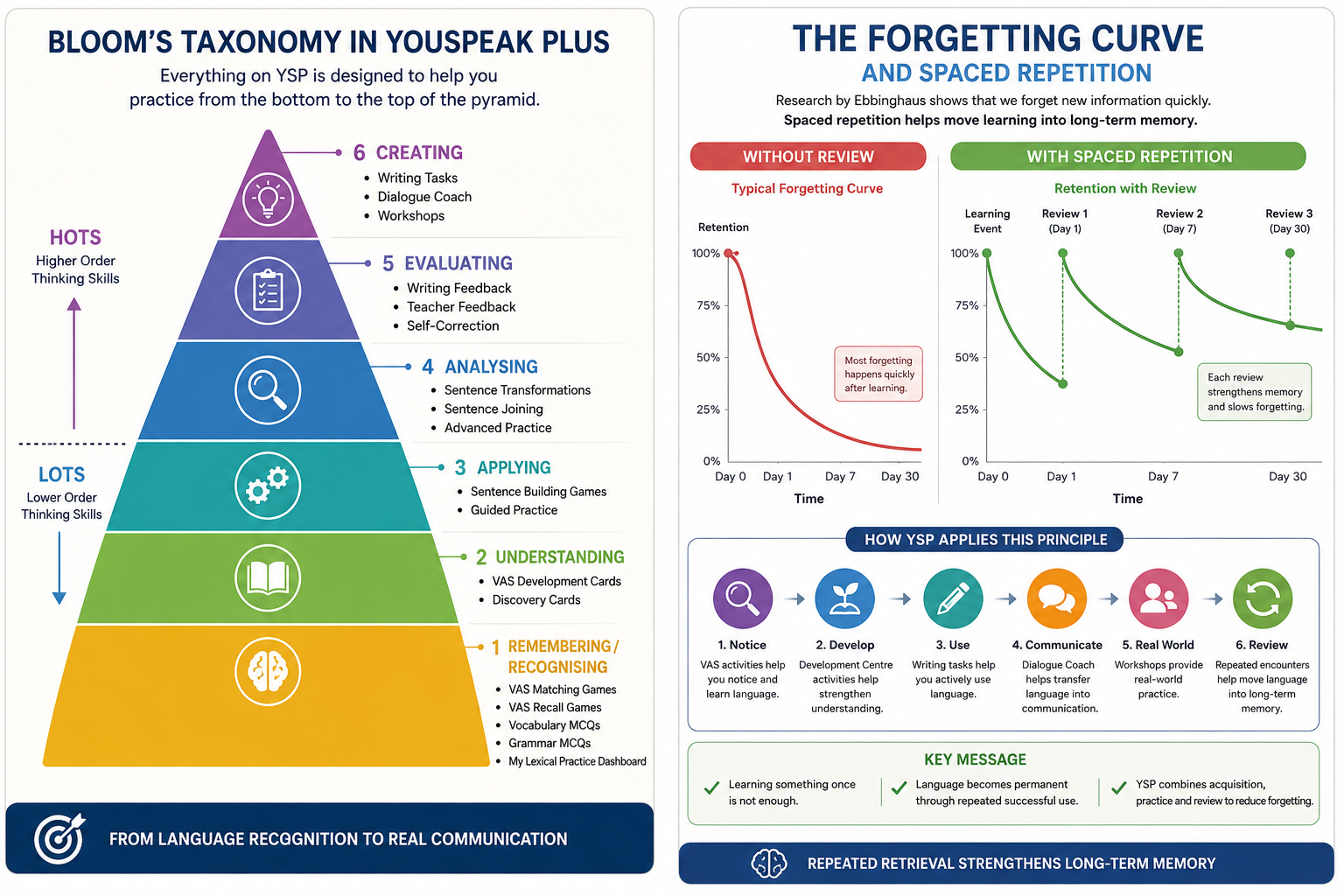
Why? Because there’s something called the forgetting curve. You meet a new word today and feel like you know it. Tomorrow, you’ve lost 50% of that memory. By next week, it’s nearly gone unless you’ve revisited it. This is where spaced repetition comes in. The VAS (Vocabulary Acquisition System) on YouSpeakPlus is built exactly for this. It surfaces words at expanding intervals — day 1, day 3, day 7 — so you rehearse them just as your brain is about to forget. That’s what turns a word you recognise into a word you can actually use under pressure.
Play the VAS games: the Matching Game for speed, the Cloze Tasks for production, the Sinking Ship for deep recall. The system tracks which words you’re struggling with and brings them back sooner. Your job is to trust the process and keep practising across multiple sessions. Lexical acquisition at this level isn’t about cramming 100 words in a weekend. It’s about embedding 15–20 high-value terms so deeply that they become automatic.
4 Writing to Learn, Not Learning to Write
Here’s a shift in perspective that can transform your study: writing things down isn’t just about producing a text. It’s a learning tool. When you write, you’re not ‘learning to write’ — you’re writing in order to learn.
Why does this work? Because writing forces you to retrieve language from memory, make choices about structure and vocabulary, and rehearse the thought processes you’ll need when speaking. It’s slower than speaking, which is actually an advantage: you have time to notice what you’re doing, catch your own errors, and refine your output before you hit ‘submit.’
There’s also a physical component. Writing creates muscle memory. Your hand learns the spelling of necessary or accommodation through repetition in a way that reading alone never achieves. Your brain encodes the information more deeply when your body is involved.
And here’s the connection that many learners miss: writing helps speaking. When you write out an argument, a description, or a narrative, you’re rehearsing the vocabulary and structures you’ll need when it’s time to speak. You’re building fluency in slow motion. This is why people write speeches before they deliver them — to refine the ideas, lock in the key phrases, and rehearse the flow. Then, when it’s time to produce the language live, it’s already partially automatic.
So when you see a Writing Task on YouSpeakPlus, don’t think of it as a test of your writing ability. Think of it as a rehearsal for everything else. Write your paragraph. Get the AI feedback. Notice what you got wrong. Write again. That’s the cycle. Every time you complete that loop, you’re strengthening the neural pathways that make language production — speaking and writing — faster and more accurate.
5 Learning-to-Learn Q&A: Your Questions Answered
Jordan, learning consultant, sits with a small group of returning B2 learners in a quiet study room. They’ve just finished reviewing their language profiles.
Sam: I feel like I know so much English, but when I try to speak, it all disappears. Why does that happen?
Jordan: Because knowing and retrieving under pressure are two completely different skills. Reading activates recognition memory — you see the word and think, ‘Yes, I know that.’ Speaking requires recall — you have to pull the word out of nowhere, fast. The gap between those two is normal. Close it by practising retrieval: use the VAS games, do speaking tasks, write without looking things up first. Make your brain work to find the word. That’s what builds recall strength.
Alex: I’ve been using the same words for years. How do I actually expand my range?
Jordan: Stop learning words in isolation. Learn them in topic sets and collocations. If you learn make a decision, also learn reach a decision, reverse a decision, postpone a decision. They’re a family. Use the Vocabulary Discovery Mode in Claude Chat — pick a topic and have a conversation that forces you to use new terms in context. Then log those terms in your VAS and rehearse them over the next week. Range comes from repeated encounters in varied contexts, not from memorising lists.
Chris: How often should I actually study? I’m busy.
Jordan: Little and often. Fifteen minutes four times a week beats two hours on Sunday. Your brain consolidates learning between sessions, so spacing works better than cramming. Do a quick VAS session Monday morning, a writing task Wednesday evening, some MCQs Friday, and a Claude chat Saturday. That’s four short sessions. Sustainable, effective, and it fits around work.
Taylor: I keep making the same grammar mistakes. Will I ever stop?
Jordan: Yes, but not by just noticing them. You need to unlearn the wrong pattern and overwrite it with the correct one. Write sentences using the correct structure. Do it ten times. Then do it again next week. Use the Writing Tasks with AI feedback so you’re catching errors in real time. The mistake is fossilised because you’ve repeated it hundreds of times. You need hundreds of correct repetitions to replace it. It takes time, but it absolutely works.
Morgan: I don’t understand why writing helps speaking. They feel totally different.
Jordan: Writing is rehearsal for speaking. When you write, you’re working out what you want to say, choosing your words, structuring your argument — all the things you need to do when speaking, but at a slower pace. It’s like musicians practising scales slowly before playing fast. The vocabulary and structures you use in writing become more readily available when you speak. That’s why people write speeches. Try this: before your next meeting in English, write three sentences summarising your main point. You’ll find those sentences come out much more smoothly when you speak.
Sam: One last thing — I feel like I’m forgetting everything I learn. Is that normal?
Jordan: Completely normal. It’s called the forgetting curve. You forget about 50% of new information within a day unless you revisit it. That’s why spaced repetition is so powerful. The VAS brings words back just before you forget them — day 1, day 3, day 7. Each time you retrieve the word successfully, the memory gets stronger and lasts longer. So don’t panic when you forget. Just make sure you’re using a system that brings the information back at the right intervals. That’s what turns short-term exposure into long-term acquisition.
6 Recap: Your Learning-to-Learn Toolkit
You’ve seen your profile: you’re an independent user with solid foundations but some gaps to fill. You know now that grammar at this level is about consolidation and nuance, not learning from scratch. You understand that lexis is the real engine of communication, and that multi-modal learning — reading, listening, writing, speaking, and spaced repetition — is what makes vocabulary stick.
You’ve learned that writing isn’t just about producing text; it’s a rehearsal tool that strengthens everything, including speaking. And you’ve heard from other learners just like you: the path forward is little and often, targeted practice, and trusting the process of retrieval and repetition.
Your English is bigger than it feels. Now you have the strategies to make it feel as big as it actually is.
Member-Exclusive Practice Bar
Access a wide range of integrated practice for this unit — from Vocabulary and Grammar activities to AI-curated Writing tasks and Thematic Chat practice.
This feature is available to YSP members.
Explore Membership Benefits
Member-Exclusive Vocabulary Review & Acquisition System
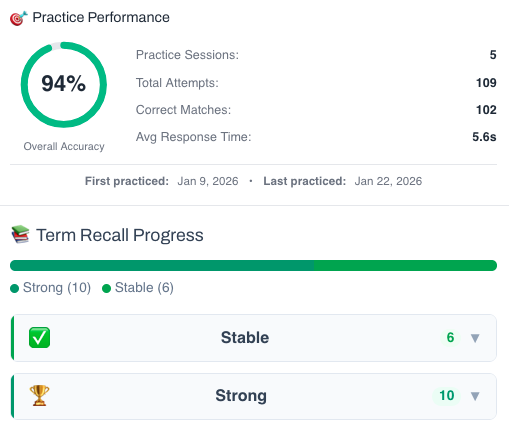
This isn’t a simple quiz — it’s a fully tracked learning system. You build knowledge through recognition, then recall, and your progress feeds directly into the Integrated Practice Bar (Writing tasks, AI Chat, and more).
- Practice sessions, accuracy, and response-time tracking
- Term strength levels (Learning → Stable → Strong)
- Personal progress history for each unit
This feature is available to YSP members.
Explore Membership Benefits🎮 Practice Games
Sentence Scrambler
How to learn again at B2 and low C1 levels – Sentence Scramble
Member-Exclusive Sentence Builder
Reconstruct scrambled sentences to practice word order and develop your grammar intuition.
This feature is available to YSP members.
Explore Membership Benefits