Essential Terms for Corporate Lawyers [Pack 1]
Core PathWay
1 Section 1. Contracts and Agreements: The Foundation
Let’s get you fluent in the language of corporate law. Every legal relationship starts with a contract. This is a legally binding agreement between two or more parties. When we say “binding,” we mean that the law can force people to do what they promised. A party is not a celebration here—it’s a person or organization that enters into a legal agreement or transaction. So if Company A and Company B sign a contract, they are the two parties. Inside every contract, you’ll find a clause. This is a separate section or provision within a legal document or contract. Each clause deals with one specific topic or rule. For example, one clause might explain payment terms, and another might explain delivery dates. A contract also needs consideration. In other words, something of value that is given in exchange for a promise or performance in a contract. This could be money, services, or goods. Without consideration, a contract usually isn’t valid. These four terms—contract, party, clause, and consideration—are the building blocks of every legal agreement.
2 Section 2. When Things Go Wrong: Breach, Liability, and Protection
Sometimes one party doesn’t do what they promised. This is called a breach. A breach is an act of breaking the terms of a law, agreement, or contract. If you breach a contract, the other party can take legal action. When someone breaches a contract, they usually face liability. Liability means legal responsibility for something, especially for paying money that is owed or for damage or injury. If you cause a problem, you are liable—you must fix it or pay for it. To protect against liability, companies often use a special promise. They agree to indemnify the other party. To indemnify means to protect someone against legal responsibility for loss or damage by agreeing to pay compensation. This is like insurance inside a contract. Companies also include a warranty in contracts. A warranty is a written promise in a contract that something is true or that something will be done. For example, a seller might warrant that a product works correctly. A representation is similar—it’s a formal statement of fact made by one party to induce another party to enter into a contract. If a representation is false, the other party might cancel the contract. These terms help parties manage risk and responsibility.
3 Section 3. Rules, Authority, and Compliance
Corporate lawyers must know where and how laws apply. Jurisdiction is the official power or authority to make legal decisions and judgments, or the area where this power applies. For example, a contract might say that English law has jurisdiction. This means English courts will decide any disputes. Companies must comply with laws and rules. To comply means to act according to an order, set of rules, or request. If you don’t comply, you can face penalties. Lawyers help companies enforce their rights. To enforce means to make sure that a law or rule is obeyed, or to make something happen by using legal authority. For example, if someone breaks a contract, you might enforce it by going to court. Companies also protect their ideas and creations. Intellectual property refers to legal rights over creations of the mind, such as inventions, designs, brands, and artistic works. This includes patents, trademarks, and copyrights. Before signing a contract, companies must share certain information. Disclosure is the act of making information known or providing documents, especially information that must be revealed by law. Honest disclosure builds trust. Some information must stay private, so contracts include confidentiality clauses. Confidentiality is the state of keeping information private and not sharing it with others who are not authorized to know it. These terms keep business dealings legal, fair, and secure.
4 Section 4. Company Structure and Governance
When people start a company, they go through incorporation. Incorporation is the legal process of forming a company or organization as a corporation. After incorporation, the company becomes a separate legal entity. People who own part of a company are called shareholders. A shareholder is a person or organization that owns shares in a company. Shareholders have certain rights, like voting on important decisions. They elect a board of directors. The board of directors is a group of people elected by shareholders to oversee the management of a company. The board makes big decisions and checks that managers are doing their jobs properly. The board can pass a resolution. A resolution is a formal decision made by the board of directors or shareholders of a company. For example, the board might pass a resolution to approve a new strategy. One company can own another company. The owned company is called a subsidiary. A subsidiary is a company that is controlled by another company which owns more than half of its shares. This structure helps large businesses organize their operations. These terms describe how companies are built and managed.
5 Section 5. Business Deals and Changes
Companies often buy or combine with other companies. A merger is the combination of two or more companies into one company. After a merger, the original companies disappear and a new, larger company exists. An acquisition is different—it’s the act of buying or obtaining control of another company or business. In an acquisition, one company buys another, but the buyer usually keeps its own name. Before any deal, the buyer conducts due diligence. Due diligence is the detailed examination and investigation of a business or person before signing a contract or making an investment. Lawyers check finances, contracts, legal problems, and risks. This process protects the buyer from nasty surprises. Sometimes companies need to change a contract. An amendment is a formal change or addition to a legal document or contract. Amendments must be agreed by all parties. Sometimes a contract must end early. To terminate means to bring a contract or agreement to an end, especially before the agreed time. Termination can happen by agreement or because of a breach. These terms cover the major events in a company’s life—deals, changes, and endings.
Member-Exclusive Practice Bar
Access a wide range of integrated practice for this unit — from Vocabulary and Grammar activities to AI-curated Writing tasks and Thematic Chat practice.
This feature is available to YSP members.
Explore Membership BenefitsMember-Exclusive Vocabulary Review & Acquisition System
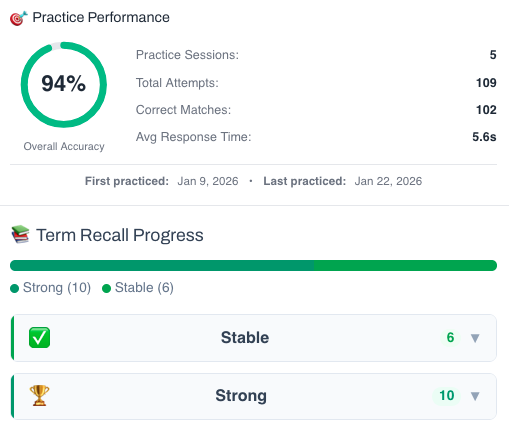
This isn’t a simple quiz — it’s a fully tracked learning system. You build knowledge through recognition, then recall, and your progress feeds directly into the Integrated Practice Bar (Writing tasks, AI Chat, and more).
- Practice sessions, accuracy, and response-time tracking
- Term strength levels (Learning → Stable → Strong)
- Personal progress history for each unit
This feature is available to YSP members.
Explore Membership Benefits🎮 Practice Games
Sentence Scrambler
Essential Terms for Corporate Lawyers [Pack 1] – Sentence Scramble
Member-Exclusive Sentence Builder
Reconstruct scrambled sentences to practice word order and develop your grammar intuition.
This feature is available to YSP members.
Explore Membership Benefits