Procedures Pack 3: Checking, Reporting, and Keeping Records
Core PathWay1 Section 1. The Language of Procedures — Let's Get You Fluent
The language of procedures is the language of getting things right. In professional settings, people need to confirm that information is correct, spot problems early, and keep clear records. This pack gives you the key terms to do all of that. We start with the basics: checking and verifying. When you check something, you look at it carefully to make sure it is correct. This is a very common action in any workplace. When you make sure something is correct, you take responsibility for it — you are not just looking, you are confirming. A step further is to verify something. This means you check it in a more formal or careful way, often using a second source. And when you confirm something, you state clearly that it is true or correct. These four words — check, make sure, verify, confirm — work closely together. They all involve looking carefully at information, but they move from casual to formal. Think of it like a dial: check is everyday, confirm is official.
2 Section 2. Working with Documents and Records
Procedures often involve paperwork or digital files. There is specific language for working with these. When you review the documentation, you read through the relevant papers or files carefully to understand what has happened or what is required. Documentation means the written records that support a process. When you inspect the records, you look at them closely — often to check that everything is in order. Inspect is slightly more formal than review and suggests a careful, official look. Organisations also need to monitor compliance. This means they regularly check that people are following the rules. It is an ongoing action, not a one-time check. Related to this is the need to track progress. This means you follow how something is developing over time — for example, checking whether a task is moving forward as planned. Finally, when you need to compare two sets of information to make sure they match, you cross-check the information. This is a useful habit in any role where accuracy matters.
3 Section 3. Spotting Problems — Errors, Gaps, and Delays
Not everything goes to plan. A key skill in any procedure is noticing when something is wrong. The verb we use most often here is identify. When you identify an error, you find a mistake in the information or process. An error is something that is wrong and needs to be corrected. When you identify a gap, you notice that something is missing. A gap is not a mistake — it is an absence. For example, a gap in the records means some information was never added. When you identify a delay, you notice that something is taking longer than it should. A delay means a process is behind schedule. These three phrases follow the same pattern: identify + the problem. Notice how identify is the key verb in all three. It means you have found the problem and named it clearly — which is always the first step before you can fix it.
4 Section 4. Reporting Problems — Flag, Report, Escalate, Resolve
Finding a problem is only the beginning. You also need to communicate it and deal with it. When you flag an issue, you draw attention to it — often informally or quickly. Flagging is like raising your hand and saying: ‘Something is not right here.’ When you report an issue, you communicate it in a more formal or official way, often in writing. When a problem is serious or cannot be solved at your level, you escalate an issue. This means you pass it to someone with more authority or responsibility. Escalate is an important word in professional settings — it shows that the problem needs a higher level of attention. Once the right person is involved, the goal is to resolve an issue. This means you find a solution and fix the problem completely. And if there was an error in the information or records, you will need to correct an error — in other words, change what was wrong and replace it with the right information. These five verbs describe a journey: flag → report → escalate → resolve → correct.
5 Section 5. Keeping Records and Ensuring Compliance
Once a problem is resolved, the work is not quite finished. You need to record what happened and make sure everything meets the required standards. When you update the record, you add new or corrected information to the existing file or document. This keeps the record accurate and current. To validate the data means to confirm that the information is correct, complete, and acceptable — often by checking it against a standard or rule. When you document the issue, you write down what happened, when, and what was done about it. This is important because it creates a clear history. To provide evidence means to show proof that something happened or was done correctly. Evidence might be a photo, a signed form, or a saved file. When all of these records are kept together in order, they form what is called an audit trail. This is a complete record of actions and decisions that allows someone to look back and understand exactly what happened and when. An audit trail is essential in any regulated or formal process.
6 Section 6. Compliance — Meeting Standards and Avoiding Breaches
The final area of this pack is about compliance — following the rules and standards that an organisation or industry requires. When you ensure compliance, you take active steps to make sure that rules are being followed. Ensure means you do not just hope it happens — you make it happen. A related phrase is to meet compliance standards. This means your work or process reaches the level that is required by the rules. When something does not reach that level, we say it fails to comply. When you fail to comply with a rule or standard, you have not followed it — and this can have serious consequences. The most serious situation is when you breach a procedure. A breach means a clear break or violation of a rule. It is stronger than simply failing to comply — it suggests the rule was broken in a significant way. Finally, to maintain an audit trail means to keep all the records, evidence, and documentation in order over time. Maintain means you keep something in good condition continuously — not just once. Together, these terms describe what it means to work within a system that values accuracy, accountability, and correct process.
Member-Exclusive Practice Bar
Access a wide range of integrated practice for this unit — from Vocabulary and Grammar activities to AI-curated Writing tasks and Thematic Chat practice.
This feature is available to YSP members.
Explore Membership BenefitsMember-Exclusive Vocabulary Review & Acquisition System
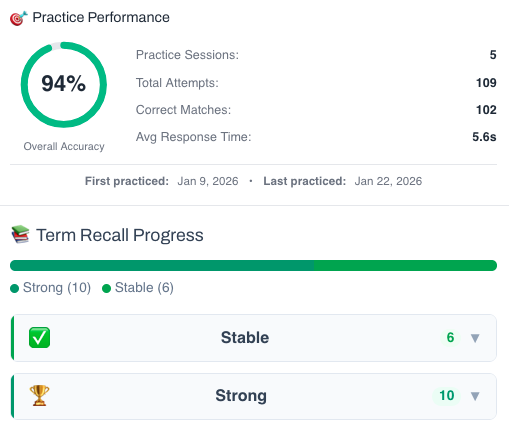
This isn’t a simple quiz — it’s a fully tracked learning system. You build knowledge through recognition, then recall, and your progress feeds directly into the Integrated Practice Bar (Writing tasks, AI Chat, and more).
- Practice sessions, accuracy, and response-time tracking
- Term strength levels (Learning → Stable → Strong)
- Personal progress history for each unit
This feature is available to YSP members.
Explore Membership Benefits