The Language of Procedures: Pack 1
Core PathWay1 Section 1. The Big Picture: Procedures and Processes
Want to talk confidently about procedures at work? It starts with these words.
A procedure is a set of steps that you follow to do something correctly. Think of it as the official way to do a task. At work, people follow procedures every day — when they make a request, handle a complaint, or onboard a new employee.
A process is similar, but it is a wider word. It means the whole series of actions that produces a result. A process might contain several procedures inside it.
A workflow describes how work moves from one person or stage to another. It shows the order of tasks and who is responsible for each one. For example, a document approval workflow might go from the writer to the manager to the director.
These three words are close in meaning, but they are not the same. Here is a simple way to think about it: a process is the full journey, a procedure is the official route, and a workflow is the map that shows who does what and when.
2 Section 2. Steps, Stages, and Phases: Breaking It Down
Big processes are easier to manage when you break them into smaller parts. English has three useful words for this.
A step is one single action in a sequence. Steps are small and specific. For example: ‘Complete the form’ is one step. ‘Submit the form’ is the next step.
A stage is a larger part of a process. A stage usually contains several steps. For example, the ‘application stage’ might include filling in a form, gathering documents, and sending everything to the right department.
A phase is the biggest of the three. A phase is a major period or section of a project or process. For example, a construction project might have a planning phase, a building phase, and a review phase.
So the relationship looks like this: a phase contains stages, and a stage contains steps. Not every process uses all three words, but knowing the difference helps you read and write about procedures with much more precision.
3 Section 3. Rules and Instructions: SOPs, Protocols, and Guidelines
In professional environments, people need clear rules to follow. This section covers the words used for official rules and instructions.
An SOP — which stands for Standard Operating Procedure — is a detailed, written set of instructions for how to carry out a specific task. SOPs are common in industries like healthcare, manufacturing, and finance. They exist so that everyone does the same task in the same way.
A protocol is a formal set of rules for a specific situation. Protocols are often used in medical, scientific, or safety contexts. For example, a hospital has a protocol for dealing with emergencies.
A guideline is a recommendation. It tells you the best way to do something, but it is usually not as strict as a rule. Guidelines give you direction without forcing you to follow every detail exactly.
A policy is an official rule or set of rules made by an organisation. Policies tell employees what they must or must not do. For example, a company might have a policy on working from home or on data privacy.
Finally, a requirement is something that is necessary. If something is a requirement, you must do it — there is no choice. For example, ‘A valid passport is a requirement for this application.’
4 Section 4. Getting Things Done: Instructions, Checklists, and Forms
Now let’s look at the practical tools people use when they follow a procedure.
An instruction tells you exactly what to do. Instructions are usually written as clear, direct commands. For example: ‘Sign the form. Attach a copy of your ID. Submit before Friday.’
A checklist is a list of tasks or items that you check off one by one. Checklists help people make sure they have not missed anything. They are very common in procedures that have many steps.
A form is a document with spaces for you to fill in information. When you apply for something — a job, a visa, a loan — you usually need to complete a form. The form collects the information that the organisation needs.
These three tools work together. The instruction tells you what to do. The checklist helps you track what you have done. The form is where you record the information that is needed.
A quick note on collocations: we ‘complete’ or ‘fill in’ a form — not ‘make’ or ‘write’ a form. And we ‘follow’ instructions — not ‘obey’ them, in most professional contexts.
5 Section 5. Paper Trails: Documents, Records, and Files
Procedures always create paperwork — or digital paperwork. This section covers the words for the things you create, collect, and keep.
A document is any written or digital piece of information. A contract, a report, and a letter are all documents.
Documentation is the word for a collection of documents related to a topic or process. For example: ‘Please provide full documentation for your application.’ Notice that ‘documentation’ is uncountable — we do not say ‘a documentation’.
Supporting documents are the extra documents you attach to prove something. For example, if you apply for a job, your CV is the main document, but copies of your qualifications are supporting documents.
A record is information that is kept because it might be needed in the future. Organisations keep records of decisions, transactions, and communications. We often say ‘keep a record’ or ‘on record’.
A file is a collection of documents about one person, case, or topic. In a digital system, a file might be a folder on a computer. In an office, it might be a physical folder in a cabinet.
Remember: ‘document’, ‘record’, and ‘file’ can all be used as nouns or verbs. For example: ‘Please document your findings.’ / ‘We need to file this application.’ / ‘Record the outcome of the meeting.’
6 Section 6. Making It Official: Applications, Approvals, and Outcomes
The final part of many procedures involves making a formal request and waiting for a decision. Here is the vocabulary you need.
An application is a formal request for something — a job, a permit, a place on a course. You ‘make’ or ‘submit’ an application.
A request is slightly less formal than an application. You can make a request by email, in a meeting, or on a form. We ‘make’ or ‘put in’ a request.
A submission is the act of sending something officially. When you send your completed form or application, that is a submission. We ‘make a submission’ or ‘submit’ documents.
Approval means that someone with authority has agreed to something. Without approval, a process cannot move forward. We ‘give’, ‘receive’, or ‘wait for’ approval.
Authorisation is similar to approval, but it often refers to giving someone permission to do something specific. For example: ‘You need authorisation from your manager before you can access the system.’
An outcome is the result of a process or decision. After a procedure is complete, there is always an outcome — positive or negative. We ‘wait for’, ‘announce’, or ‘review’ an outcome.
Finally, a reference number is a unique number given to your application or request. It helps the organisation track your case. Always keep your reference number — you will need it if you contact them again.
Member-Exclusive Practice Bar
Access a wide range of integrated practice for this unit — from Vocabulary and Grammar activities to AI-curated Writing tasks and Thematic Chat practice.
This feature is available to YSP members.
Explore Membership BenefitsMember-Exclusive Vocabulary Review & Acquisition System
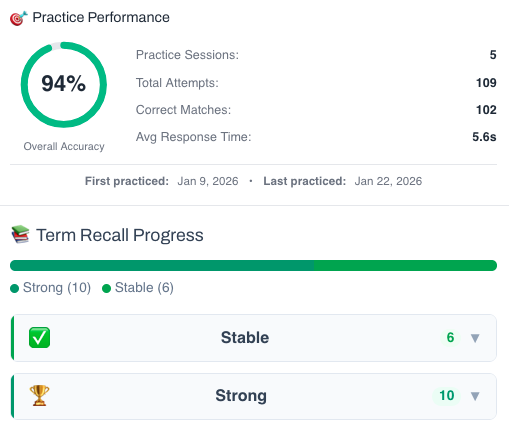
This isn’t a simple quiz — it’s a fully tracked learning system. You build knowledge through recognition, then recall, and your progress feeds directly into the Integrated Practice Bar (Writing tasks, AI Chat, and more).
- Practice sessions, accuracy, and response-time tracking
- Term strength levels (Learning → Stable → Strong)
- Personal progress history for each unit
This feature is available to YSP members.
Explore Membership Benefits