State Verbs – Primer Pack
Core PathWay
1 Section 1. What Are State Verbs?
You’ve decided to explore state verbs — great choice. Let’s dive in. State verbs describe states, not actions. They tell us how things are, what we know, and how we feel. We use them to talk about existence, thoughts, emotions, senses, and more. In this walk-through, you’ll meet all the important state verbs. Let’s start with verbs of being and having.
2 Section 2. Being and Having
First, verbs that talk about being and having. The verb be means to exist. ‘I am a student.’ Have means to own or possess. ‘She has a new phone.’ Own means to legally possess something. ‘They own a house.’ Belong means to be the property of someone. ‘This book belongs to me.’ Contain means to have something inside. ‘The bag contains a gift.’ These verbs are used to describe what something is or what it has.
3 Section 3. Knowing and Thinking
Now verbs for your mind and thoughts. Know means to have information. ‘I know the answer.’ Think means to have an opinion. ‘I think it’s a good idea.’ Believe means to think something is true without proof. ‘I believe you.’ Understand means to know the meaning. ‘Do you understand the question?’ Remember means to keep something in your mind. ‘I remember your birthday.’ Forget means to lose a memory. ‘Don’t forget to call.’ Mean means to have a particular message. ‘What does this word mean?’ These verbs describe what happens in your head.
4 Section 4. Liking and Wanting
Next, verbs about likes and desires. Like means to find something good. ‘I like ice cream.’ Love is a very strong like. ‘I love my dog.’ Hate is a very strong dislike. ‘I hate getting up early.’ Want means to desire something. ‘I want a new bike.’ Need means to feel something is necessary. ‘I need water.’ Prefer means to like one thing more than another. ‘I prefer coffee to tea.’ These verbs express what we feel and want.
5 Section 5. Sensing and Perceiving
Finally, verbs for senses and appearances. See means to notice with eyes. ‘I see a rainbow.’ Hear means to notice sound. ‘I hear birds.’ Smell means to have an odour. ‘This flower smells lovely.’ Taste means to have a flavour. ‘The soup tastes salty.’ Feel means to experience a sensation. ‘I feel cold.’ Look means to appear. ‘You look happy.’ Sound means to give an impression. ‘That sounds fun.’ Seem means to give an impression of being. ‘It seems easy.’ These verbs describe what we perceive and how things appear.
Member-Exclusive Practice Bar
Access a wide range of integrated practice for this unit — from Vocabulary and Grammar activities to AI-curated Writing tasks and Thematic Chat practice.
This feature is available to YSP members.
Explore Membership BenefitsMember-Exclusive Vocabulary Review & Acquisition System
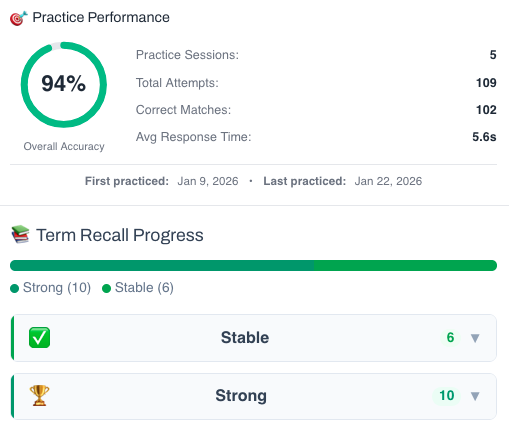
This isn’t a simple quiz — it’s a fully tracked learning system. You build knowledge through recognition, then recall, and your progress feeds directly into the Integrated Practice Bar (Writing tasks, AI Chat, and more).
- Practice sessions, accuracy, and response-time tracking
- Term strength levels (Learning → Stable → Strong)
- Personal progress history for each unit
This feature is available to YSP members.
Explore Membership Benefits🎮 Practice Games
Sentence Scrambler
State Verbs – Primer Pack – Sentence Scramble
Member-Exclusive Sentence Builder
Reconstruct scrambled sentences to practice word order and develop your grammar intuition.
This feature is available to YSP members.
Explore Membership Benefits