Workforce Planning & Management: The Essential Vocabulary
Core PathWay
1 Section 1. How Many People Do We Need?
Want to talk confidently about HR and workforce planning? It starts with these words.
Every organisation needs to decide how many people it employs. This is called headcount planning. It means deciding, in advance, how many people a business needs — and in which roles — over a given period.
But headcount planning is just one part of a bigger picture. Strategic workforce planning (SWP) is the longer-term process of aligning future workforce supply with business strategy. It is broader than a single hiring decision. Think of it as the company’s plan for its people over the next few years.
When companies count their staff, they often use a standard unit called a full-time equivalent (FTE). This converts part-time and full-time hours into a single ‘whole person’ figure. For example, two people who each work half-time count as 1 FTE.
Once you know your FTE numbers, you can calculate your cost per FTE / labour cost. This is the average cost of employing one full-time equivalent member of staff. Companies use this figure to compare efficiency and plan budgets.
Finally, every team needs the right number of people for the work it does. The staffing level / staffing ratio is the number of staff considered appropriate for a team or function — often relative to workload, customers, or students.
2 Section 2. How Is the Organisation Structured?
Now let’s look at how companies organise their people.
The organisational structure / org chart shows the way a company’s roles, teams, and reporting lines are arranged. It is often shown as a visual diagram. If you have ever seen a chart with boxes and lines connecting managers to their teams, that is an org chart.
One important feature of any structure is the span of control. This is the average number of people who report directly to one manager. A manager with ten direct reports has a wide span of control. A manager with three has a narrow one.
Organisations also have organisational layer(s) / layers of management. These are the levels between the most senior leader and the frontline staff. A company with many layers is sometimes called ‘hierarchical’. A company with few layers is often called ‘flat’.
The reporting structure shows the formal lines of who reports to whom. It is closely connected to the org chart, but it focuses specifically on those reporting relationships.
These four concepts — org chart, span of control, layers of management, and reporting structure — work together. They describe how power, responsibility, and communication flow through an organisation.
3 Section 3. Who Stays, Who Leaves, and Why It Matters
Understanding how people move in and out of an organisation is a core HR skill. There are several important terms here.
The attrition rate is the percentage of employees who leave an organisation over a given period, for any reason. The turnover rate is similar — it measures how quickly employees leave and are replaced, usually as a percentage per year.
Not all departures are the same. Voluntary turnover happens when employees leave by their own choice — for example, when someone resigns to take a new job. Involuntary turnover happens when the organisation ends someone’s employment — for example, through redundancy or dismissal.
The opposite of turnover is the retention rate. This is the percentage of employees who stay with the organisation over a given period. A high retention rate is generally a positive sign.
All of these figures are part of workforce analytics — the use of data to understand and improve workforce decisions. Workforce analytics helps HR teams spot problems early. For example, if the attrition rate rises suddenly in one department, the data can help leaders find out why.
These numbers tell a story about the health of an organisation’s workforce.
4 Section 4. The Employee Journey and Talent Planning
Let’s follow the path an employee takes through an organisation.
The employee lifecycle is the full journey an employee goes through — from being hired to eventually leaving the organisation. It includes stages such as recruitment, onboarding, development, and departure.
At some point in this journey, HR and leaders start thinking about the future. Succession planning is the process of identifying and developing employees who could fill key roles in the future. The person identified for a future role is called a successor.
The overall readiness of an organisation’s internal talent is called bench strength. If a company has strong bench strength, it has several capable people ready to step into senior roles. If bench strength is weak, the company may struggle when key people leave.
Some roles are more important than others. A critical role is a position that is essential to the organisation — one whose vacancy would carry significant risk. Critical roles are always prioritised in succession planning.
To assess employees formally, many organisations use a talent review. This is a regular meeting or process where leaders discuss and assess employees’ performance and potential. A common tool used in talent reviews is the 9-box grid, which plots employees on performance versus potential. It helps leaders make succession and development decisions.
Succession planning also uses specific phrases to describe readiness. Ready now / ready in (1-2 years) is standard phrasing that describes how soon a potential successor could take on a role.
5 Section 5. Building a Flexible, Optimised Workforce
The final cluster of terms is about making the workforce as effective as possible.
A skills gap analysis is the process of comparing the skills an organisation currently has against the skills it needs. When there is a difference, that is called a ‘gap’. Identifying gaps helps HR plan training, hiring, or restructuring.
Workforce flexibility is an organisation’s ability to expand, contract, or adapt its workforce quickly in response to changing needs. A flexible workforce can grow when business is strong and reduce when it slows down.
Workforce optimisation takes this further. It means using data and process improvements to get the most effective use out of an existing workforce. The goal is not just to have the right number of people, but to make sure they are working as productively as possible.
All of these activities depend on good data. That is why workforce analytics — introduced in Section 3 — is so central to modern HR. Without data, it is very difficult to plan, optimise, or respond to change.
Taken together, these terms describe a complete approach to managing people strategically. From counting FTEs and drawing org charts, to planning successors and closing skills gaps — this is the language of workforce planning.
Member-Exclusive Practice Bar
Access a wide range of integrated practice for this unit — from Vocabulary and Grammar activities to AI-curated Writing tasks and Thematic Chat practice.
This feature is available to YSP members.
Explore Membership BenefitsMember-Exclusive Vocabulary Review & Acquisition System
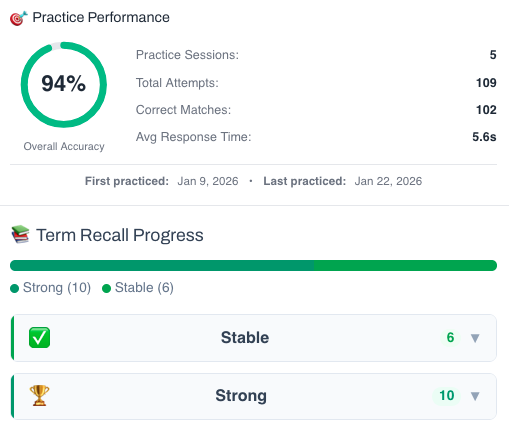
This isn’t a simple quiz — it’s a fully tracked learning system. You build knowledge through recognition, then recall, and your progress feeds directly into the Integrated Practice Bar (Writing tasks, AI Chat, and more).
- Practice sessions, accuracy, and response-time tracking
- Term strength levels (Learning → Stable → Strong)
- Personal progress history for each unit
This feature is available to YSP members.
Explore Membership Benefits