Workforce Planning & Management: Schedules, Attendance, Leave and Absence
Core PathWay
1 Section 1. Schedules and Shifts: Who Works When
Ready to build your vocabulary for workforce planning? Here is where we start.
Every organisation needs to know who is working and when. The document that shows this is called a rota, a roster, or a schedule — these three words mean the same thing. In British English, ‘rota’ is very common. In American English, ‘roster’ or ‘schedule’ are more usual.
When a manager puts someone on the schedule, we say they roster someone on. When they remove someone, they roster someone off. So the verb ‘to roster’ is used with ‘on’ or ‘off’.
Most organisations do not plan shifts one by one. Instead, they use a shift pattern — a fixed, repeating arrangement of working hours. For example, a hospital might use an early/late/night shift pattern so that someone is always on duty.
Sometimes an employee cannot work their assigned shift. If two employees agree to swap their shifts — and a manager approves it — this is called a shift swap. It sounds simple, but most companies have a formal process for approving a shift swap.
All of this planning feeds into workforce management software (WFM) — a specialist digital tool that helps HR teams build schedules, predict staffing needs, and track attendance. Think of it as the engine that keeps the whole scheduling process running.
2 Section 2. Clocking In and Tracking Time
Once the schedule is set, someone needs to check that employees are actually working their hours. This is the job of a time and attendance (system). This is the software or process that records when employees start and finish work each day.
The most common way employees register their hours is by using clock in / clock out. To clock in means to formally record the start of your work period — often by tapping a card, using an app, or pressing a button on a terminal. To clock out means to record the end. These two actions are the foundation of any attendance record.
Unfortunately, not everyone follows this honestly. Buddy punching is when one employee clocks in or out on behalf of a colleague who is not actually there. For example, if Maria is running late, her friend clocks in for her so it looks like she arrived on time. Buddy punching is considered fraud, and many companies use biometric systems — like fingerprint readers — to prevent it.
Good time and attendance data also helps managers see patterns. If someone is regularly late or leaving early, the system will show it. This makes time and attendance tracking an important tool — not just for payroll, but for fairness too.
3 Section 3. Extra Hours: Overtime and TOIL
Sometimes employees work more hours than their contract requires. These extra hours are called overtime. In many organisations, overtime is paid at a higher rate — for example, 1.5 times the normal hourly pay. However, not all overtime is paid.
When an employee works extra hours but receives paid time off instead of extra money, this is called time off in lieu (TOIL). ‘In lieu’ is a formal phrase that means ‘instead of’. So time off in lieu (TOIL) = time off instead of pay. For example, if you work four extra hours on a Saturday, you might take four hours off the following week as TOIL.
Both overtime and time off in lieu (TOIL) need to be carefully tracked. This is another reason why good time and attendance systems are so important — they keep an accurate record of every extra hour worked.
It is worth knowing that overtime and TOIL are different choices an organisation can offer. Some employees prefer the extra money; others prefer the extra time. HR teams often need to manage both options at the same time.
4 Section 4. Leave: Entitlement, Requests and Accrual
Every employee has the right to take time off work. The total amount of paid holiday they are entitled to each year is called their annual leave or leave entitlement. In the UK, for example, most full-time workers have a statutory minimum leave entitlement of 28 days per year.
But how does an employee build up their holiday allowance? This happens through accrual. To accrue leave means that it builds up gradually as you work. For example, if you join a company in July, you will not immediately have 28 days of holiday. You will accrue leave month by month until the end of the leave year.
Once an employee wants to use their annual leave, they need to go through a process. The system or process that handles leave requests, approvals, and tracking is called a leave management (system). A good leave management system makes it easy for employees to request time off and for managers to approve or decline those requests.
All of this connects back to demand forecasting — predicting how much staffing will be needed in a future period. If too many employees take annual leave at the same time, the organisation may not have enough staff to meet demand. Managers use demand forecasting to plan ahead and avoid this problem.
Labour demand is the amount of work that needs to be staffed. Labour capacity is the number of hours that staff can actually provide. When lots of employees are on annual leave, labour capacity drops — and if labour demand stays the same, there is a gap that needs to be managed.
5 Section 5. Absence: Monitoring, Measuring and Managing
Not all time away from work is planned. Absence management is the process of monitoring and managing all employee absence — both planned and unplanned — to keep attendance at a healthy level.
The most common type of unplanned absence is sickness absence — time off work due to illness. When an employee is sick for a short period, they usually complete a self-certification (of sickness) — their own written statement confirming they were ill, without needing a doctor’s note. In the UK, employees can self-certify for up to seven days. After that, a doctor’s note is required.
If an employee is sick for longer, they may receive statutory sick pay (SSP) — the legally required minimum level of pay for employees who are off sick. In the UK, SSP is paid by the employer and is set by the government.
Some absence is not due to illness. Unauthorised absence is time off taken without permission or proper notification. This is more serious than sickness absence and can lead to a formal HR process.
To measure how much absence an organisation has, HR teams calculate the absence rate — the proportion of scheduled working time that is lost to absence, usually shown as a percentage.
One well-known tool for measuring the impact of absence is the Bradford Factor. This formula gives a higher score to employees who have many short absences rather than one long one. The idea is that frequent short absences cause more disruption to a team than a single long period of illness.
When an employee returns after any absence, many organisations hold a return to work interview — a short, informal conversation to check in with the employee and record the reason for their absence. This is a key part of good absence management.
Finally, flexible working, hybrid working, and remote working are all arrangements that can affect absence patterns. Flexible working lets employees vary their hours or work pattern. Hybrid working combines office and remote days. Remote working means working from a location other than the employer’s premises. Research suggests that employees with more flexibility often have lower absence rates — though good absence management remains important whatever the working arrangement.
Member-Exclusive Practice Bar
Access a wide range of integrated practice for this unit — from Vocabulary and Grammar activities to AI-curated Writing tasks and Thematic Chat practice.
This feature is available to YSP members.
Explore Membership BenefitsMember-Exclusive Vocabulary Review & Acquisition System
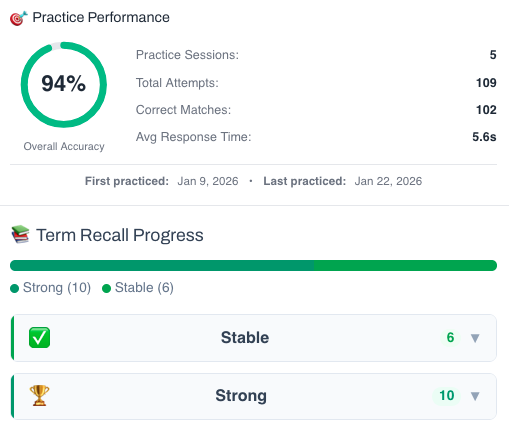
This isn’t a simple quiz — it’s a fully tracked learning system. You build knowledge through recognition, then recall, and your progress feeds directly into the Integrated Practice Bar (Writing tasks, AI Chat, and more).
- Practice sessions, accuracy, and response-time tracking
- Term strength levels (Learning → Stable → Strong)
- Personal progress history for each unit
This feature is available to YSP members.
Explore Membership Benefits