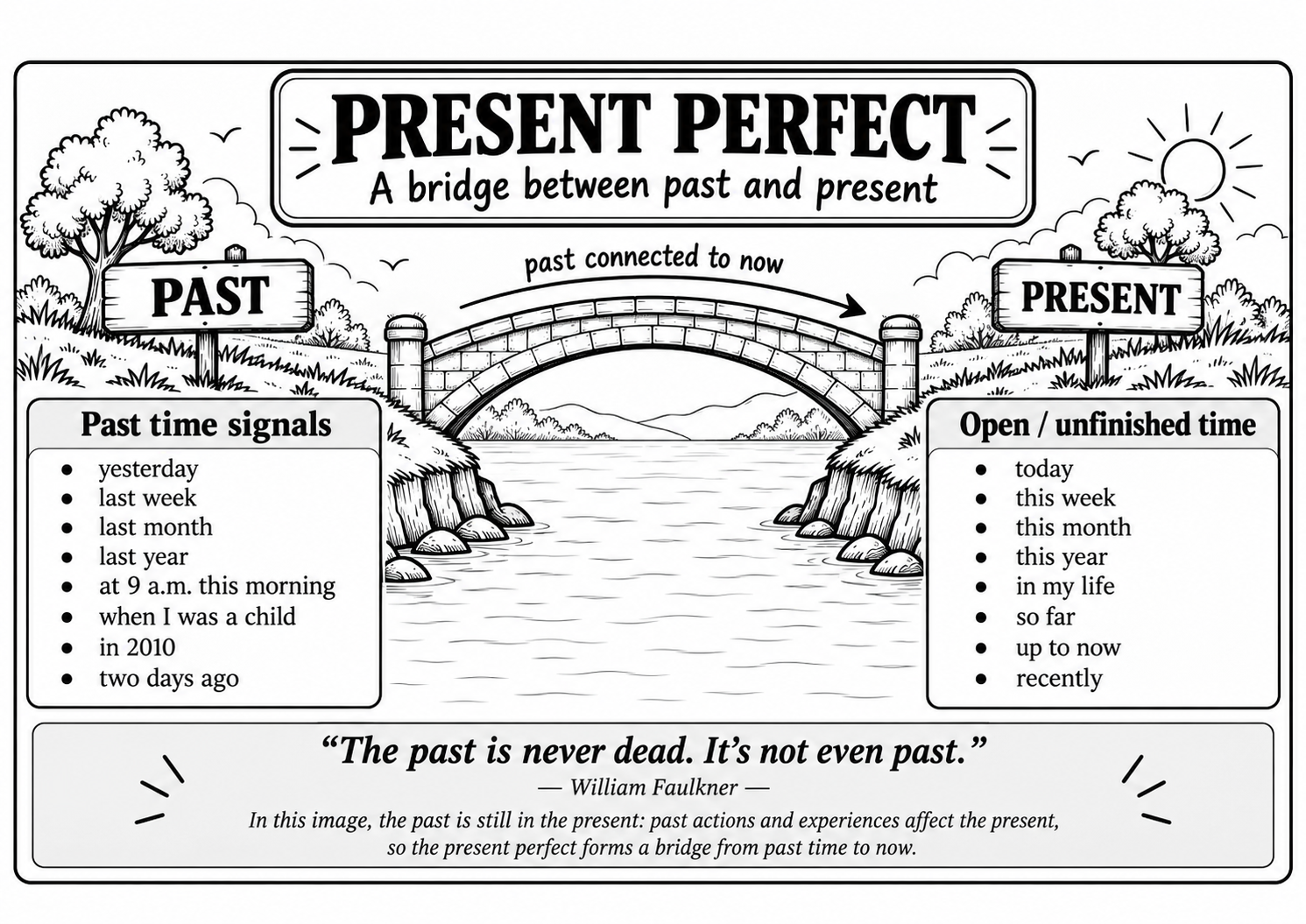
Open or Closed? How Time Signal Words Tell You Which Tense to Use
Core PathWay
1 Section 1. What Do Time Signal Words Actually Tell Us?
A student has a question. The time words are confusing. Listen to how the trainer explains which words signal the past and which keep a connection to now.
💬 Dialogue 1: Open Time, Closed Time — A Student Asks
An online lesson. Sam is a student. Jordan is an experienced language trainer.
Sam: “Jordan, I’m confused. My book says to use present perfect with ‘today’ — but my friend said ‘I worked hard today’ and that sounds fine too. How do I know which tense to use?”
Jordan: “Great question. Here is the key idea. Ask yourself: is the time period still open, or is it finished and closed? Think of it like a door. ‘Today’ is still happening right now — so the door is open. That means you use present perfect: ‘I’ve worked hard today.’ The day is not over yet.”
Sam: “OK, so ‘today’ is open because the day is still happening. What about ‘this morning’? Is that open too?”
Jordan: “It depends on the clock. If it is still morning — say, 10am — then ‘this morning’ is open. You say: ‘I’ve had two coffees this morning.’ But if it is now 3pm, the morning is finished. The door is closed. So you say: ‘I had two coffees this morning.’ Same words, different tense — because the time has changed.”
Sam: “That’s really clear. So the time on the clock decides the tense. What about words like ‘yesterday’ or ‘last week’? Are those always past simple?”
Jordan: “Always. Those are closed time signals. The time is 100% finished — the door cannot open again. You cannot use present perfect with them. ‘I saw her yesterday.’ ‘We met last week.’ Never say ‘I have seen her yesterday’ — that is a very common mistake. Remember it.”
Sam: “OK. What about the word ‘when’? I see it a lot. Can I use it with present perfect?”
Jordan: “’When’ always signals a specific moment in the past. It closes the time immediately — every time. So you always use past simple after ‘when’: ‘When did you arrive?’ ‘When I was a student…’ Never use present perfect with ‘when’. That is a rule you can trust every time. And one more thing: if you give a specific time inside an open period — like ‘today at 9am’ and it is now 11am — that specific time is closed. So you say: ‘I sent the email at 9am today’, not ‘I have sent it at 9am.’ The ‘at 9am’ closes it.”
2 Section 2. Time Signal Words: Open or Closed?
Every time word sends a signal. Some say: ‘this time period is still open — I am still in it.’ Others say: ‘that time is finished — it is closed.’ The tense you choose depends on that signal. Look at the table below. It shows you which words are open and which are closed.
Focus
- OPEN time signals → use PRESENT PERFECT (the time period includes NOW)
- CLOSED time signals → use PAST SIMPLE (the time period is 100% finished)
- ‘WHEN’ always signals a specific past moment → always use PAST SIMPLE
- ‘Today’ is open — but ‘today at 9am’ (when it is now 10am) is CLOSED
- ‘This morning’ is OPEN before midday — CLOSED after midday
- A specific clock time (at 9am, at 3pm) always CLOSES the time period
Rules
- OPEN SIGNALS — PRESENT PERFECT: today | this morning (before midday) | this week | this month | this year | this semester | recently | so far | up to now | in the last few days
- CLOSED SIGNALS — PAST SIMPLE: yesterday | last night | last week | last month | last year | in 2019 | on Monday | at 9am | ago (two days ago) | when… | in the morning (that morning, not this one)
- CONTEXT-DEPENDENT — check the clock: ‘this morning’ = OPEN if it is still morning / CLOSED if it is now afternoon or evening | ‘today at 9am’ = CLOSED if the clock has moved past 9am | ‘today’ alone = OPEN as long as the day is not over
- WHEN = PAST SIMPLE always. ‘When did you finish?’ / ‘When I arrived…’ / ‘When was the meeting?’ — ‘when’ points to a specific moment. That moment is in the past and closed. Never use present perfect with ‘when’.
Examples
- OPEN → PRESENT PERFECT: ‘I’ve sent three emails this morning.’ (It is still morning.) | ‘We’ve had a lot of meetings this week.’ (The week is not over.) | ‘She has worked here since January.’ (She still works here.)
- CLOSED → PAST SIMPLE: ‘I sent three emails this morning.’ (It is now afternoon — morning is over.) | ‘We had a meeting last Tuesday.’ (Last Tuesday is finished.) | ‘I called him at 9am today.’ (9am has passed — that moment is closed.)
- WHEN → PAST SIMPLE always: ‘When did you start this job?’ | ‘I met her when I lived in Rome.’ | ‘When was the last time you travelled?’ — Notice: you cannot say ‘When have you started this job?’ — this is wrong.
Common mistake
Key Terms
3 Section 3. Two Lenses, One Event
The same event can be described in two ways. It depends on how you look at it — through the present perfect lens or the past simple lens. Listen to how a teacher and student practise this together.
💬 Dialogue 2: Same Trip, Two Tenses
A classroom practice session. Alex is a student. Jordan is the teacher. It is Thursday afternoon.
Jordan: “OK Alex, let’s try something. Tell me about a trip you’ve taken this year. Use present perfect.”
Alex: “OK… I’ve been to Barcelona this year. It was amazing.”
Jordan: “Good. Now tell me the same thing, but use past simple. Give me a specific detail — when exactly did you go?”
Alex: “I went there in March. I stayed for five days and visited the Sagrada Família.”
Jordan: “Perfect. Do you see what happened? ‘This year’ is still open — we are still in this year right now. So present perfect works. But ‘in March’ is closed — March is finished. So past simple is correct. Same trip, two different lenses. The time signal decides the tense.”
Alex: “So I can say both? ‘I’ve been to Barcelona this year’ AND ‘I went in March’? Both sentences are about the same trip?”
Jordan: “Exactly right. The first sentence connects the trip to now — this year is still happening. The second sentence puts the trip in a closed, specific time — March is over. Both sentences are about the same trip. The time signal is the only thing that changes. Let me hear you try another one.”
Alex: “OK. ‘I’ve read two books this month.’ And then: ‘I read the first one last weekend.’ Is that right?”
4 Section 4. Write About This Year
Now it’s your turn. Use what you’ve learned about open and closed time signals. Write about your year — start with the big picture, then zoom in on the details.
5 Section 5. Quick Review: Do You Know Your Signals?
A fast six-turn check. Jordan asks the questions. See how quickly you can answer — and check your thinking against Alex’s answers.
💬 Dialogue 3: Signal Word Review
End of lesson. Jordan is reviewing. Alex answers.
Jordan: “Quick review. Is ‘last year’ an open signal or a closed signal?”
Alex: “Closed. Last year is finished. So I use past simple — ‘I worked in London last year.’”
Jordan: “Good. What about ‘this week’ — and it’s only Wednesday today?”
Alex: “Open! The week isn’t over — it’s only Wednesday. So: ‘I’ve had three meetings this week.’ Present perfect.”
Jordan: “Perfect. Now — ‘this morning’. It’s currently 4pm. Open or closed?”
Alex: “Closed. The morning is finished — it’s 4pm now. So: ‘I had a call this morning.’ Past simple. And one last thing — you can never use present perfect with ‘when’, right? ‘When did you arrive?’ Not ‘When have you arrived?’”
6 Section 6. Recap: The Signal Decides the Tense
Here is the key idea from this page. Every time word sends a signal. That signal tells you which tense to use.
If the time period is still open — still happening now — use the present perfect. Words like ‘today’, ‘this week’, ‘this month’, and ‘recently’ are open signals. The time is not finished.
If the time period is closed — completely finished — use the past simple. Words like ‘yesterday’, ‘last week’, ‘in March’, and ‘two days ago’ are closed signals. The time is over.
Some words depend on the clock. ‘This morning’ is open before midday. After midday, it is closed. ‘Today at 9am’ is closed as soon as 9am has passed. Always check: is the time still happening, or is it finished?
And remember: the word ‘when’ always signals a specific moment in the past. Use past simple with ‘when’ — every time, no exceptions.
Member-Exclusive Practice Bar
Access a wide range of integrated practice for this unit — from Vocabulary and Grammar activities to AI-curated Writing tasks and Thematic Chat practice.
This feature is available to YSP members.
Explore Membership BenefitsMember-Exclusive Vocabulary Review & Acquisition System
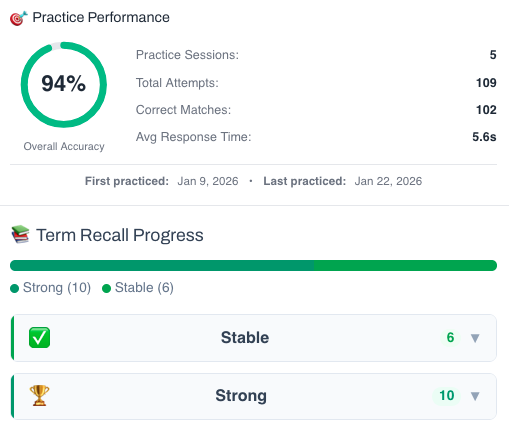
This isn’t a simple quiz — it’s a fully tracked learning system. You build knowledge through recognition, then recall, and your progress feeds directly into the Integrated Practice Bar (Writing tasks, AI Chat, and more).
- Practice sessions, accuracy, and response-time tracking
- Term strength levels (Learning → Stable → Strong)
- Personal progress history for each unit
This feature is available to YSP members.
Explore Membership Benefits🔗 Explore Linked Content
Practice
Extra tasks to practice what you learned
Present Time SIGNALS verus CLOSED Past - Grammar Practice
Present Time SIGNALS verus CLOSED Past - Grammar Practice 2
Dialogues
Extra listening practice on the Hub's grammar or vocabulary points