Present Perfect Negatives with Since & For: Not Once vs Not as Much
Core PathWay
1 Section 1. Turning the Present Perfect Negative
You have studied sentences like I have had my car for three years (a state) and I have been driving to work since January (a habitual action). Now let’s flip them into negatives — and that’s where something interesting happens.
Before we look at the rules, try this small challenge. How would you express these two ideas using the Present Perfect?
➤ I last went to the cinema three years ago.
➤ The last time I went to England was ten years ago.
Here are the answers:
✔ I haven’t been to the cinema for three years.
✔ I haven’t been to England for ten years.
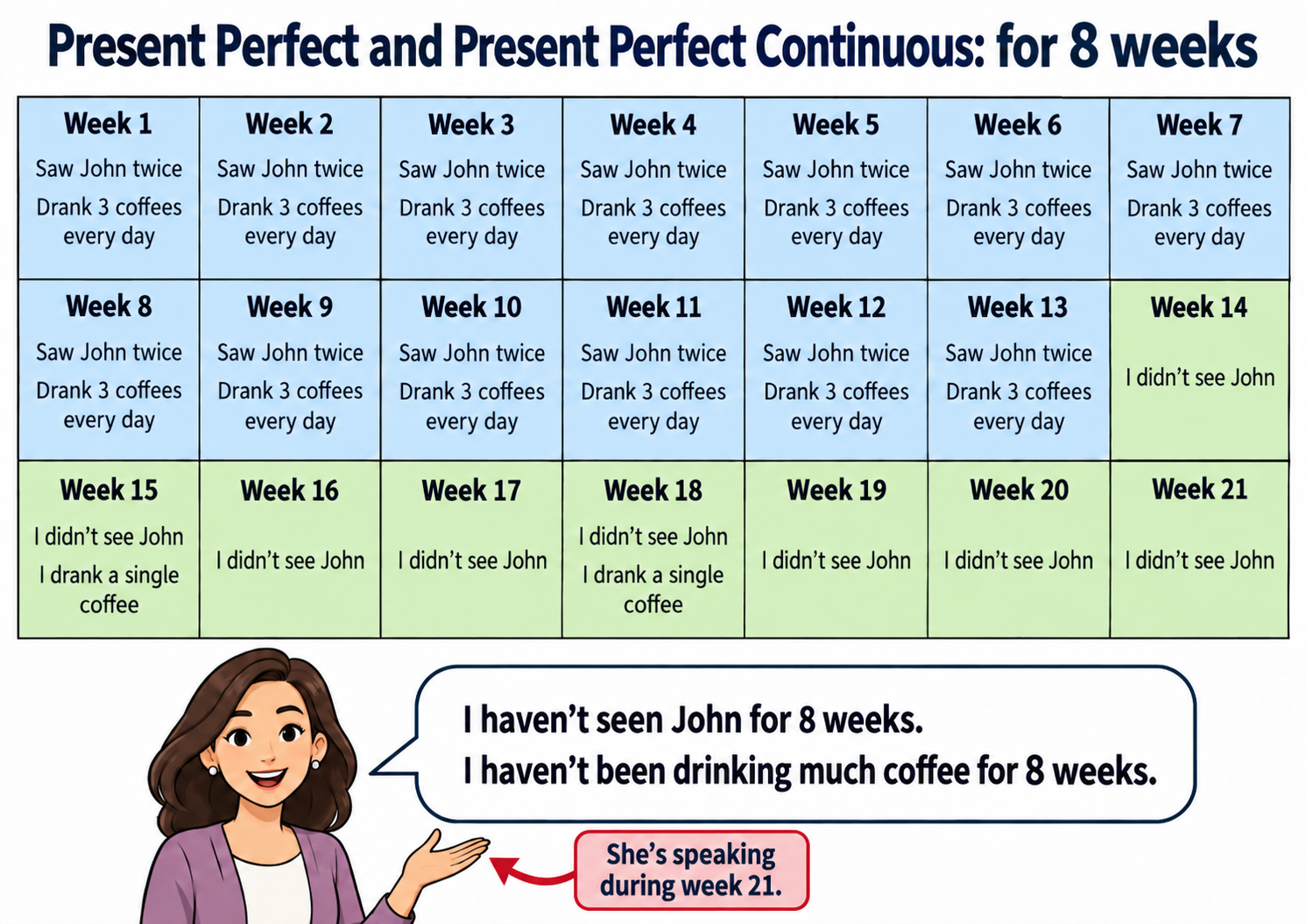
Notice the pattern. The negative present perfect simple (haven’t / hasn’t + past participle) tells us that something did not happen at all during a stretch of time from the past up to now. There was no cinema visit. Not even one. The arc of time — from three years ago to this moment — is completely empty of that event or state.
This works the same way for both state verbs and action verbs. Whether you are talking about owning something, knowing something, or doing something, the negative present perfect simple means: not once in that whole period.
Key Terms
2 Section 2. How Long Haven’t You…?
Three friends — Alex, Sam, and Jordan — are catching up over lunch. They start comparing notes on things they haven’t done in a while.
💬 Dialogue 1: Things We Haven’t Done in Ages
A casual lunch between three friends who haven’t seen each other for a few weeks
Alex: “I can’t remember the last time I went to the gym. Actually, I last went in February. Can you believe that?”
Sam: “February? So you haven’t been to the gym for nearly six months! Why not? What happened?”
Alex: “Work, mostly. I just haven’t had time. Every week I tell myself I’ll go, and then something comes up. What about you two — have you been keeping up with anything?”
Jordan: “Well, I haven’t eaten meat since last Christmas. It started as a one-month challenge and then I just… kept going. I didn’t even plan it.”
Sam: “Wow, so you haven’t had a single burger or anything for almost a year? I couldn’t do that. I love a good burger too much.”
Jordan: “It’s easier than you think, honestly. After the first few weeks, I stopped missing it. What about you, Sam? I feel like I haven’t seen you at the coffee shop recently.”
Sam: “Yeah, I haven’t drunk coffee since the start of summer. The doctor told me to cut back. The last time I had a proper coffee was June — sitting right here at this table, actually.”
Alex: “You haven’t had any coffee at all for two months? That’s impressive. I haven’t gone a single day without it. I’d have a headache by ten in the morning.”
Sam: “I know — I didn’t think I could do it either. The first week was rough. But honestly, I’ve slept much better since I stopped. Maybe you should both try it.”
3 Section 3. The Slippery Negative: Present Perfect Continuous
The negative present perfect simple is clear and logical: haven’t + past participle means that something did not happen, not even once, in a period of time leading to now. Easy.
But the negative present perfect continuous — haven’t been + verb-ing — works very differently. It does NOT mean ‘not at all’. It usually means a big reduction in something, or a break from a regular habit. The action may still have happened sometimes.
Look at these pairs carefully:
I haven’t smoked for six months.
I haven’t been smoking for six months.
Here is another pair:
I haven’t eaten fast food since January.
I haven’t been eating fast food since January.
Because the continuous negative can feel a little vague, speakers often add much to make the meaning clearer:
✔ I haven’t been drinking coffee much since June. (= much less than before, but maybe some)
This is the key difference to remember:
– Simple negative = not at all (zero)
– Continuous negative = not regularly (reduced habit, possibly some)
4 Section 4. At the Doctor’s
Doctor-patient conversations are a great place to see both negative forms in action — because patients don’t always tell the whole truth straight away.
💬 Dialogue 2: The Check-Up
A patient’s annual health check-up at a medical clinic
Doctor: “Good morning. Let’s get started. So, let’s begin with your lifestyle. When did you last smoke?”
Patient: “I haven’t smoked for about six months now. I’m quite proud of that, actually.”
Doctor: “Good. So not a single cigarette in six months — is that right? I want to make sure I have the full picture.”
Patient: “Well… I haven’t been smoking regularly, I’ll say that. But I did have one or two at a party last month. And I haven’t bought a packet since April.”
Doctor: “I see — so it’s more that you’ve cut back significantly rather than stopped completely. That’s still progress, and I appreciate the honesty. But let’s be precise going forward. What about alcohol?”
Patient: “I haven’t been drinking much since the summer. I used to have a glass of wine every night, but I haven’t done that for months now.”
Doctor: “And have you had any alcohol at all recently? Even a small amount?”
Patient: “A little, yes. Maybe at weekends. But I haven’t had a drink during the week since July. That’s a big change for me — I used to open a bottle on Monday evenings without thinking.”
Doctor: “That is a good change. Keeping alcohol to weekends only is much better for your liver and your sleep. Now, what about exercise? The last time you came in, you mentioned a running routine.”
Patient: “I haven’t been running much lately, I’m afraid. Life got busy. I last went for a proper run about three weeks ago.”
Doctor: “So you haven’t stopped completely, but you’ve reduced it quite a lot. Let’s try to get that back to at least twice a week. Small steps — even twenty minutes counts.”
Key Terms
5 Section 5. Write About Your Habits
Now practise both negative forms — and the past simple alternatives — in your own writing.
• Present perfect simple negative + for/since (e.g. ‘I haven’t eaten…’)
• Present perfect continuous negative + for/since (e.g. ‘I haven’t been going…’)
• ‘I last…’ + past simple (e.g. ‘I last went to…’)
• ‘The last time I…’ + past simple (e.g. ‘The last time I…’)
Start your paragraph with: ‘Over the past few months, my habits have changed quite a bit…’
Target: around 80 words. Use natural, informal language.
6 Recap: What You’ve Covered
Here is a quick summary of everything on this page.
The negative present perfect simple (haven’t/hasn’t + past participle + for/since) means not at all — zero occurrences in a period of time up to now. I haven’t smoked for six months means not a single cigarette.
The negative present perfect continuous (haven’t/hasn’t been + verb-ing + for/since) means not regularly — a strong reduction in a habit, but not necessarily zero. I haven’t been smoking for six months means much less than before, but possibly one or two. Adding much helps make this meaning clear: I haven’t been smoking much since June.
You can also express the same idea with past simple alternatives: I last went to the cinema three years ago or The last time I had coffee was June. These forms are natural and common in conversation.
Keep the core contrast in mind:
– Simple negative → not once, not any
– Continuous negative → not regularly, much less than before
Member-Exclusive Practice Bar
Access a wide range of integrated practice for this unit — from Vocabulary and Grammar activities to AI-curated Writing tasks and Thematic Chat practice.
This feature is available to YSP members.
Explore Membership BenefitsMember-Exclusive Vocabulary Review & Acquisition System
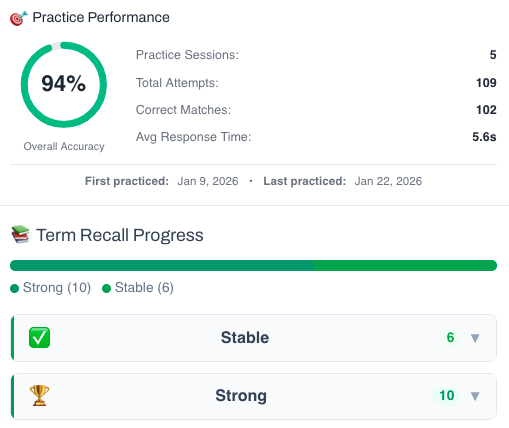
This isn’t a simple quiz — it’s a fully tracked learning system. You build knowledge through recognition, then recall, and your progress feeds directly into the Integrated Practice Bar (Writing tasks, AI Chat, and more).
- Practice sessions, accuracy, and response-time tracking
- Term strength levels (Learning → Stable → Strong)
- Personal progress history for each unit
This feature is available to YSP members.
Explore Membership Benefits🎮 Practice Games
Sentence Scrambler
I haven’t had a coffee since June vs I haven’t been having coffee since June – Sentence Scramble
Member-Exclusive Sentence Builder
Reconstruct scrambled sentences to practice word order and develop your grammar intuition.
This feature is available to YSP members.
Explore Membership Benefits🔗 Explore Linked Content
Practice
Extra tasks to practice what you learned