I’ve Been Here for Hours — Present Perfect Simple for States That Continue Now
Core PathWay
1 Section 1. States That Last — What We’re Exploring Now
You have already covered a lot of ground with the present perfect. You know how to use it to talk about life experience, to give news, and to use it with words like just, already, and yet. Now we move to something different — and very useful.
In this section, we look at states that started in the past and are still true now. Think about this situation: you arrived at a café two hours ago. You are still there. How do you say this in one sentence? That is exactly what this section teaches.
But first — what is a state verb? A state verb describes a situation, not an action. It describes something that is true, not something that happens. Common state verbs include be (I am tired), know (She knows the answer), love (He loves jazz), and have for possession (They have a dog). These verbs describe conditions that can last for a long time. That is why they work so well with the duration form of the present perfect.
One important thing to notice: there is a big difference between I have been married and I have been married for ten years. The first sentence means you have this experience in your life — but you may not be married now. The second sentence connects the past moment (you got married) to the present state (you are still married). That connection — past to present — is the heart of what we are studying here.
Key Terms
2 Section 2. Jack Explains the Bridge — A Student-Teacher Conversation
Francesca wants to understand why English uses the present perfect to talk about situations that started in the past and are still present now. Jack explains — step by step.
💬 Dialogue 1: How Long Have You Been Here? — Understanding the Duration Form
An online lesson. Francesca has a question about a sentence she read.
Francesca: “Jack, I saw this sentence: ‘I have been here for two hours.’ But I’m here right now — so why isn’t it ‘I am here for two hours’? That feels more logical to me.”
Jack: “Great question — and you’re not alone in thinking that. Let’s slow it down. Imagine you arrived at a café at 10 o’clock. It’s now noon. Two things are true: you arrived in the past, and you’re still there now. Two facts, yes?”
Francesca: “Yes, exactly. I was there at 10, and I’m still there now.”
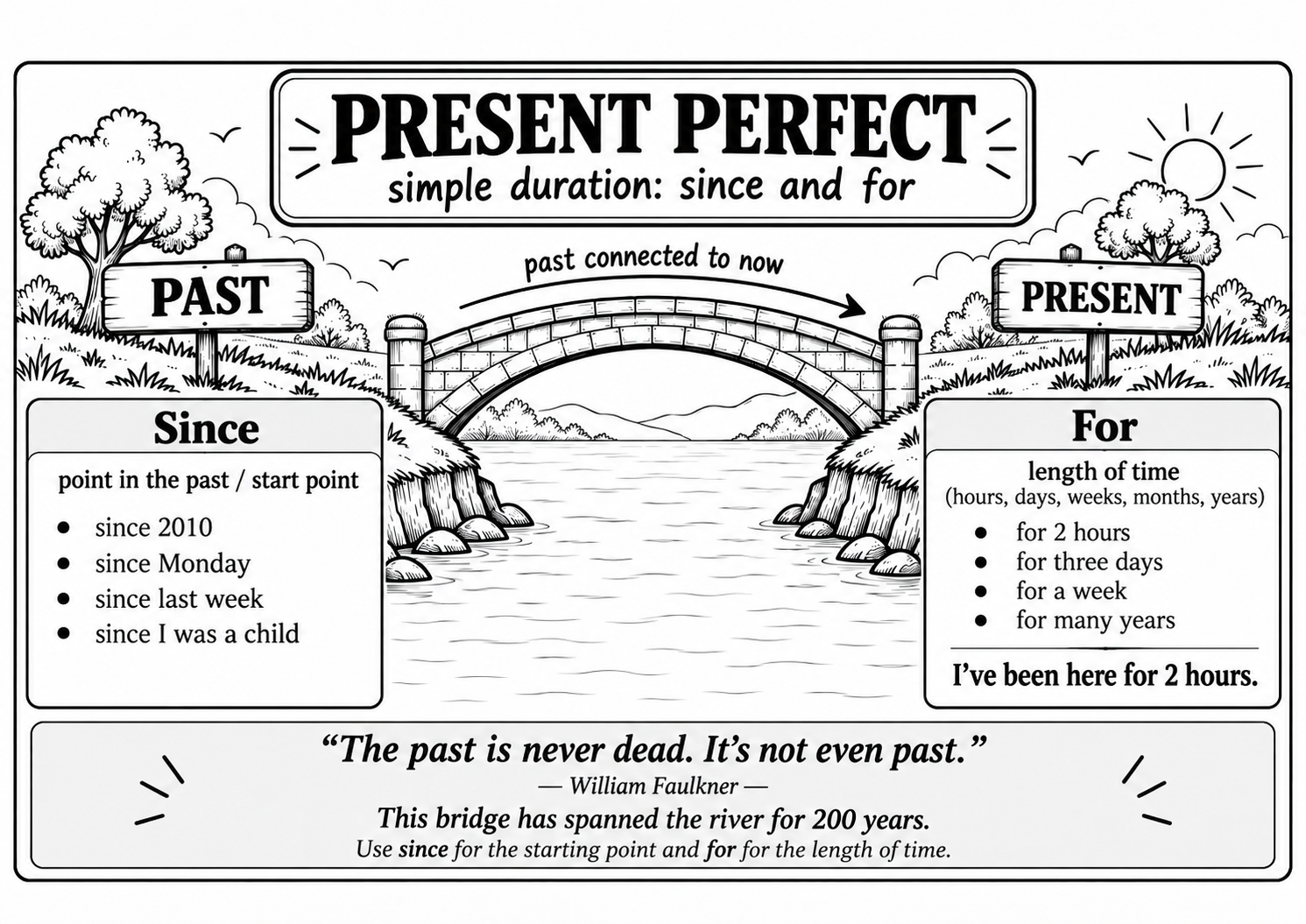
Jack: “Right. So in some languages, you might say those two facts as two separate sentences — ‘I arrived at 10’ and ‘I’m still here.’ But in English, we combine them into one sentence with the present perfect: ‘I have been here for two hours.’ Think of it as a bridge. One side is the past moment — when you arrived. The other side is right now. The present perfect connects them.”
Francesca: “Oh — so it’s one sentence that covers both the past and the present at the same time?”
Jack: “Exactly. And we use two specific time signals with this form. We use ‘for’ when we say the length of time — like ‘for two hours’ or ‘for three years’. We use ‘since’ when we name the starting point — like ‘since 10 o’clock’ or ‘since 2019’. So: ‘I have been here for two hours’ tells us the length. ‘I have been here since 10 o’clock’ tells us when it started.”
Francesca: “So ‘for’ is the amount of time, and ‘since’ is when it started? Like — ‘I have known her for five years’ or ‘I have known her since 2019’?”
Jack: “Perfect — and notice the verb you chose: ‘know’. That’s a state verb. It describes a situation that continues — it doesn’t describe a single action. Other state verbs work the same way: ‘love’, ‘have’, ‘be’, ‘own’, ‘believe’. These verbs describe situations that stay true over time, so they work well with this duration form. ‘I have loved this city since I was a child.’ ‘She has owned that house for twenty years.’ The state continues — the bridge holds.”
Francesca: “I see. So if I say ‘I have been here since two hours ago’ — is that correct? It sounds a little strange to me.”
Jack: “It does sound a little unusual at first, but yes — it’s correct. You’re using ‘since’ with a past reference point: ‘two hours ago’ is the starting moment. So ‘I have been here since two hours ago’ is another way to say ‘I have been here for two hours.’ All three forms are correct: ‘for two hours’, ‘since 10 o’clock’, ‘since two hours ago.’ They just give different information about the same situation.”
Francesca: “That’s really useful. And how do I ask someone about this? What’s the question form?”
Jack: “We use ‘How long have you…?’ — that’s the key question form. For example: ‘How long have you known her?’ or ‘How long has he worked here?’ Notice the word order: ‘How long’ — then ‘have’ or ‘has’ — then the subject — then the past participle. Can you try one? Ask me how long I have lived in this city.”
Francesca: “Okay — ‘How long have you lived in this city?’”
Jack: “That’s exactly right. So let’s bring it all together. You have the bridge image: past on one side, present on the other. You have ‘for’ and ‘since’ and ‘since… ago’ as your time signals. You have state verbs — know, love, have, be, own — as the verbs that work here. And you have ‘How long have you…?’ as your question form. Keep those four things in mind and you have the full picture.”
Key Terms
3 Section 3. Grammar Guide — The Duration Form: For, Since, and Since…Ago
You already know how to form the present perfect. Now let’s focus on one specific use: talking about states that started in the past and are still true now. This is the duration form. The key question it answers is: How long?
Three time signals make this form work: for, since, and since…ago. Each one does a different job. Understanding the difference is the most important step.
Focus
- Use the present perfect duration form when a STATE started in the past and is still true NOW.
- Use ‘for’ + a period of time to say HOW LONG the state has lasted.
- Use ‘since’ + a point in time to say WHEN the state started.
- Use ‘since…ago’ to combine ‘since’ with a duration — it names the starting point by counting back from now.
- Use ‘How long have/has + subject + past participle…?’ to ask about duration.
- This form is used with STATE VERBS — verbs that describe continuing situations, not single actions.
Rules
- FOR + period of time: ‘for two hours’, ‘for three years’, ‘for a long time’, ‘for six months’. Use ‘for’ when you say the length of the period.
- SINCE + point in time: ‘since 2019’, ‘since Monday’, ‘since 10 o’clock’, ‘since last summer’. Use ‘since’ when you name the moment it started.
- SINCE + [time expression] + AGO: ‘since two hours ago’, ‘since three years ago’. This means: it started [that long ago] and is still true now. Use ‘since’ — not ‘for’ — with ‘ago’.
- QUESTION FORM: How long + have/has + subject + past participle? → ‘How long have you known her?’ / ‘How long has he lived here?’
- NEGATIVE FORM: subject + haven’t/hasn’t + past participle + for/since → ‘I haven’t seen him since last year.’ / ‘She hasn’t slept for 20 hours.’
- IMPORTANT — ‘been’ vs ‘gone’: Use ‘been’ for a state that continues now. → ‘He has been here for years.’ NOT ‘He has gone here for years.’
Examples
- I have known her for ten years. [for + period — the friendship started 10 years ago and is still true now]
- She has lived in Tokyo since 2018. [since + starting point — she moved in 2018 and still lives there]
- They have owned that car since three years ago. [since…ago — they bought it 3 years ago and still own it]
- How long have you worked here? — I’ve worked here for about six months. [question + answer using ‘for’]
- He hasn’t felt well since last Monday. [negative + since — the state of not feeling well started Monday and continues]
Common mistake
4 Section 4. State Verbs — Why These Verbs and Not Others?
Not all verbs work the same way. Some verbs describe actions — things that happen and finish. Other verbs describe states — situations that continue over time. This section focuses on state verbs and explains why they pair naturally with the present perfect duration form.
A state verb describes something that is true — a feeling, a relationship, a belief, or ownership. Because these situations can last for months or years, they connect naturally to the question How long? — and that is exactly what the present perfect duration form answers.
Focus
- State verbs describe conditions, feelings, relationships, beliefs, or ownership — not actions.
- State verbs are used with the present perfect duration form because the state can continue over time.
- Common state verbs: BE, KNOW, LOVE, LIKE, HATE, WANT, NEED, OWN, HAVE (possession), BELIEVE, UNDERSTAND, REMEMBER, PREFER, BELONG, SEEM, APPEAR.
- These verbs are NOT normally used in continuous forms — this is why the simple form is used for duration, not the continuous form.
- Action verbs (run, eat, write, build) describe things that happen and finish — they work differently.
Rules
- If the verb describes a FEELING → it is a state verb. Example: love, hate, like, prefer, want, need.
- If the verb describes KNOWING or BELIEVING → it is a state verb. Example: know, understand, believe, remember, forget.
- If the verb describes OWNERSHIP or BELONGING → it is a state verb. Example: have, own, belong, possess.
- If the verb describes HOW SOMETHING APPEARS → it is a state verb. Example: seem, appear, look (in the sense of ‘appear’).
- If the verb describes a RELATIONSHIP → it is often a state verb. Example: know (a person), love (a person).
- State verbs + present perfect + for/since = a state that started in the past and is still true now.
Examples
- I have known him for twenty years. [KNOW = state verb — the relationship continues]
- She has owned that house since 2010. [OWN = state verb — the ownership continues]
- They have believed this theory since they were students. [BELIEVE = state verb — the belief continues]
- He has had that watch for a long time. [HAVE for possession = state verb — the possession continues]
- I have loved jazz since I was a teenager. [LOVE = state verb — the feeling continues]
Common mistake
5 Section 5. Nice Jacket! — A Conversation About Clothes, Phones, and Belongings
Three friends meet up and start noticing each other’s things. Listen to how they ask about belongings — and notice the mix of ‘How long have you had it?’ and ‘When did you get it?’
💬 Dialogue 2: Nice Jacket! — Talking About What We Own
Three friends — Sofia, Luca, and Mia — meet at a café. They haven’t seen each other for a few weeks.
Sofia: “Luca! Is that a new jacket? I love it.”
Luca: “This? No, I’ve had it for ages — about two years, I think. I just don’t wear it very often.”
Mia: “It looks brand new though. Where did you get it?”
Luca: “From that shop on the high street — the one near the station. I got it in a sale, actually. Half price.”
Sofia: “Nice. Oh, Mia — is that a new phone? That looks different from your old one.”
Mia: “Yes! I’ve had it since last month. I finally upgraded — my old phone was so slow.”
Luca: “How long did you have the old one for? It felt like forever.”
Mia: “Almost four years. I know — it was time. When did you last upgrade yours, Luca?”
Luca: “I got this one about eighteen months ago. I’ve had it since the spring before last. It’s still fine, to be honest.”
Sofia: “I need a new one. I’ve had mine since 2021 and the battery is terrible now.”
Mia: “Oh, that’s a long time. How long have you had those earrings, by the way? They’re beautiful.”
Sofia: “These? My grandmother gave them to me. I’ve had them since I was about sixteen. I wear them all the time.”
Luca: “That’s lovely. Is that bag new, Sofia? I don’t remember seeing it before.”
Sofia: “Yes! I got it two weeks ago. I’ve only had it since then, but I already love it. It goes with everything.”
Mia: “How long have you wanted a bag like that? You’ve been talking about getting one forever.”
Sofia: “Honestly? Since about three years ago. I finally found the right one.”
Key Terms
6 Section 6. Writing Task — Your World Right Now
Now it’s your turn. Use the present perfect duration form to write about states that are true in your life right now.
7 Section 7. Recap — The Bridge Between Then and Now
Let’s bring everything together.
In this section, you studied one specific and very important use of the present perfect: states that started in the past and are still true now. The key idea is the bridge — one side is the past moment when the state began, and the other side is the present moment where the state is still true.
You use for when you give the length of time — for two years, for a long time. You use since when you give the starting point — since 2019, since last Monday. And you can combine them: since…ago — since three years ago — which means ‘it started three years ago and is still true now’.
You also learned about state verbs — verbs like know, love, own, have (for possession), believe, and want. These verbs describe situations that continue over time, which is why they work so naturally with this form.
The question form is How long have you…? — use this whenever you want to ask about the duration of a state.
Finally, remember the important distinction: I have been married means this is a life experience — you may not be married now. But I have been married for ten years means the state is still true — you are married right now. The time expression changes everything.
Keep the bridge image in your mind. Past on one side. Present on the other. The present perfect connects them.
Member-Exclusive Practice Bar
Access a wide range of integrated practice for this unit — from Vocabulary and Grammar activities to AI-curated Writing tasks and Thematic Chat practice.
This feature is available to YSP members.
Explore Membership BenefitsMember-Exclusive Vocabulary Review & Acquisition System

This isn’t a simple quiz — it’s a fully tracked learning system. You build knowledge through recognition, then recall, and your progress feeds directly into the Integrated Practice Bar (Writing tasks, AI Chat, and more).
- Practice sessions, accuracy, and response-time tracking
- Term strength levels (Learning → Stable → Strong)
- Personal progress history for each unit
This feature is available to YSP members.
Explore Membership Benefits🎮 Practice Games
Sentence Scrambler
I’ve been here for hours… – Sentence Scramble
Member-Exclusive Sentence Builder
Reconstruct scrambled sentences to practice word order and develop your grammar intuition.
This feature is available to YSP members.
Explore Membership Benefits🔗 Explore Linked Content
Dialogues
Extra listening practice on the Hub's grammar or vocabulary points