Things in the Bathroom: Pack 2 — From Bath Mat to Dental Floss
Core PathWay
1 Section 1. Welcome to the Bathroom
Want to talk confidently about the bathroom? It starts with these words. The bathroom has many small but important objects. Some are on the floor. Some are on shelves or by the sink. Some are in a cabinet. We group them here so they are easier to learn. Let’s start at the floor and work our way up. When you get out of the bath or shower, the first thing you step onto is a bath mat. This is a thick, soft mat that sits on the floor. It stops the floor from getting wet. It also stops you from slipping. Next to it, you will often find a bathroom bin. This is a small bin for used items — things like cotton pads or empty packets. Every bathroom needs one. Near the door or on a wall, you might also see a grab rail. This is a metal or plastic bar fixed to the wall. People hold it to help them get in or out of the bath safely. It is especially useful for older people or anyone who needs extra support.
2 Section 2. Towels and Drying Off
After a bath or shower, you need something to dry yourself. The large towel you use for your whole body is called a bath towel. It is big enough to wrap around you. A hand towel is smaller. You hang it near the sink and use it to dry your hands after washing them. Even smaller is a face cloth. This is a small square of soft fabric. You use it to wash your face — sometimes with soap, sometimes just with water. These three items — bath towel, hand towel, and face cloth — are often sold together as a set. Notice that we say ‘a set of towels’, not ‘a group of towels’. That is the natural phrase. On the floor, the bath mat also helps with drying — it absorbs water from your feet when you step out. So the bath mat and the bath towel work together. Both are made from absorbent fabric. ‘Absorbent’ means it takes in water quickly.
3 Section 3. Skin and Body Care
Now let’s look at the items you use to clean and care for your body. The most basic one is soap. This is what you use to wash your skin. Bar soap is a solid block. But many people now prefer liquid soap, which is called hand soap when it is kept by the sink in a pump bottle. In the shower, people often use shower gel instead of bar soap. Shower gel is a liquid that you squeeze from a bottle. You might also use a sponge to spread the shower gel on your skin. A sponge is a soft object — either natural or made from foam — that holds water and soap. For your hair, there are two key products. Shampoo cleans your hair. Conditioner makes your hair soft and smooth after washing. You use shampoo first, then conditioner. Notice the order — it matters. Finally, bathroom scales are a flat device you stand on to check your weight. They sit on the floor, often near the bath mat. We say ‘bathroom scales’ — always plural, even when we talk about one device.
4 Section 4. Face and Hair Grooming
This section covers items you use to look after your face and hair. If you have long hair, you probably use a hairbrush. This is a brush with a flat base and many bristles. You use it to smooth and style your hair. A comb is different. It is a flat tool with teeth. You use it to separate and tidy your hair, often after washing it. Both items do a similar job, but people often use both — the comb first to remove tangles, then the hairbrush to smooth. To dry your hair quickly, you use a hairdryer. This is an electric device that blows hot air. We say ‘blow-dry your hair’ when we use it. Notice: a hairdryer ‘blows’ air — it does not ‘push’ or ‘send’ air. For shaving, men often use a razor — a sharp blade tool — and shaving foam. The shaving foam is a white cream that you put on your skin before you use the razor. It makes shaving easier and protects the skin. Finally, a magnifying mirror is a special mirror that makes things look bigger. People use it to check their skin closely or to apply make-up carefully.
5 Section 5. Teeth and Oral Care
Good oral care means looking after your teeth and mouth. ‘Oral’ means relating to the mouth. There are four key items here. A toothbrush is the small brush you use to clean your teeth. You should use it at least twice a day. Toothpaste is the cream you put on the toothbrush. It cleans your teeth and keeps your breath fresh. Notice: we say ‘a tube of toothpaste’, not ‘a bottle of toothpaste’. The container matters when we talk about amounts. Mouthwash is a liquid you rinse your mouth with after brushing. You do not swallow it — you swish it around your mouth and then spit it out. It kills bacteria and freshens your breath. Finally, dental floss is a thin thread that you use to clean between your teeth. ‘Dental’ means relating to teeth — you will also hear it in ‘dental appointment’ or ‘dental hygiene’. These four items are often found together in a bathroom cabinet or on a shelf near the sink. Dentists recommend using all four, not just a toothbrush and toothpaste.
6 Section 6. The Toilet Area
The toilet area has its own set of essential items. The most important one is toilet paper. This is the soft paper on a roll that you use after using the toilet. In British English, people also say ‘loo roll’ in informal speech, but ‘toilet paper’ is the standard term. Next to the toilet, you will usually find a toilet brush. This is a brush with a long handle that you use to clean the inside of the toilet bowl. It usually sits in a small holder on the floor. Notice: we say ‘clean the toilet’ with a toilet brush — not ‘wash’ or ‘scrub’. ‘Clean’ is the natural verb here. You might also see a grab rail on the wall near the toilet, especially in accessible bathrooms — bathrooms designed for people with disabilities or reduced mobility. ‘Mobility’ means the ability to move around. These items are simple, but they are important to know — especially if you are shopping, moving into a new home, or helping someone set up a bathroom.
7 Section 7. Now Hear It in Use
You have met all 25 words from this pack. Now hear them working in a real conversation. Listen to how two people talk about bathroom items naturally — notice which words they choose and how they put them together.
💬 Dialogue 1: Setting Up the New Bathroom
Priya and Dan have just moved into a new flat together. They are standing in the bathroom with a shopping list, working out what they need to buy. They need to agree on what is essential and what can wait.
Priya: “Right, so we have the basics — toilet paper, soap, and a couple of bath towels. But I think we’re missing quite a lot still.”
Dan: “Yeah, I noticed there’s no bath mat. The floor is going to be soaking every time we get out of the shower.”
Priya: “Good point. Add that to the list. And we definitely need a toilet brush — I’m not leaving that one until later.”
Dan: “Agreed, that’s a day-one essential. What about hand towels? We’ve got the big bath towels, but we’ll need something smaller by the sink for drying our hands.”
Priya: “Oh, you’re right — I hadn’t thought about that. We should get two hand towels, one each. And what about a hairdryer? Did you pack yours, or is that still in one of the boxes?”
Dan: “I’m pretty sure mine is in one of the boxes in the bedroom — I’ll check later. But we definitely need shampoo and conditioner. I forgot to pack those completely.”
Priya: “Same — I’ve got nothing for my hair. And we need shower gel too, or at least some soap for the shower. Oh, and toothbrushes and toothpaste. I’ve got a toothbrush but no toothpaste.”
Dan: “I’ve got toothpaste — I think I put it in my bag. So we can cross that off. But I haven’t got a toothbrush, so add one for me. And we need a bathroom bin. There’s nowhere to put anything at the moment.”
Priya: “Good thinking. A bin is definitely essential. I was also thinking — my mum is coming to stay next month, and she finds it hard to get in and out of the bath. Should we look at getting a grab rail fitted?”
Dan: “That’s a really good idea. We should look into that properly — I think you need someone to fit it to the wall securely, so it’s not a quick job. Let’s put it on a separate list of things to sort out this week.”
Priya: “Good idea. So the shopping list for today is: bath mat, toilet brush, hand towels, shampoo, conditioner, shower gel, toothbrush for you, and a bathroom bin. Did I miss anything?”
Dan: “I think that covers the essentials. Oh — one more thing. If my hairdryer isn’t in those boxes, we’ll need to buy one of those too. Let me check before we go. Right, let’s get to the shops!”
Member-Exclusive Practice Bar
Access a wide range of integrated practice for this unit — from Vocabulary and Grammar activities to AI-curated Writing tasks and Thematic Chat practice.
This feature is available to YSP members.
Explore Membership BenefitsMember-Exclusive Vocabulary Review & Acquisition System
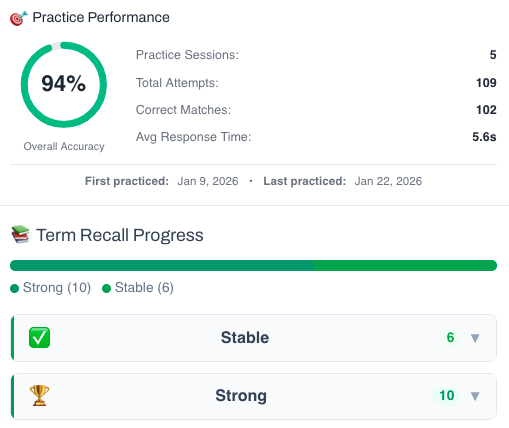
This isn’t a simple quiz — it’s a fully tracked learning system. You build knowledge through recognition, then recall, and your progress feeds directly into the Integrated Practice Bar (Writing tasks, AI Chat, and more).
- Practice sessions, accuracy, and response-time tracking
- Term strength levels (Learning → Stable → Strong)
- Personal progress history for each unit
This feature is available to YSP members.
Explore Membership Benefits