Rooms! The Language of Home Spaces
Core PathWay
1 Section 1. The Heart of the Home
Want to talk confidently about rooms? It starts with these words.
Every home has a few rooms that everyone uses every day. These are the rooms at the centre of daily life.
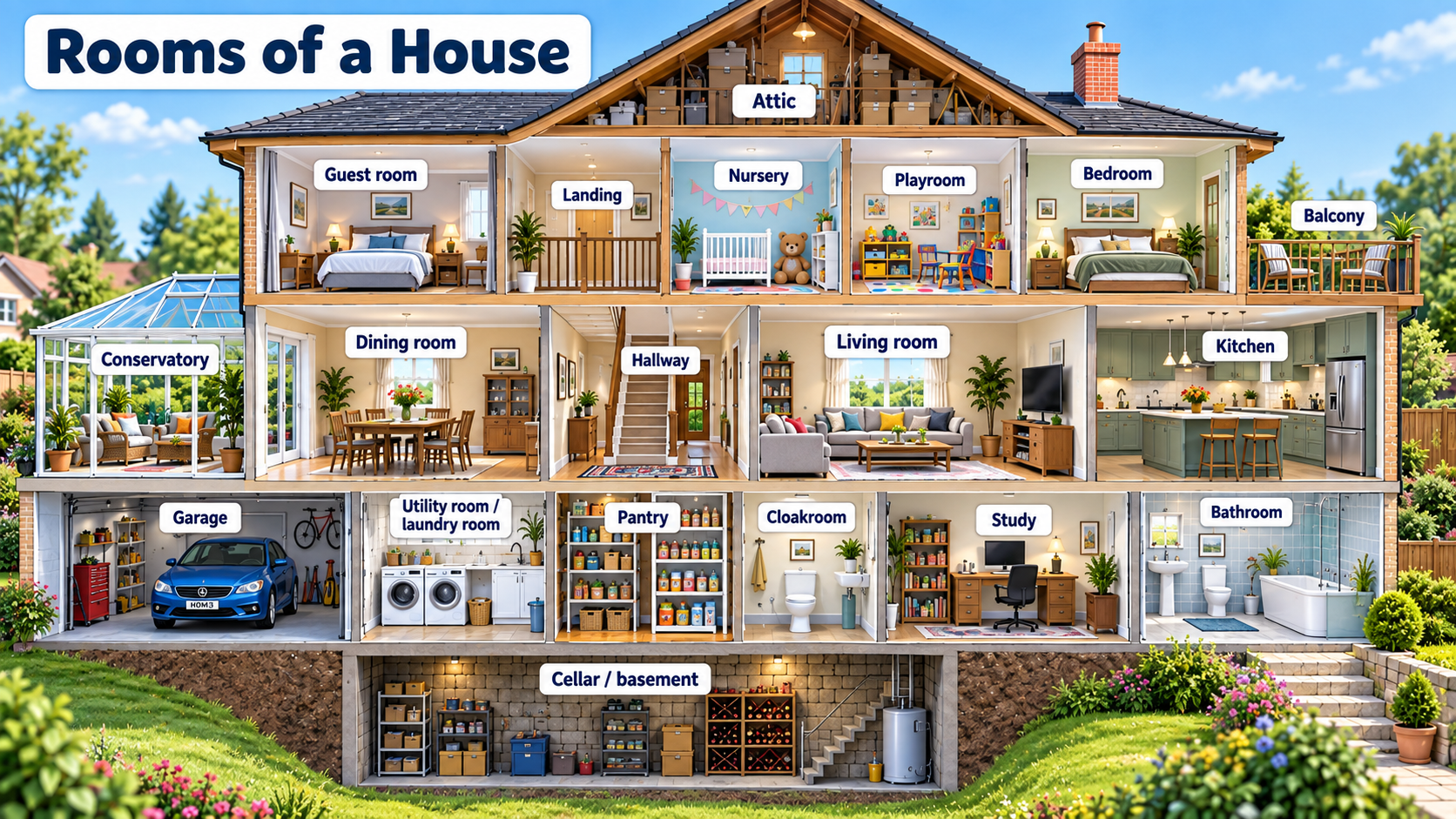
The kitchen is where people cook and prepare food. It is one of the busiest rooms in the house. Next to the kitchen, or sometimes connected to it, you might find a dining room. This is a room with a table where people sit down to eat meals together.
The living room is where people relax. People watch TV, read, or spend time with family there. Some people call it the sitting room or lounge — these all mean the same thing.
The bedroom is the room where people sleep. Most homes have more than one bedroom. The bathroom is where people wash. It usually has a bath or shower, and a sink.
These five rooms — kitchen, dining room, living room, bedroom, and bathroom — are the ones you will find in almost every home.
2 Section 2. Getting In and Moving Around
When you enter a home, the first space you usually reach is the hall or hallway. These two words mean the same thing. This is the entrance area — the space between the front door and the rest of the house. You take off your coat and shoes here.
In a two-storey home, there is usually a staircase. At the top of the stairs, there is often a landing. This is the small open area on an upper floor where the stairs finish and the doors to the upstairs rooms begin. Think of it as a small corridor between rooms.
Some homes also have a cloakroom near the front door. This is a small room with a toilet and a sink. It is for guests to use. It is not a full bathroom — just a quick, convenient option near the entrance.
A toilet can mean the room itself, or the fixture inside it. In British English, people often say ‘the toilet’ to mean the small room with just a toilet and sink — especially downstairs.
3 Section 3. Rooms for Work and Storage
Not all rooms are for relaxing or sleeping. Some rooms have very specific jobs.
A study is a quiet room used for reading, writing, or working. It usually has a desk and bookshelves. If someone works from home regularly, they might use a home office instead. A home office is similar to a study, but the focus is on professional work — meetings, emails, and computer work.
A pantry is a small room or large cupboard near the kitchen. It is used to store food, tins, and dry goods. A storeroom is bigger. It is used to keep things that are not needed every day — boxes, tools, or seasonal items.
A utility room or laundry room is where people keep the washing machine and dryer. People do their laundry there. Some homes have both; many homes have just one. In British English, ‘utility room’ is more common. In American English, ‘laundry room’ is the usual term.
A garage is a covered space for a car. It is usually attached to the house or just outside it. Many people also use the garage for storage.
4 Section 4. Rooms for Children and Guests
Homes with children or frequent visitors often have extra rooms with special uses.
A nursery is a room for a baby or very young child. It usually has a cot, soft colours, and baby furniture. As children get older, the nursery often becomes a playroom — a room where children can play, keep their toys, and make a mess without worrying about the rest of the house.
A guest room is a bedroom for visitors. It is kept ready for people who come to stay. Some people call it the spare room. It means the same thing.
These rooms are not in every home. They depend on the size of the house and the needs of the family. A small flat might have none of these. A large house might have all three.
5 Section 5. Below Ground and Above the Ceiling
Some homes have spaces that are not on the main floors. These are the hidden areas — below the house or above it.
A basement is a room or set of rooms below ground level. It is often used for storage, but some people turn it into a living space, a gym, or a games room. A cellar is similar, but it is usually smaller and darker. People traditionally used cellars to store wine or coal. Today, many people still use the word cellar for a wine storage area, even if it is quite small.
At the top of the house, above the top floor, you often find an attic. This is the space under the roof. It is usually used for storing things that are not needed often — old furniture, boxes, or seasonal decorations. Some people convert their attic into an extra bedroom or office.
Notice the difference: a basement is below ground, a cellar is also below ground but usually smaller and older in style, and an attic is at the very top, under the roof.
6 Section 6. Light, Glass, and the Outdoors
Some rooms connect the inside of the home to the outside world. These spaces are about light, air, and the view.
A conservatory is a room with glass walls and a glass roof. It is attached to the house. People use it to sit in, grow plants, or enjoy the garden without going outside. It is very popular in British homes.
A sunroom is similar to a conservatory. It has large windows and lets in a lot of natural light. The difference is small: a sunroom usually has more solid walls and a normal roof, while a conservatory is mostly glass. Both are used for relaxing and enjoying daylight.
A balcony is a small outdoor platform attached to the outside of a building. It is usually on an upper floor. You step through a door to reach it. Balconies are common in flats and apartments. They are not rooms — they are outdoor spaces — but they are part of the home.
These three spaces — conservatory, sunroom, and balcony — are extras. Not every home has them, but they are very common in descriptions of homes and in conversations about where people live.
7 Section 7. Now Hear It in Use
You have met all the key words. Now hear them working in a real conversation. Listen to how two people use these room names naturally — and notice which rooms come up most when people talk about their homes.
💬 Dialogue 1: Showing Around the New Place
Maya has just moved into a new house. Her friend Dan is visiting for the first time. Maya is showing him around and explaining how she plans to use each room.
Dan: “Wow, this hallway is really wide. You’ve got a lot more space than your old flat.”
Maya: “I know! It makes such a difference, doesn’t it? And there’s a cloakroom just here on the left — really useful when you have guests over. You know, somewhere to hang coats and drop bags without bringing everything into the living room. Come through — let me show you.”
Dan: “Oh, this living room is lovely. It’s so bright. And is that a conservatory through those glass doors?”
Maya: “Yes! That’s actually my favourite part of the whole house. I’m going to put all my plants in there — it gets sun all afternoon. And look, the kitchen is just behind you. Come and have a look — there’s even a pantry, which is brilliant for storage. I’ve never had one before.”
Dan: “A pantry! That’s very old-fashioned in a good way. So where are you going to set up your home office? Do you have a study somewhere?”
Maya: “Yes, there’s a study upstairs — small but perfect for working from home. And next to it there’s a guest room, so you’ll have somewhere to stay if you ever come for the weekend. I’m going to keep it simple in there — just a bed and a wardrobe.”
Dan: “A guest room — I’ll definitely be taking you up on that! And what about the balcony? I can see it from the outside. Does it look out over the garden?”
Maya: “It does, yes — it’s just off the main bedroom. I’ve already ordered some outdoor chairs for it. It’s not huge, but it’s big enough for a morning coffee. Oh, and I should show you the utility room — it’s at the back of the kitchen. That’s where the washing machine and the boiler are, so it keeps all of that out of the way.”
Dan: “That’s really practical. So is there anything underneath the house? Like a basement or a cellar?”
Maya: “There is a basement, actually — I haven’t done anything with it yet. It’s dry, which is good, so I might use it for storage or maybe a little gym one day. And there’s an attic too, up at the top. I’ve already put about fifteen boxes up there.”
Dan: “Ha! So the attic is doing most of the work right now. Honestly, Maya, it’s a fantastic house. You must be so happy. Which room do you think you’ll spend the most time in?”
Maya: “Honestly? Probably the conservatory — or the kitchen. I always end up in the kitchen. But I think once I get the study sorted and the guest room ready, it’s really going to feel like home. Right, shall we go and put the kettle on?”
Member-Exclusive Practice Bar
Access a wide range of integrated practice for this unit — from Vocabulary and Grammar activities to AI-curated Writing tasks and Thematic Chat practice.
This feature is available to YSP members.
Explore Membership BenefitsMember-Exclusive Vocabulary Review & Acquisition System

This isn’t a simple quiz — it’s a fully tracked learning system. You build knowledge through recognition, then recall, and your progress feeds directly into the Integrated Practice Bar (Writing tasks, AI Chat, and more).
- Practice sessions, accuracy, and response-time tracking
- Term strength levels (Learning → Stable → Strong)
- Personal progress history for each unit
This feature is available to YSP members.
Explore Membership Benefits