Numbers 100 to 999: British English Patterns
Core PathWay
1 Section 1. How British English Builds Numbers from 100 to 999
Every number from 100 to 999 follows the same small set of patterns. Once you see them, you can say any number in the range.
The hundreds. Start with a single digit plus the word hundred: one hundred (100), two hundred (200), three hundred (300) — and so on up to nine hundred (900). Notice: it is always hundred, never hundreds, when you are saying a specific number.
Adding ‘and’. In British English, you always say and between the hundreds and whatever comes after. This is the key difference from American English, which often drops the ‘and’. So 101 is one hundred and one, 250 is two hundred and fifty, and 999 is nine hundred and ninety-nine.
The tens and units. After ‘and’, you add the remaining number using the same patterns you already know: the tens (twenty, thirty, forty… ninety) and the units (one to nine). For round tens — 110, 220, 560 — you say one hundred and ten, two hundred and twenty, five hundred and sixty. For numbers with both a ten and a unit — 135, 478, 863 — you say one hundred and thirty-five, four hundred and seventy-eight, eight hundred and sixty-three.
Round hundreds. When there is nothing after the hundred — 100, 200, 500 — you stop at hundred. No ‘and’ is needed: five hundred, nine hundred.
Three patterns cover the whole range:
– Hundreds only → six hundred
– Hundreds + tens → six hundred and forty
– Hundreds + tens + units → six hundred and forty-three
Notice the hyphen between tens and units when you write the words: forty-three, ninety-nine, twenty-one. The hyphen appears for all compound tens from twenty-one to ninety-nine.
2 Section 2. Drilling the Range: 100 to 999
Two speakers take turns saying numbers across the full range from 100 to 999. Notice how every number follows the patterns from Section 1 — especially the British English ‘and’ after the hundreds.
💬 Dialogue 1: Counting Through the Hundreds
Two speakers practise saying numbers in British English, moving through the range from one hundred to nine hundred and ninety-nine.
Sam: “Right, let's work through the hundreds together. I'll say a number, then you say the next one. Ready? One hundred.”
Alex: “One hundred and thirty-three.”
Sam: “Good. Notice that 'and' after 'hundred' — that's the British English pattern. You always say it when there are tens or units after the hundred. One hundred and sixty-seven.”
Alex: “One hundred and ninety-nine.”
Sam: “Perfect. Now we move up. Two hundred.”
Alex: “Two hundred and forty-five.”
Sam: “Two hundred and seventy-eight. See how the pattern stays exactly the same? Hundred, then 'and', then the rest.”
Alex: “Two hundred and ninety-nine.”
Sam: “Three hundred. Your turn — give me something in the three hundreds.”
Alex: “Three hundred and twelve.”
Sam: “Three hundred and fifty-six. Notice that 'fifty-six' — the hyphen connects the tens and the units. That hyphen is always there in written English too.”
Alex: “Three hundred and eighty-one.”
Sam: “Four hundred. Keep going — what comes next in your sequence?”
Alex: “Four hundred and twenty-two.”
Sam: “Four hundred and sixty-four. I like that one — sixty-four has a nice rhythm to it. Your turn.”
Alex: “Four hundred and ninety-seven.”
Sam: “Five hundred. We're halfway through the hundreds now. How are you finding it?”
Alex: “Five hundred and thirty-eight. It's getting easier. The pattern is always the same.”
Sam: “Exactly — it is always the same. That's what makes it useful to practise. Five hundred and seventy-three.”
Alex: “Five hundred and ninety-nine.”
Sam: “Six hundred. We're into the higher hundreds now. Six hundred and fifteen.”
Alex: “Six hundred and fifty-two.”
Sam: “Six hundred and eighty-eight. That's a tricky one to say quickly — eighty-eight. Try it again on your own.”
Alex: “Six hundred and eighty-eight. Yes, you have to be careful not to run the sounds together.”
Sam: “Seven hundred. Your turn.”
Alex: “Seven hundred and forty-one.”
Sam: “Eight hundred. We're nearly at the top. Eight hundred and sixty-three.”
Alex: “Eight hundred and ninety-four.”
Sam: “Nine hundred. Just one more to go — and it's the big one. Can you say it?”
Alex: “Nine hundred and ninety-nine.”
Sam: “Nine hundred and ninety-nine — well done. So the rule is simple: say 'and' after the hundred whenever there are tens or units to follow, and always hyphenate the tens and units when you write them. That pattern works for every number from one hundred and one all the way to nine hundred and ninety-nine.”
3 Recap: What You Have Practised
You have now seen and heard all the key patterns for saying numbers from 100 to 999 in British English. Here is a quick summary to keep.
Round hundreds (nothing after the hundred): say the digit plus hundred and stop. Example: seven hundred.
Hundreds with tens or units: add and after the hundred, then say the rest. Example: three hundred and fifty or three hundred and fifty-six.
Hyphenated compound numbers: when a tens digit and a units digit appear together, link them with a hyphen in writing. Example: forty-two, ninety-nine.
The word and is the most important habit to build. In British English, it always appears between the hundreds and what follows — whether that is a round ten, a single unit, or a full tens-and-units combination. Practise saying the numbers from the dialogue aloud. The more you repeat them, the more automatic the pattern becomes.
Member-Exclusive Practice Bar
Access a wide range of integrated practice for this unit — from Vocabulary and Grammar activities to AI-curated Writing tasks and Thematic Chat practice.
This feature is available to YSP members.
Explore Membership BenefitsMember-Exclusive Vocabulary Review & Acquisition System
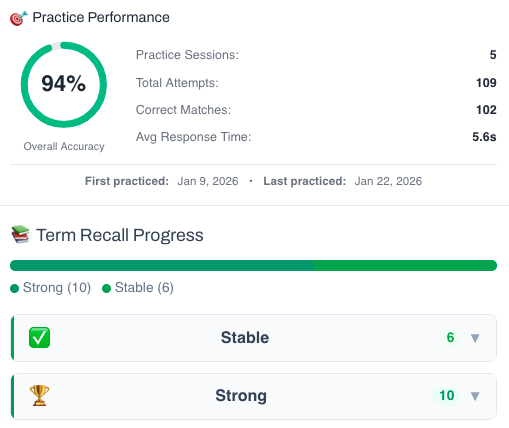
This isn’t a simple quiz — it’s a fully tracked learning system. You build knowledge through recognition, then recall, and your progress feeds directly into the Integrated Practice Bar (Writing tasks, AI Chat, and more).
- Practice sessions, accuracy, and response-time tracking
- Term strength levels (Learning → Stable → Strong)
- Personal progress history for each unit
This feature is available to YSP members.
Explore Membership Benefits🎮 Practice Games
Sentence Scrambler
Numbers 100 to 999 – Sentence Scramble
Member-Exclusive Sentence Builder
Reconstruct scrambled sentences to practice word order and develop your grammar intuition.
This feature is available to YSP members.
Explore Membership Benefits