GO + -ING: Activities and Adventures
Core PathWay
1 Section 1. Let's Go!
Want to talk confidently about activities and free time? It starts with these phrases.
In English, we use GO + -ING to talk about many leisure activities. The pattern is simple: GO + a verb ending in -ING.
For example: I go swimming. She goes running. We went hiking last weekend.
Notice that GO changes — I go, she goes, we went — but the -ING word stays the same.
Two of the most common phrases in this pattern are go shopping and go window-shopping.
Go shopping means to go to shops to buy things. For example: I go shopping every Saturday.
Go window-shopping is different. This means to look at things in shop windows but not buy anything. In other words, you enjoy looking — but you keep your money in your pocket.
These two phrases are a good example of how GO + -ING works. The -ING word tells you what kind of activity it is.
You will see this pattern again and again in this lesson. Each time, notice the -ING word — that is the activity.
2 Section 2. Moving Your Body
Many GO + -ING phrases are about exercise and moving your body. These are very common in everyday conversation.
Go swimming means to go to a pool, lake, or the sea to swim. For example: We go swimming at the local pool on Fridays.
Go running means to run outside for exercise. It is a very popular activity. For example: He goes running every morning before work.
Go jogging is similar to go running, but usually slower and more relaxed. Many people use go running and go jogging to mean the same thing, but go jogging often sounds more casual.
Go walking means to go for a walk, usually for pleasure or exercise. For example: We went walking in the park yesterday.
Go cycling means to ride a bike, usually for exercise or fun. For example: She goes cycling at the weekend.
Go dancing means to go somewhere to dance — usually to a club, a class, or a party. For example: They went dancing on Saturday night.
Go bowling means to play the sport of bowling, where you roll a ball to knock down pins. For example: Do you want to go bowling this evening?
All of these phrases follow the same pattern: GO + -ING. Notice how natural they sound in a sentence.
3 Section 3. On Wheels, Ice, and Water
Some GO + -ING phrases are about activities that use special equipment — like skates, skis, or a boat.
Go skating means to move on ice or a smooth surface using skates. For example: We went skating at the ice rink last winter.
Go skiing means to travel down snow-covered slopes on skis. For example: They go skiing in the Alps every February.
Go snowboarding is similar to skiing, but you use one wide board instead of two skis. For example: He tried go snowboarding for the first time last year.
Go sailing means to travel on water in a boat with a sail. For example: She goes sailing on the lake every summer.
Go surfing means to ride waves in the sea on a surfboard. For example: We went surfing in Portugal — the waves were perfect.
Go canoeing means to travel on water in a small, narrow boat called a canoe, using a paddle. For example: They went canoeing on the river at the weekend.
Notice that go skiing, go snowboarding, go skating, go sailing, go surfing, and go canoeing all describe activities where you move through or across something — snow, ice, or water. This is a useful way to remember them as a group.
4 Section 4. Out in Nature
Many GO + -ING phrases are about spending time outdoors in nature. These are very popular for talking about holidays and weekends.
Go sightseeing means to visit interesting or famous places, usually as a tourist. For example: We went sightseeing in Rome and saw the Colosseum.
Go hiking means to walk a long distance in the countryside or mountains. It is more serious than go walking. For example: They went hiking in the Scottish Highlands last summer.
Go camping means to sleep outdoors, usually in a tent. For example: We went camping near the lake — it was cold but beautiful.
Go fishing means to try to catch fish, usually in a river, lake, or the sea. For example: My grandfather loves to go fishing on Sunday mornings.
Go climbing means to climb rocks or mountains. For example: She goes climbing in the Peak District every spring.
Go horse riding means to ride a horse, usually for pleasure or sport. For example: Have you ever gone horse riding? It is harder than it looks.
Go hunting means to go into nature to find and catch wild animals. For example: He goes hunting in the forest with his father.
Go diving means to go underwater, usually with special equipment to help you breathe. For example: They went diving in the Red Sea and saw incredible fish.
These phrases are especially useful when you talk about holidays, travel, and outdoor adventures.
5 Section 5. Socialising and Nightlife
Not all GO + -ING phrases are about sport or nature. Some are about social life — going out and spending time with other people.
Go clubbing means to go to a nightclub to dance and socialise. For example: They went clubbing last Friday and stayed out until 3am.
Go drinking means to go to a bar or pub to have alcoholic drinks with friends. For example: A few colleagues went drinking after work on Thursday.
Go partying means to go to a party or to go out and celebrate. For example: She went partying with her friends on her birthday.
These three phrases are informal. We use them in conversation with friends, not in formal writing.
Notice something interesting: go clubbing, go drinking, and go partying often go together in stories about a night out. People might say: We went drinking, then went clubbing, and ended up partying until sunrise.
Also notice that go dancing from Section 2 fits here too — dancing in a club is very connected to go clubbing.
When you use these phrases, you can add details. For example: We went drinking at a little bar near the station. This gives a much clearer picture than just saying We went out.
6 Section 6. Using GO + -ING in Real Sentences
Now you have met all 26 GO + -ING phrases. Let’s look at how to use them naturally in sentences.
You can talk about habits: I go running three times a week. She goes cycling every Sunday.
You can talk about past experiences: We went skiing in Austria last winter. Have you ever gone diving?
You can make plans: Do you want to go bowling tonight? We are going camping next weekend.
You can ask questions: Where do you usually go walking? Have you ever gone horse riding?
Notice that after GO, the -ING word never changes. You do not say I went hiked or she goes swam. The -ING form is always the same: go hiking, go swimming — always.
Also notice that you can use the present perfect with these phrases: Have you ever gone surfing? I have never gone hunting.
One more thing to notice: some of these phrases are very common and some are less common. Go shopping, go swimming, go running, and go sightseeing are phrases you will hear all the time. Go canoeing or go snowboarding are less frequent, but they follow exactly the same pattern.
Pay attention to this pattern. The more you use it, the more natural it will feel.
7 Section 7. Now Hear It in Use
You have met all 26 phrases. Now hear them working in a real conversation.
Listen to Sam and Priya planning their holiday. Notice how naturally they use GO + -ING phrases to talk about activities, make suggestions, and reach a decision.
Pay attention to how the -ING word stays the same, even when GO changes.
💬 Dialogue 1: What Should We Do on Holiday?
Sam and Priya are friends planning a week-long holiday together. They are trying to agree on activities that both of them will enjoy.
Sam: “So, I was thinking — what if we went hiking in the mountains? I found this amazing trail that takes three days.”
Priya: “Three days hiking? That sounds exhausting! Can't we do something a bit more relaxed — like go sightseeing in a city, or maybe go cycling along the coast?”
Sam: “Cycling could work, actually. And we could go swimming in the sea too — the water should be warm in September. But I still want to do something outdoorsy. What about going camping for a couple of nights?”
Priya: “Camping could be fun, as long as we don't have to carry too much! And if we're near the coast, we could go sailing one afternoon — I've always wanted to try that.”
Sam: “Oh, sailing — yes! I love that idea. And what about the evenings? We can't just sit in a tent every night. Could we go dancing somewhere? I heard there are some great beach bars with live music.”
Priya: “Go dancing — definitely yes! And maybe one morning we could go fishing? My uncle used to take me when I was little, and I really enjoyed it. It's so peaceful.”
Sam: “Fishing? I've never tried it, but I'm open to it. OK, so we've got swimming, cycling, camping, sailing, dancing, fishing — that's already a lot! Do you want to go shopping at any point? We could look for local markets.”
Priya: “Oh, definitely — I'd love to go shopping for local food and souvenirs. And if we find a nice town, we could go window-shopping too, just to look around without spending too much money!”
Sam: “Ha! Yes, window-shopping is always a good idea for the budget. Right, so let's make a rough plan. Mornings — go cycling or go hiking on shorter trails. Afternoons — go swimming or go sailing. Evenings — go dancing or just relax.”
Priya: “That sounds perfect. And we can go sightseeing on the days when we're in a town — visit the old streets, the market, maybe a museum. I don't want the whole week to be just outdoor activities.”
Sam: “Agreed — a good mix of everything. I'll look into campsites near the coast this week. And maybe we should book the sailing trip in advance, because those spots fill up fast.”
Priya: “Good idea. I'll check the cycling routes and find some local markets for our shopping day. I can't wait — this is going to be a brilliant week!”
Member-Exclusive Practice Bar
Access a wide range of integrated practice for this unit — from Vocabulary and Grammar activities to AI-curated Writing tasks and Thematic Chat practice.
This feature is available to YSP members.
Explore Membership BenefitsMember-Exclusive Vocabulary Review & Acquisition System
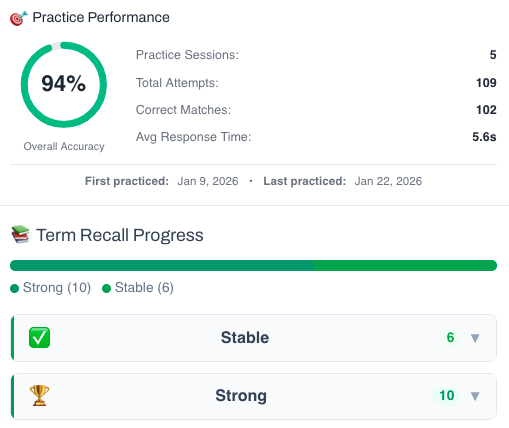
This isn’t a simple quiz — it’s a fully tracked learning system. You build knowledge through recognition, then recall, and your progress feeds directly into the Integrated Practice Bar (Writing tasks, AI Chat, and more).
- Practice sessions, accuracy, and response-time tracking
- Term strength levels (Learning → Stable → Strong)
- Personal progress history for each unit
This feature is available to YSP members.
Explore Membership Benefits