🎙 How Long Have You Been Doing That?
Present Perfect Continuous: Duration“RUN”
Understand and use the present perfect continuous to talk about actions that started in the past and are still happening now. Say how long something has been going on using for and since.
🚌 On the go
Press play once and listen to the whole episode: the welcome, the grammar, the word focus and the story. Perfect for the bus, the car or a walk.
One button, the whole episode. Good for the bus, the car or a walk.
🧩 Piece by piece
Take your time. Listen to one part at a time, then open Read and replay line by line to hear any sentence again.
Welcome
Jenny: “Welcome to the YouSpeakPlus Audio Cast. I'm Jenny.”
Bill: “And I'm Bill. Great to have you with us today.”
Jenny: “So today we're looking at how to talk about things that started in the past and are still happening now. For example: she's been running the project for six months.”
Bill: “And we're also exploring the word run. It does a lot more than just moving fast on your feet.”
Jenny: “Then we bring it all together in a short story about two colleagues and a very long week.”
Bill: “Ready? Let's start.”
Part 1 · Grammar
Jenny: “Today we're looking at how to say something started in the past and is still happening now. This is useful when you want to show that an action is not finished. Listen to this sentence: I've been living in Rome for ten years.”
Giulia: “I've been living in Rome for ten years. So that means I'm still there right now?”
Jenny: “Exactly. The action started in the past and it's still true right now. That's the key idea. It hasn't stopped. Now, when do we use this? Think about a friend who started a new job in January. She's still working there today. How would you say that?”
Giulia: “She's been working there since January?”
Jenny: “Perfect. Now think about waiting. Imagine you're at a bus stop. You arrived twenty minutes ago and the bus still hasn't come. What would you say?”
Giulia: “I've been waiting for this bus for twenty minutes?”
Jenny: “That's exactly right. You're still at the stop, still waiting. The action is ongoing. Now what about your English studies? You started your course a while ago and you're still going. How would you say that?”
Giulia: “I've been studying English for two years. Or maybe: I've been studying English since last September?”
Jenny: “Both are correct. Well done. So you've noticed something important there. We can use for or since with this form, but they do different jobs. Use for with a length of time: for two years, for six months, for a few weeks. Use since with a starting point: since Monday, since last September, since two thousand and twenty.”
Giulia: “Oh, I see. So since is the moment it started, and for is how long it's been going on.”
Jenny: “Exactly right. Now let's look at the pattern itself. It's: have or has, then been, then the main verb with ing. So: I've been working, she's been waiting, they've been living. The been stays the same every time. Only the main verb changes.”
Giulia: “Have been working. OK, I think I've got it. Can I try some examples?”
Jenny: “Please do. Tell me about your city. How long have you lived there?”
Giulia: “I've been living in Milan since I was a child.”
Jenny: “Lovely. Now tell me about a hobby. Something you started in the past and still do now.”
Giulia: “I've been playing the piano for about fifteen years.”
Jenny: “That's great. One more. Your friend Marco started running last spring. He still runs every weekend. What would you say about him?”
Giulia: “He's been running since last spring.”
Jenny: “Perfect. Now let's look at two common mistakes. I want you to listen carefully and tell me what's wrong. First one: I work here for five years.”
Giulia: “I work here for five years. Hmm. Is it wrong because I'm still working there now? So it needs the full form?”
Jenny: “Exactly. The action is still going on, so we need the present perfect continuous. The correct sentence is: I've been working here for five years. Say it once more.”
Giulia: “I've been working here for five years.”
Jenny: “Good. Now the second mistake. This one is very common. Listen: I've been living here since five years. What's the problem?”
Giulia: “Since five years is wrong because since needs a starting point, not a length of time. It should be: I've been living here for five years.”
Jenny: “Spot on. So remember: since two thousand and twenty is fine because that's a point in time. But since five years is wrong because five years is a length, not a point. Use for with a length of time. So today's pattern is: have or has, plus been, plus verb-ing, plus for or since. Before next time, think of two or three things in your own life that are still going on, and practise saying them out loud.”
Part 2 · Word focus
Jenny: “OK, Giulia. Today we're looking at one small word with a lot of jobs. The word is run. Listen: I run every morning before work.”
Giulia: “Run. Yes, that's easy. It means to move fast on foot, right?”
Jenny: “That's the most common meaning, yes. She runs five kilometres every day. He ran all the way to the bus stop. That's the physical sense.”
Giulia: “OK, simple enough. Is there another meaning?”
Jenny: “Lots. Here's a very useful one. Listen: My uncle runs a hotel in Florence. She's been running the company for ten years.”
Giulia: “Oh, so run can mean manage? Like, be in charge of something?”
Jenny: “Exactly. You can run a business, run a team, run a project. It's very natural in everyday English. More natural than manage, actually, in conversation.”
Giulia: “So I could say: my brother runs a small shop?”
Jenny: “Perfect. Now here's a third sense. Think about technology. This app runs on older phones. The heating system runs on gas.”
Giulia: “So it means the machine or the system works, or operates?”
Jenny: “Right. And notice: the computer's running slowly today. That means it's operating but not well. Now, what about transport? Listen: the trains don't run on Sundays.”
Giulia: “Oh, so run means the service goes, or travels on its route?”
Jenny: “Exactly. The buses run every fifteen minutes. The ferry runs twice a day. It's about a regular service. Now let's look at a few less common uses.”
Giulia: “OK, I'm ready.”
Jenny: “Listen to this one: she's running for mayor next month. What do you think that means?”
Giulia: “Running for mayor? Is she trying to win the election?”
Jenny: “Spot on. Run for president, run for office. It means you're a candidate. And here's one more: we've run out of coffee. There's none left.”
Giulia: “Oh, run out of. I know that one. We ran out of time in the exam.”
Jenny: “Good. And there's in the long run. That means after a long time, when you look at everything. It costs more now, but it's cheaper in the long run.”
Giulia: “In the long run. OK. Can I ask something? In Italian, correre means to run. But we also use it for being very busy. Can I say: I've been running all day?”
Jenny: “Ah, good question. In English, running all day means physically running, like a marathon. We'd say: I've been on the run all day, or just: I've been so busy all day.”
Giulia: “So on the run all day is the right phrase for that feeling of being rushed?”
Jenny: “Yes, on the run means moving fast from thing to thing, no time to stop. Now let's do a quick check. I say a sentence, you tell me which meaning of run it is.”
Giulia: “OK, go ahead.”
Jenny: “First one: the show ran for two years in London.”
Giulia: “That means it continued for two years, right? Like it was on for that time?”
Jenny: “Exactly. Second one: she runs a language school in Rome.”
Giulia: “She manages it. She's in charge of it.”
Jenny: “Right. Last one: the buses don't run on public holidays.”
Giulia: “The service doesn't operate. There are no buses those days.”
Jenny: “Perfect. So the one thing to remember: run does a lot of work. Move fast, manage something, operate, travel on a route. Pay attention to what's around it and the meaning becomes clear.”
- move fast on foot She runs to the station every morning because she's always late.
- manage or be in charge of a business, organisation, or event He runs a small restaurant in the city centre.
- a machine, engine, or system operates or functions The app runs on both phones and tablets.
- a bus, train, or service travels on a regular route The buses don't run after midnight.
- a liquid moves or flows She ran some cold water over her hand.
- a programme, show, or event continues for a period of time The play ran for six months in London.
- stand as a candidate in an election She's running for mayor next year.
- a road, path, or line goes in a particular direction The river runs along the edge of the town.
Part 3 · Story
Jenny: “It's Friday afternoon, and Sofia drops into the chair next to Dan. She looks exhausted.”
Bill: “I've been running this whole project by myself since Monday. I'm completely done.”
Jenny: “Dan looks up from his laptop.”
Bill: “I know. I've been watching you go from meeting to meeting all week.”
Jenny: “Sofia nods and says:”
Bill: “Paolo should have been here. He's been running the team for three years. He knows how everything works.”
Jenny: “Dan nods slowly and asks:”
Bill: “How long has he been away? It feels like forever.”
Jenny: “Sofia counts on her fingers.”
Bill: “He's been travelling for clients since last Sunday. Five days.”
Jenny: “Dan laughs.”
Bill: “Only five days? I've been telling everyone it's been two weeks.”
Jenny: “Sofia does not laugh.”
Bill: “It's not funny, Dan. The system has been running on the old settings since Tuesday. Nobody's fixed it.”
Jenny: “Dan sits up straight.”
Bill: “Wait, since Tuesday? That's three days. Why didn't you say something?”
Jenny: “Sofia gives him a look.”
Bill: “I've been trying to deal with the client reports. I haven't had time.”
Jenny: “Dan pulls up the system on his screen.”
Bill: “OK, I'll look at it now. It won't take long.”
Jenny: “Then Sofia's phone rings. She looks at the screen and sighs.”
Bill: “It's the director. She's been calling me for the last hour.”
Jenny: “Sofia answers the call.”
Bill: “Yes, the report is nearly ready. We've been working on it for two days.”
Jenny: “There is a pause. Then Sofia's face changes.”
Bill: “Oh. You want it today? Not Monday?”
Jenny: “She ends the call and looks at Dan.”
Bill: “We've run out of time. The deadline is five o'clock.”
Jenny: “Dan closes the system window.”
Bill: “Right. I'll take over the report. You fix the system. Deal?”
Jenny: “Sofia nods.”
Bill: “Deal. And next week, you're running the Monday meeting. I need a rest.”
Jenny: “Dan grins.”
Bill: “Fine. But in the long run, we really need Paolo back.”
Jenny: “They both look at the clock. Four forty-five. They've been sitting there for exactly three minutes. They get back to work.”
Bill: “So there's your story. Now listen again and count how many times you hear the present perfect continuous. It came up eight times. And how many times did you hear 'run' used in different ways? Four times. See what you catch.”
Member-Exclusive Practice Bar
Access a wide range of integrated practice for this unit — from Vocabulary and Grammar activities to AI-curated Writing tasks and Thematic Chat practice.
This feature is available to YSP members.
Explore Membership BenefitsMember-Exclusive Vocabulary Review & Acquisition System
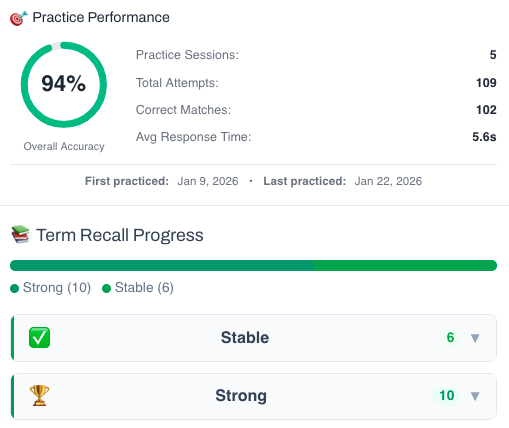
This isn’t a simple quiz — it’s a fully tracked learning system. You build knowledge through recognition, then recall, and your progress feeds directly into the Integrated Practice Bar (Writing tasks, AI Chat, and more).
- Practice sessions, accuracy, and response-time tracking
- Term strength levels (Learning → Stable → Strong)
- Personal progress history for each unit
This feature is available to YSP members.
Explore Membership Benefits