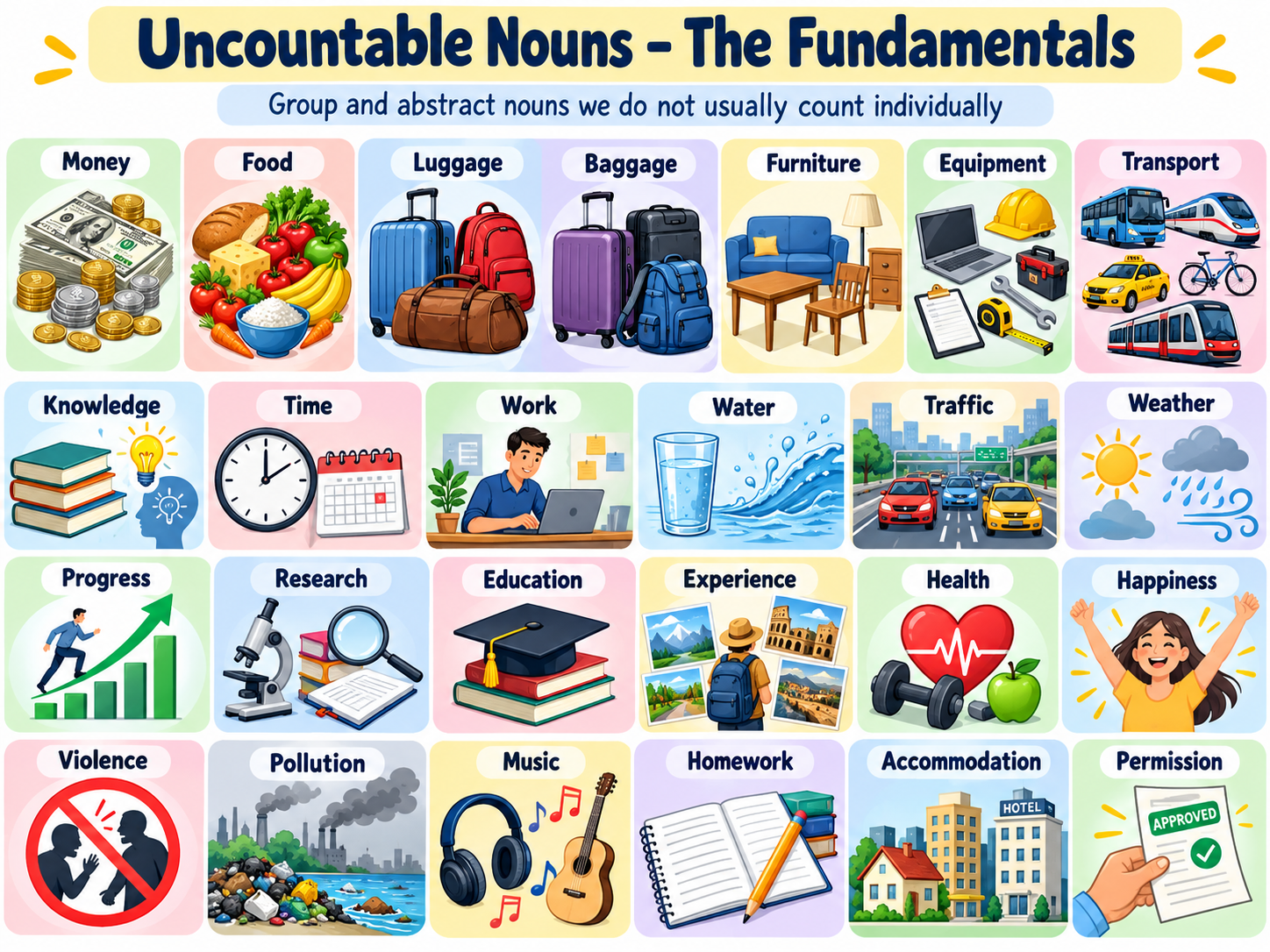
Uncountable Nouns | Pack 1 | Fundamental
Core PathWay1 Section 1. What Are Uncountable Nouns?
Want to talk confidently about everyday life in English? It starts with these words.
Some nouns in English have no plural form. We call them uncountable nouns. This means we cannot say ‘a knowledge’ or ‘two knowledges’. We just say knowledge.
Here is the key pattern to notice: uncountable nouns never take ‘a’ or ‘an’. They never add -s at the end. And we use ‘is’ with them, not ‘are’.
Look at these examples:
‘Money is important, but it isn’t everything.’
‘Time passes quickly when you’re busy.’
‘Water is essential for life.’
Each of these nouns refers to something we think of as a whole — not as separate, countable things. You cannot count water drop by drop and call each one ‘a water’. You think of water as a substance.
This is the same for food. We say ‘there is food on the table’, not ‘there are foods on the table’ (unless we mean different types of food).
Notice also that we use ‘some’, ‘much’, ‘a lot of’, or ‘a little’ with these nouns — not ‘many’ or ‘a few’. ‘Much knowledge‘ and ‘a little time‘ are correct. ‘Many knowledges’ is not.
2 Section 2. Things You Can't Put in a Bag
Some uncountable nouns are easy to picture because they are physical — you can see or touch them. Others are harder to picture because they are ideas or feelings.
Let’s start with physical things. Water is uncountable. Food is uncountable. Traffic is uncountable — it refers to all the vehicles on a road together, not individual cars.
‘There was a lot of traffic on the motorway this morning.’
Now think about things you carry when you travel. When you pack your bags for a trip, all those bags together are called luggage or baggage. Both words mean the same thing. Neither has a plural form.
‘I only have one bag, so I don’t have much luggage.’
‘The airline lost my baggage.’
Next, think about the things inside a home or office — the chairs, tables, desks, and shelves. Together, we call all of these furniture. It is always uncountable.
‘We need to buy some new furniture for the office.’
And the tools, machines, or devices used for a specific job? That is equipment. A camera, a laptop, a drill — these are all pieces of equipment.
‘The team has all the equipment they need for the project.’
Notice the pattern: ‘a piece of furniture’, ‘a piece of equipment’, ‘a piece of luggage’. We use ‘piece of’ to count individual items when the noun itself cannot be counted.
3 Section 3. Things You Can't See or Touch
Many uncountable nouns are abstract. This means they are ideas, not physical things. You cannot hold them or put them in a box.
Work is one of the most common. It refers to tasks, effort, or employment in general. ‘I have a lot of work to do today.’ Note that ‘a work’ is possible in art — ‘a work of art’ — but in everyday speech, work is uncountable.
Knowledge refers to everything you know about a subject. ‘She has a lot of knowledge about history.’
Education is the process of learning, usually in a school or university. ‘A good education opens many doors.’
Experience is what you learn from doing things over time. ‘He got the job because he had a lot of experience.’ Note: ‘an experience’ (countable) means one particular event. ‘Experience’ (uncountable) means general skill built over time.
Progress means moving forward or improving. ‘The students are making good progress.’
Research means careful study to find new information. ‘Scientists are doing research into the disease.’
Health is the condition of your body and mind. ‘Good health is more valuable than money.’
Happiness is the feeling of being happy. ‘Money can’t buy happiness.’
These abstract nouns all follow the same rule: no article ‘a/an’, no plural -s, and we use ‘is’ with them, not ‘are’.
4 Section 4. Society, Environment, and Everyday Life
Some uncountable nouns describe things around us in society and the world.
Weather refers to the conditions outside — sun, rain, wind, and so on. We always say ‘the weather’. ‘The weather was beautiful yesterday.’
Pollution means harmful substances in the air, water, or land. ‘Air pollution is a serious problem in many cities.’
Violence means physical force used to hurt people. ‘There is too much violence in some neighbourhoods.’
Music is sound organised into patterns that people enjoy. ‘She listens to music while she works.’
Now think about practical everyday needs. Transport refers to all the ways of moving from one place to another — buses, trains, cars, and so on. ‘Public transport in this city is very good.’
Accommodation means a place to stay, such as a flat, hotel, or room. ‘Finding affordable accommodation in the city centre is difficult.’
Permission means the right to do something, given by someone in authority. ‘You need permission from your manager to take the day off.’
Homework is the work that students do at home for school or class. ‘The teacher gave us a lot of homework this week.’
All of these nouns describe things that exist around us, but we think of each one as a whole, not as separate countable units. This is why they are uncountable.
5 Section 5. Key Collocations — the Words That Go Together
Knowing a word is only half the job. The other half is knowing which words go with it naturally.
With time, we say: ‘spend time’, ‘save time’, ‘waste time’, ‘have time’, ‘run out of time’.
With money, we say: ‘spend money’, ‘save money’, ‘earn money’, ‘run out of money’.
With work, we say: ‘do work’, ‘find work’, ‘look for work’, ‘finish work’.
With research, we say: ‘do research’, ‘carry out research’, ‘conduct research’.
With progress, we say: ‘make progress’. This is the standard collocation — ‘do progress’ is not correct.
With experience, we say: ‘have experience’, ‘gain experience’, ‘get experience’.
With knowledge, we say: ‘have knowledge’, ‘gain knowledge’, ‘share knowledge’.
With permission, we say: ‘ask for permission’, ‘give permission’, ‘get permission’.
With education, we say: ‘get an education’, ‘receive an education’.
Notice that ‘make progress’ and ‘do research’ are fixed combinations. Native speakers use these automatically. Pay attention to them when you read or listen, and try to use the same combinations when you speak or write.
With traffic, weather, pollution, and violence, we often say ‘heavy’ or ‘serious’: ‘heavy traffic‘, ‘heavy pollution‘, ‘serious violence‘.
With luggage and baggage, we say ‘carry luggage’, ‘check in baggage’, ‘lose luggage’.
With furniture and equipment, we say ‘buy furniture’, ‘use equipment’, ‘need equipment’.
6 Section 6. Common Mistakes to Watch For
These nouns cause mistakes for many learners. Here are the most common ones.
Mistake 1: Adding -s. Never say ‘informations’, ‘furnitures’, ‘equipments’, ‘homeworks’, ‘researches’ (as a general noun), or ‘luggages’. These forms do not exist in standard English.
Mistake 2: Using ‘a’ or ‘an’. Never say ‘a knowledge’ or ‘a progress’. If you need to refer to one item, use ‘a piece of’: ‘a piece of furniture‘, ‘a piece of equipment‘, ‘a piece of luggage‘.
Mistake 3: Using ‘many’ instead of ‘much’. Say ‘much work‘, ‘much traffic‘, ‘much pollution‘ — not ‘many works’, ‘many traffics’.
Mistake 4: Confusing ‘experience’ (uncountable) and ‘an experience’ (countable). ‘She has a lot of experience in marketing.’ (general skill) vs ‘That was an amazing experience.’ (one event).
Mistake 5: Confusing luggage and baggage. These two words mean the same thing. Luggage is more common in British English. Baggage is more common in American English. Both are correct.
Mistake 6: Using ‘do’ instead of ‘make’ with progress. Always say ‘make progress‘, not ‘do progress’.
Mistake 7: Forgetting that accommodation and transport are uncountable. Do not say ‘an accommodation’ or ‘a transport’. Say ‘some accommodation’ or ‘public transport’.
Keep these patterns in mind and your accuracy will improve quickly.
7 Section 7. Now Hear It in Use
You’ve met all 25 words. Now hear them working in a real conversation. Listen to how two speakers use these uncountable nouns naturally — notice the collocations, the quantifiers, and the way neither speaker ever adds -s to these nouns.
💬 Dialogue 1: A New Job in a New City
Maya has just accepted a new job in another city. She is talking to her friend Dan, who moved to the same city two years ago. They are discussing what Maya needs to organise before she starts work.
📝 Comprehension Check: Maya's Big Move
Answer the questions based on what you heard in the audio.
Which speaker says that the cost of living near the workplace is very high?
Which speaker says that a Sunday market is a good place to save money on furniture?
Which speaker plans to send some things by delivery service before the main move?
What does Dan say about the train journey?
Why is Maya worried about starting her new job?
What does Dan say Maya should do first to get ready for the move?
Maya: “Dan, I finally got the job. I start in three weeks, but I have so much to sort out. Finding accommodation is the biggest problem right now — everywhere near the office is really expensive.”
Dan: “Congratulations, Maya! That's brilliant news. I remember that feeling. When I moved here, I spent a lot of time looking before I found a good place. Have you thought about areas a bit further out? The transport links are actually very good from the east side of the city.”
Maya: “That's a good idea. I also need to think about moving all my furniture. I have quite a lot of it, and I don't want to leave it behind. Do I need special permission from the building to use the lift for moving?”
Dan: “Yes, most buildings here ask for permission in advance — usually just an email to the building manager. It's not complicated, but you need to give them some notice. And honestly, moving a lot of furniture on your own is hard work. Have you thought about hiring a van?”
Maya: “I was thinking about that. But I'm worried about money — moving is so expensive, and I also need to buy some equipment for my new flat, like a desk and some kitchen things.”
Dan: “I know, the costs add up quickly. When I moved, I didn't have much money to spare either. One thing that helped me was buying second-hand furniture — there's a great market here on Sundays. You can find some really good stuff for very little money. It might be worth checking out before you spend too much.”
Maya: “Oh, that sounds perfect. I'll definitely look into that. What about luggage — I'm planning to take a few bags on the train when I first arrive, before the furniture is moved. Is there much space for luggage on the trains here?”
Dan: “The trains are fine for luggage — there's usually a good amount of space in the overhead racks, and the journey is only about two hours. Just make sure you don't bring too much baggage on a busy Friday train, though. Those get quite full. Can you split your things into two trips if you need to?”
Maya: “Two trips is a good idea. I think I'll send some boxes by courier and just take the essentials on the train. I'm also a bit nervous about starting work — it's a new team, and I don't have much knowledge of the software they use.”
Dan: “Don't worry too much about that. You'll pick it up quickly. Most companies expect some learning time at the start — they know you won't have all the knowledge on day one. And if the work gets overwhelming at first, just ask for help. People here are generally very friendly.”
Maya: “That's really reassuring. I think I'm making progress with the planning — I have a list now and I feel a bit more organised. I just need to make sure I don't run out of time before the start date.”
Dan: “You're doing great, Maya. Three weeks is actually a reasonable amount of time if you stay organised. Sort out the accommodation first, then the transport, and leave the smaller things for last. And remember — I'm just a phone call away if you need any help when you arrive.”
Member-Exclusive Practice Bar
Access a wide range of integrated practice for this unit — from Vocabulary and Grammar activities to AI-curated Writing tasks and Thematic Chat practice.
This feature is available to YSP members.
Explore Membership BenefitsMember-Exclusive Vocabulary Review & Acquisition System

This isn’t a simple quiz — it’s a fully tracked learning system. You build knowledge through recognition, then recall, and your progress feeds directly into the Integrated Practice Bar (Writing tasks, AI Chat, and more).
- Practice sessions, accuracy, and response-time tracking
- Term strength levels (Learning → Stable → Strong)
- Personal progress history for each unit
This feature is available to YSP members.
Explore Membership Benefits