🎙 Few or A Few: Good News or Bad?
Few / Little — scarcity, sufficiency & contextual evaluation“Experience”
Understand the difference between 'few', 'a few', 'little', and 'a little', and choose the right form to show whether a quantity feels positive or negative in context.
One button, the whole episode. Good for the bus, the car or a walk.
Welcome
Jenny: “Welcome to the YouSpeakPlus Audio Cast. Today we're looking at two things that go together really well.”
Elena: “What are we starting with?”
Jenny: “First, the difference between 'a few' and 'few', 'a little' and 'little'. Same small amount — but very different feelings. For example: I have a little time, so we can talk.”
Elena: “And the second thing?”
Jenny: “The word 'experience'. It has more than one job in English, and choosing the wrong one is a very common mistake.”
Elena: “So we'll hear some dos and don'ts, and one question to keep in mind?”
Jenny: “Exactly. And at the end, a short story that puts everything together. Ready? Let's start.”
Part 1 · Grammar
Jenny: “Today we're looking at 'a few', 'few', 'a little', and 'little'. Listen to this: we have a little time, so we can relax. That small amount is ENOUGH. That's the key idea today: the same small quantity, but two very different feelings.”
Elena: “So the words change the feeling, not just the number?”
Jenny: “Exactly. It's your viewpoint — the way you choose to present the quantity. And that choice changes everything.”
Jenny: “Listen to two sentences. First: there's a little petrol, so we can reach the next town. Second: there's little petrol, so we need to stop now and buy some more. Same small amount of petrol — different viewpoint, different consequence.”
Elena: “Oh, 'a little' is good news and 'little' is bad news?”
Jenny: “That's a great start. 'A little' says: some exists, and it's enough. 'Little' says: the amount is very small — less than I need or expected. Now listen with countable nouns. I've got a few emails to answer, so I'll be busy for a while. I've got few emails today, so I can finish early.”
Elena: “So 'a few' means some emails exist, and 'few' means almost none?”
Jenny: “Right. 'A few' highlights the feelining of 'suffiecient for our needs'. But 'Few' highlights scarcity — not enough, or a surprisingly small quantity. One more pair. We had a few meetings this week, so the team is well informed. This means we had enough meetings – NOT many, but enough. compare that with 'We had few meetings this week, so nobody knows the plan'. In that sentence we didn't have enough meetings.”
Elena: “I see it now. The article 'a' changes the whole feeling.”
Jenny: “Exactly. And here's the pattern for each form. Use 'a few' or 'few' with a plural countable noun — like 'meetings', 'emails', 'days'. Use 'a little' or 'little' with an uncountable noun — like 'time', 'petrol', 'money'. Never say 'a few time' or 'a little emails'. Those combinations don't work.”
Elena: “And can I say 'very a little'? Like, to make it stronger?”
Jenny: “No — never 'very a little'. You can say 'very little' or 'very few' to make the SCARCITY stronger. 'I have Very little money, so I can't go out for a pizza.' But never put 'very' in front of 'a little' or 'a few'.”
Jenny: “Good. Now it's your turn. Here's a situation: you worked late last night, and you only slept for four hours. Tell me about your sleep, and say what happened this morning because of it.”
Elena: “I had a little sleep, so I was tired this morning?”
Jenny: “Good try, but think about the viewpoint. Was four hours enough, or not enough?”
Elena: “Not enough. So… I had very little sleep, so I was tired this morning.”
Jenny: “Yes, and say it once more.”
Elena: “I had very little sleep, so I was tired this morning.”
Jenny: “Perfect. 'very Little' showed the scarcity, and the consequence matched it. Now: you have some money saved — not a lot, but enough for a short holiday. Tell me.”
Elena: “I've saved a little money, so I can take a short holiday.”
Jenny: “That's exactly right. 'A little' communicated this: 'I don't have a lot of money, but I have ENOUGH for the short holiday. Now try this one. You sent a survey at work, and many people replied — more than you expected. Use 'quite a few'.”
Elena: “Quite a few colleagues replied, so I have a lot of data.”
Jenny: “Brilliant. 'Quite a few' means a fairly large number — more than a simple 'a few'. One more situation. You checked your calendar and almost no meetings are booked for Friday.”
Elena: “I have very few meetings this Friday, so I can focus on my report.”
Jenny: “Excellent. 'Very few' pushed the scarcity even further — almost none. Now let's look at two common mistakes. Listen to this wrong sentence: 'The flight had a few delays, so everything was fine.' Say that back to me.”
Elena: “The flight had a few delays, so everything was fine.”
Jenny: “Now, those two ideas fight each other. 'A few delays' says some delays existed. But 'everything was fine' says no problem. Those ideas don't match. Don't choose 'a few' or 'few' based on the noun alone. Decide by your viewpoint. If the delays were real and caused a problem, say: the flight had a few delays, so we arrived late. Say that.”
Elena: “The flight had a few delays, so we arrived late.”
Jenny: “And again.”
Elena: “The flight had a few delays, so we arrived late.”
Jenny: “Good. The consequence matched the viewpoint. Don't let the noun decide for you. Now, second mistake. Listen: 'Quite a few customers called, so nobody was interested.' Say it.”
Elena: “Quite a few customers called, so nobody was interested.”
Jenny: “Those ideas fight again. 'Quite a few' means a fairly large number — so 'nobody was interested' makes no sense. Don't confuse 'quite a few' with 'very few'. If almost nobody called, say: very few customers called, so we need a new plan. Say that twice.”
Elena: “Very few customers called, so we need a new plan. Very few customers called, so we need a new plan.”
Jenny: “Perfect. So: don't use 'quite a few' when you mean almost none. Use 'very few' for an extremely small number. Now, before you speak, ask yourself one question: is this good news or bad news?”
Elena: “So I ask myself: is this good news or bad news? Good news means 'a few' or 'a little'. Bad news, or not enough, means 'few' or 'little'.”
Jenny: “That's it. Use that question every time before you choose. It'll keep you on the right track.”
Part 2 · Word focus
Jenny: “Right, let's move on to a word you'll use every week. The word is 'experience'. Listen to this: she has ten years of experience, so the company trusts her completely. That word does two very different jobs in English, and Italian speakers often mix them up.”
Elena: “Two jobs? I thought 'experience' was just one word.”
Jenny: “It is one word, but it carries two separate meanings. And the grammar around it changes depending on which meaning you want. That's what we're focusing on today.”
Elena: “Okay, I'm listening.”
Jenny: “First meaning. 'Experience' without the article 'a' means knowledge and skill you've built over time by doing something — not from a book, but from actually doing it. Listen: he has a lot of experience in project management, so his team always meets its deadlines.”
Elena: “So it's like the knowledge you collect over the years at work?”
Jenny: “Exactly. It's uncountable in this meaning — no article 'a', no plural. One more example: I have little experience with this software, so I'll need some training. Notice: no article 'a', and no 's' at the end.”
Elena: “And 'little experience' — that's bad news, right? Like we practised before.”
Jenny: “Well noticed. 'Little experience' means not enough — so the consequence is needing training. Now your turn. Tell me about your own work background using this first meaning.”
Elena: “I have several years of experience in customer service, so I know how to handle difficult clients.”
Jenny: “That's excellent. No article, no plural, and a strong consequence. That's the first meaning working perfectly. Now the second meaning.”
Elena: “Okay.”
Jenny: “Second meaning. 'An experience' or 'experiences' — with the article 'a' or in the plural — means one specific event that happened to you, something you remember, often because it affected you. Listen: living in London was a wonderful experience, so she decided to stay another year.”
Elena: “So it's more like a story — something that happened to you.”
Jenny: “Exactly. It's a moment, an event, a memory. One more: travelling alone for the first time was a scary experience, so she called her family every evening. Notice the article 'a' before 'experience', and the consequence shows how it felt.”
Elena: “Can you have more than one? Like 'experiences' in the plural?”
Jenny: “Yes, absolutely. 'Experiences' in the plural means a collection of events you remember. For example: she talked about her experiences in Japan, so everyone wanted to hear more. Now your turn. Tell me about one memorable event from your life — travel, food, work, anything.”
Elena: “Eating street food in Bangkok was an amazing experience, so now I always try local food when I travel.”
Jenny: “That's a great sentence. 'An amazing experience' — one specific event, the article 'a', and a clear consequence. That's the second meaning done well. Now let's look at one less common but very useful use.”
Elena: “What is it?”
Jenny: “The fixed phrase 'in my experience'. You use it to share something you've learned from your own life or work. It signals that you're not just guessing — you know from practice. For example: in my experience, short meetings are more productive, so I always keep them under thirty minutes.”
Elena: “Oh, I like that. It sounds very natural and confident.”
Jenny: “It does. Use it when you want to show that your opinion comes from real knowledge, not just an idea. Now, here's the trap. This is where Italian speakers often go wrong. Listen to this sentence: 'I have a lot of experiences in finance, so I'd like this job.' Say that back to me.”
Elena: “I have a lot of experiences in finance, so I'd like this job.”
Jenny: “That sounds wrong to a native speaker. 'Experiences' in the plural means individual events you remember — like stories. But a job application needs the first meaning: your professional knowledge and skill. Those two ideas don't match. Which meaning do you need for a job application?”
Elena: “The first one — knowledge built over time. So I should say: I have a lot of experience in finance, so I'd like this job.”
Jenny: “Yes. Say it once more.”
Elena: “I have a lot of experience in finance, so I'd like this job.”
Jenny: “Perfect. No article, no plural — that's the professional skill meaning. Now let's practise both meanings together. I'll name a situation, and you make a sentence. First: you've worked in sales for eight years.”
Elena: “I have eight years of experience in sales, so I'm confident with clients.”
Jenny: “Good. No article, no plural, strong consequence. Next: you once cooked a traditional Italian meal for twenty people at a friend's wedding.”
Elena: “Cooking for twenty people was a memorable experience, so I still talk about it with my friends.”
Jenny: “Excellent. Article 'a', singular, specific event — that's the second meaning. One more: you want to share what you've learned from years of managing teams.”
Elena: “In my experience, clear communication is the most important thing in a team, so I always start every project with a team meeting.”
Jenny: “That's really natural. 'In my experience' opened the sentence, and the consequence was specific. Now a quick check. I'll say three short sentences. Tell me which meaning — professional knowledge, or a specific event.”
Elena: “Ready.”
Jenny: “First: she has a lot of experience with difficult negotiations.”
Elena: “That's professional knowledge — no article, built over time.”
Jenny: “Correct. Second: losing my luggage was a stressful experience, so I always carry essentials in my hand luggage now.”
Elena: “That's a specific event — article 'a', something that happened and she remembers it.”
Jenny: “Exactly right. Third: in my experience, the first week in a new job is always the hardest.”
Elena: “That's the fixed phrase — she's sharing something she learned from her own life.”
Jenny: “Perfect, all three. So before you use this word, ask yourself: am I talking about knowledge built over time, or about one event I remember? Knowledge built over time — no article, no plural. One event I remember — article 'a', or the plural 'experiences'.”
Elena: “So the question is: am I talking about knowledge built over time, or about one event I remember? If it's knowledge, no article. If it's an event, use the article 'a' or the plural.”
Jenny: “That's it exactly. Keep that question with you every time you use this word, and you'll always choose the right form.”
- knowledge and skill you gain over time by doing something, not from a book She has ten years of experience in marketing, so the company trusts her decisions.
- something that happens to you and that you remember, often because it affected you strongly Living abroad was a wonderful experience, so she decided to stay another year.
- to have something happen to you, or to feel something directly He experienced a lot of stress at work, so he asked for a shorter schedule.
Part 3 · Story
Jenny: “Now here is a story that puts today's lesson into practice. It's Friday afternoon in a company's HR office. Two managers, Clare and David, are reviewing candidates for a new project coordinator role. They have a shortlist of three people and very little time before the end of the day.”
Clare: “Okay, David, we have very little time before the five o'clock meeting. Let's go through these three candidates quickly.”
David: “Agreed. I've read all the files. Let's start with Marco.”
Clare: “Marco. Right. He has a few years of project experience, so he knows the basics. But he's only managed small teams.”
David: “Small teams are fine for this role. What worried me was his application. He wrote that he has 'many experiences in project management.' That phrase sounded odd to me.”
Clare: “You're right, it did. He probably meant professional knowledge — the kind you build over years of work. But 'experiences' in the plural sounds like he's talking about individual events he remembers, not a solid professional background.”
David: “Exactly. In my experience, that kind of mistake in a written application tells you something about a candidate's attention to detail.”
Clare: “Fair point. Still, his interview was decent. He had a few good answers about handling difficult clients.”
David: “A few good answers — so enough to stay on the list, but not enough to put him at the top.”
Clare: “Agreed. Let's move to Sofia. She has little experience with the software we use, so she'd need training in the first month.”
David: “That's a real problem. The project starts in three weeks. We have very little time for training right now.”
Clare: “I know. And during her interview, she mentioned a strange experience with a previous manager — apparently he gave her almost no feedback for six months.”
David: “Six months with almost no feedback? That must have been a difficult experience for her.”
Clare: “It was. She handled it well, though. She set up her own review meetings and asked for feedback herself.”
David: “That's actually impressive. But the software gap is still a problem. Little experience with the tools means she can't hit the ground running.”
Clare: “Right. So Sofia stays on the list, but she's not our first choice. Now, James.”
David: “James. Now, he's interesting. He has quite a few years of experience in coordination roles, so he already knows how these projects work.”
Clare: “Quite a few years — so more than just a little background. That's good news.”
David: “And he's worked with our software before. He said in the interview that he uses it every day in his current job.”
Clare: “So very few gaps in his profile. I liked him. He was confident but not arrogant.”
David: “In my experience, that balance is rare. Most candidates are either too quiet or they oversell themselves.”
Clare: “He did mention one thing that gave me pause. He said his last role had a substandard experience with team communication — basically, nobody talked to each other.”
David: “A substandard experience — so a specific event, or a whole period that went badly?”
Clare: “A whole period, I think. He said it lasted almost a year. But he fixed it by introducing weekly check-ins.”
David: “So he identified the problem and acted on it. That's exactly what we need in this role.”
Clare: “I agree. And he had quite a few concrete examples ready — not just general ideas, but real situations he'd handled.”
David: “Quite a few examples — so a fairly large number. That always impresses me more than a candidate who gives very few details.”
Clare: “Right. Very few details usually means the experience isn't as deep as the CV suggests.”
David: “So we're agreed. James is the strongest candidate. We offer him the role with a three-month probationary period.”
Clare: “Yes. And we keep Sofia's details. If James says no, she's our next call — she just needs a little support with the software at the start.”
David: “A little support — so some, and probably enough. That works. I'll send James the offer this afternoon.”
Jenny: “Now listen to the story one more time. Count how many times you hear 'a few', 'few', 'a little', 'little', 'quite a few', or 'very few' — the answer is twelve. And listen for the word 'experience' in its different uses — you'll hear it nine times.”
Jenny: “And remember the two questions. For the grammar: is this good news or bad news? Good news means 'a few' or 'a little'. Bad news, or not enough, means 'few' or 'little'. For the word: am I talking about knowledge built over time, or about one event I remember? Keep those two questions with you, and you'll always choose the right form.”
Member-Exclusive Practice Bar
Access a wide range of integrated practice for this unit — from Vocabulary and Grammar activities to AI-curated Writing tasks and Thematic Chat practice.
This feature is available to YSP members.
Explore Membership BenefitsMember-Exclusive Vocabulary Review & Acquisition System
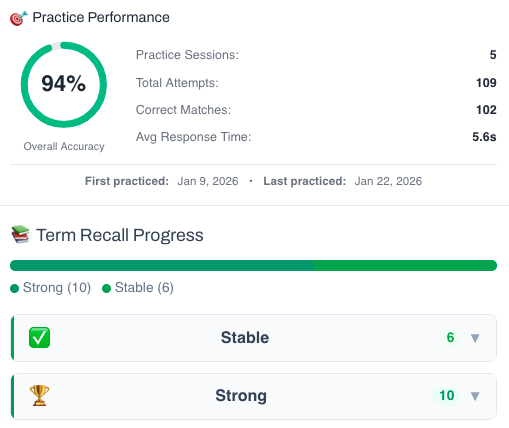
This isn’t a simple quiz — it’s a fully tracked learning system. You build knowledge through recognition, then recall, and your progress feeds directly into the Integrated Practice Bar (Writing tasks, AI Chat, and more).
- Practice sessions, accuracy, and response-time tracking
- Term strength levels (Learning → Stable → Strong)
- Personal progress history for each unit
This feature is available to YSP members.
Explore Membership Benefits