🎙 What Are You Doing Right Now?
Present Continuous — happening now “Vocabulary Focus: have as a state and an action”
Use the present continuous to talk about actions happening right now. Recognise the signals ‘Look!’ and ‘Listen!’ that tell you to use this form.
One button, the whole episode. Good for the bus, the car or a walk.
Welcome
Josie: “Welcome to the YouSpeakPlus Audio Cast. Today we have three parts for you.”
Marco: “First, the present continuous — actions happening right now. Like this: ‘She is working, so I can’t call her.’”
Josie: “Then we look at the word ‘have’. It does more than one job, and that surprises a lot of learners.”
Marco: “And then a short story that puts both together. You will hear some dos and don’ts, and one question to remember.”
Josie: “Ready? Let’s start.”
Part 1 · Grammar
Josie: “Today we’re talking about actions happening right now. Listen to this: ‘She is working.’ She is working right now, so I can’t call her. That’s the present continuous, and that’s our focus today.”
Marco: “OK. So it’s for things that are happening at this moment?”
Josie: “Exactly. Right now, at this moment. Not every day, not always. Just now.”
Josie: “Listen to four situations. First: Look out the window. It is raining, so we need an umbrella. Second: Listen! The phone is ringing, so someone wants to talk to you.”
Marco: “OK, I hear the difference. ‘It is raining’ means right now, outside.”
Josie: “Yes. Third: My colleague is eating lunch right now, so I can’t ask her a question. Fourth: The children are sleeping, so we can talk quietly.”
Marco: “I see. Every example has a consequence. ‘She is sleeping, so we can be quiet.’ The action is happening now, and that changes something.”
Josie: “Perfect. That’s exactly the idea. Now, notice the signals. ‘Look!’ and ‘Listen!’ are your biggest signals. They tell you to use this form.”
Marco: “Because when I say ‘Look!’, the action is happening at that exact moment?”
Josie: “Yes. ‘Look! The bus is coming.’ Right now. You can see it. Now let’s look at the form.”
Josie: “The frame is: subject, then ‘am’, ‘is’, or ‘are’, then the verb with ‘ing’ at the end. ‘I am working.’ ‘She is eating.’ ‘They are waiting.’ Always ‘am’, ‘is’, or ‘are’ plus ‘ing’.”
Marco: “And never without ‘is’ or ‘are’?”
Josie: “Never. You always need ‘am’, ‘is’, or ‘are’. Never just the verb with ‘ing’ alone.”
Josie: “Now your turn, Marco. I give you a situation, you make a sentence with a consequence. Ready? The situation: your boss is in a meeting right now.”
Marco: “My boss is having a meeting right now, so I can’t talk to him.”
Josie: “Great sentence. You used ‘is’ and ‘ing’, and the consequence makes the meaning clear. One more. The situation: you look out the window and you see your neighbour. She is running.”
Marco: “Look! My neighbour is running, so she can’t stop to talk.”
Josie: “Excellent. You used ‘Look!’ as your signal. That’s exactly right. Next situation: your phone is on the table and it starts to make a sound.”
Marco: “Listen! My phone is ringing, so I need to answer it.”
Josie: “Perfect. ‘Listen!’ tells everyone the action is happening right now. One more situation: you are in a queue at the supermarket. The queue is not moving.”
Marco: “The queue is not moving, so I am waiting a long time.”
Josie: “Good. You kept both verbs in the right form. Now a harder one. Your friend is at the coffee machine. He makes coffee.”
Marco: “He makes coffee right now, so I can wait and have one.”
Josie: “Almost. Think about the moment. Is it happening right now, at this moment? ‘He makes coffee’ is for every day. What about right now?”
Marco: “Oh, I need ‘is’ and ‘ing’. He is making coffee right now, so I can wait and have one. He is making coffee right now, so I can wait and have one.”
Josie: “Yes. ‘He is making’ shows it’s happening at this moment. That’s the one. Now, two things to watch. Listen to this wrong sentence: ‘He working now.’ What do you hear that’s missing?”
Marco: “’Is’. There’s no ‘is’.”
Josie: “Right. Without ‘is’, the sentence has no form. It doesn’t tell me when. The right sentence is: ‘He is working now.’ Say it.”
Marco: “He is working now. He is working now.”
Josie: “Good. You need ‘is’ to carry the meaning of right now. Don’t drop it. Do say ‘He is working now.’ Now the second one. Listen: ‘Look! It rains.’ You see rain outside right now. What’s wrong?”
Marco: “’Rains’ is the simple form. But it’s happening right now, so I need ‘is raining’?”
Josie: “Exactly. ‘It rains’ sounds like every day, like a fact. But you can see it right now. The right sentence is: ‘Look! It is raining.’ Say it twice.”
Marco: “Look! It is raining. Look! It is raining.”
Josie: “Perfect. Don’t use the simple form for a visible action right now. Do say ‘It is raining.’ So, before you speak, ask yourself one question: is it happening right now, at this moment?”
Marco: “Is it happening right now, at this moment? If yes, I use ‘is’ or ‘are’ plus ‘ing’.”
Josie: “That’s it. Keep that question with you every time. Use it until the form feels natural.”
Part 2 · Word focus
Josie: “Marco, today’s word is ‘have’. Listen to this: I have a good job, so I feel happy. You hear ‘have’ every minute of every day. It does two very different jobs, and mixing them up is a very common mistake.”
Marco: “Two jobs? I thought ‘have’ just means to own something.”
Josie: “That’s the first job, yes. ‘Have’ for things you own or things that are part of you. I have a car, so I can drive to work. He has a sister, so he is not alone. Notice: no ‘is’ or ‘are’ here. Just ‘have’ or ‘has’.”
Marco: “OK, so ‘I have a laptop’ means I own it. That one feels natural. Can you give me another type?”
Josie: “Yes. You also use ‘have’ for illness and pain. It’s the same idea — the feeling is part of you right now. She has a headache, so she needs to rest. I have a cold, so I can’t go to the office.”
Marco: “OK, the illness is something I have, like a thing. That makes sense. Can I try one?”
Josie: “Please.”
Marco: “I have a bad back today, so I can’t sit at my desk for long.”
Josie: “That’s a good sentence. You used ‘have’ for a physical feeling, and the consequence is clear. Now the second job. This is where it gets interesting. ‘Have’ can also describe an action — something you do. Listen: we have lunch at one o’clock, so the morning is long.”
Marco: “But ‘lunch’ is not a thing I own. So ‘have’ here means to eat?”
Josie: “Exactly. ‘Have lunch’, ‘have breakfast’, ‘have dinner’ — these all mean to eat a meal. ‘Have a coffee’ means to drink a coffee. They are fixed expressions. You learn them as a group.”
Marco: “So I can say ‘I have a coffee with my colleague every morning, so we can talk before work starts’?”
Josie: “Perfect. That’s exactly right. Now, one more action use. ‘Have’ works with daily activities too. I have a shower every morning, so I feel ready for the day. She has a break at three, so she can rest a little.”
Marco: “So ‘have a shower’, ‘have a break’ — these are actions, not things I own.”
Josie: “Yes. And here is where the present continuous from our last lesson connects. Remember: if the action is happening RIGHT NOW, you use ‘is having’ or ‘are having’. Listen: she is having a meeting right now, so she can’t answer the phone.”
Marco: “So ‘she has a meeting every Monday’ is a fact about every week. But ‘she is having a meeting right now’ means at this moment?”
Josie: “Exactly. ‘Has’ for the regular fact. ‘Is having’ for right now. That’s the key difference. Now, there is a trap here that Italian speakers often fall into. Listen to this sentence: I am having a car.”
Marco: “Hmm. Is that wrong? In Italian I might say it that way.”
Josie: “It is wrong in English. Owning a car is a state — it doesn’t happen right now, it’s just true. So you can’t use ‘is having’ for it. The right sentence is: I have a car, so I can drive to work. Say that twice.”
Marco: “I have a car, so I can drive to work. I have a car, so I can drive to work.”
Josie: “Good. You used ‘have’ without ‘is’, because owning is a state, not an action. The same rule works for illness. Don’t say ‘I am having a headache.’ Say: I have a headache, so I need to rest. Say it twice.”
Marco: “I have a headache, so I need to rest. I have a headache, so I need to rest.”
Josie: “Good. Now let’s practise. I give you a sense, you make a sentence with a consequence. First sense: you own something. Go.”
Marco: “I have a good dictionary, so I can check new words.”
Josie: “Nice. ‘Have’ for something you own, and a clear consequence. Second sense: an illness or pain. Your turn.”
Marco: “My colleague has a cold today, so she is working from home.”
Josie: “Good. You used ‘has’ for the illness and the consequence is natural. Third: a daily action, happening right now at this moment.”
Marco: “My boss is having a meeting right now, so I am waiting outside his office.”
Josie: “Excellent. ‘Is having’ for the action right now, and ‘am waiting’ too — both in the right form. One more. A fixed expression with food or drink. Your turn.”
Marco: “We are having lunch now, so the office is quiet.”
Josie: “Almost. Think: is the lunch happening right now at this moment, or is it a regular fact about every day?”
Marco: “Oh. If it’s right now, I need ‘are having’. But if it’s every day, I say ‘we have lunch at one’. So ‘we are having lunch now’ is correct for right now?”
Josie: “Yes, that’s it. ‘We are having lunch now, so the office is quiet.’ Say it twice.”
Marco: “We are having lunch now, so the office is quiet. We are having lunch now, so the office is quiet.”
Josie: “Good. Now a quick check. I say a sentence, you tell me which meaning it is. Ready? ‘She has two brothers, so she is never alone.’”
Marco: “That’s owning — or, well, it’s a fact about her family. It’s a state. Not an action.”
Josie: “Right. It’s a state — something that is just true about her. Next one: ‘They are having a break right now, so the machines are off.’”
Marco: “That’s an action happening right now. ‘Are having’ shows it’s at this moment.”
Josie: “Exactly. Last one: ‘I have a terrible headache, so I can’t concentrate.’”
Marco: “That’s an illness or pain. It’s a state — something I feel right now, not an action.”
Josie: “Perfect. So before you use ‘have’, ask yourself one question: is this a state — something you own or feel — or is it an action happening right now?”
Marco: “So I ask: is it a state or an action right now? If it’s a state, I use ‘have’ or ‘has’. If it’s an action happening right now, I use ‘is having’ or ‘are having’.”
Josie: “That’s it. Keep that question with you every time you want to use ‘have’. It will keep you on the right track.”
- to own something, or for something to be part of you I have a car, so I can drive to work.
- to eat or drink something We have lunch at one o’clock, so the morning is long.
- to experience something, or to do an activity She is having a meeting right now, so she can’t answer the phone.
- to feel an illness or pain in your body He has a headache, so he needs to rest.
- used in fixed expressions for daily activities I have a shower every morning, so I feel ready for the day.
Part 3 · Story
Josie: “Now here is a story that puts parts one and two into practice. It is Tuesday lunchtime at a busy office. Two colleagues, Sara and Mia, meet near the canteen. Sara has a problem, and Mia is trying to help.”
Sara: “Mia! Are you going to the canteen now?”
Mia: “Yes, I am. I am so hungry. I am having the soup today. What about you?”
Sara: “I want to come, but I have a problem. My manager is calling me right now. Listen! My phone is ringing.”
Mia: “Oh, answer it. I can wait for you here.”
Sara: “OK, one moment. Hello? Yes, I am coming. Two minutes. OK, bye.”
Mia: “What is happening? Is everything OK?”
Sara: “My manager needs me. He is dealing with a big problem right now and he wants my help.”
Mia: “Right now? But it is lunchtime! Are you going to eat?”
Sara: “I have to go to him first. Can you get me a sandwich? I have some money in my bag.”
Mia: “Of course. What do you want?”
Sara: “Anything. Maybe tuna and tomato if they have it at the canteen. Thank you, Mia.”
Mia: “No problem. Go to help your boss. I am walking over to the canteen righ now and getting your sandwich, so don’t worry.”
Josie: “Twenty minutes later, Sara comes back to the office kitchen. Mia is sitting at a small table with two sandwiches and two coffees.”
Sara: “Mia! You are still here. And you have a coffee for me too?”
Mia: “Yes, I have your sandwich and your coffee right here. Sit down. You look tired.”
Sara: “I am. I have a terrible headache now. That meeting was very stressful.”
Mia: “Eat something. You need it. Is that your phone ringing?”
Sara: “Oh no, yes it is. My phone is ringing every ten minutes today.”
Mia: “Don’t answer it. You are eating your lunch now. If it’s important, they will call back.”
Sara: “You are right. I am having my lunch now, so the ccaller can wait five minutes.”
Mia: “Good. Also, look out the window. It isn’t raining very much now, maybe we can have a walk after your sandwich.”
Sara: “Perfect. I need some fresh air. My head is hurting and I can’t concentrate.”
Mia: “Drink your coffee. And after our little walk, tell your manager you are taking a short break. You have a headache, so you need to rest.”
Sara: “He will not like that. He is writing a report right now and he wants me near his office.”
Mia: “Sara. You have a headache. You can’t work well when your head is hurting like this.”
Sara: “You are right. I will tell him. Look, the rain is stopping now. The sun is coming out.”
Mia: “Good. We let’s have that walk. The fresh air will help your head.”
Sara: “That sounds good. Thank you, Mia. You are a good friend.”
Josie: “Listen to the story again. Listen for the present continuous — ‘is’ or ‘are’ plus ‘ing’ — and for the word ‘have’. The present continuous comes up ten times. The word ‘have’ comes up six times, in more than one sense. And remember the two questions: is it happening right now, at this moment? And is ‘have’ about a state — something you own or feel — or about an action happening right now?”
Member-Exclusive Practice Bar
Access a wide range of integrated practice for this unit — from Vocabulary and Grammar activities to AI-curated Writing tasks and Thematic Chat practice.
This feature is available to YSP members.
Explore Membership BenefitsMember-Exclusive Vocabulary Review & Acquisition System
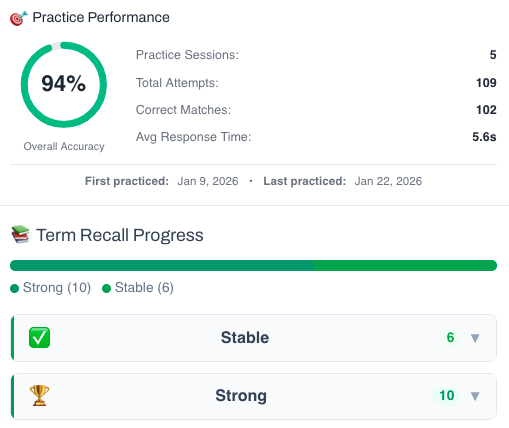
This isn’t a simple quiz — it’s a fully tracked learning system. You build knowledge through recognition, then recall, and your progress feeds directly into the Integrated Practice Bar (Writing tasks, AI Chat, and more).
- Practice sessions, accuracy, and response-time tracking
- Term strength levels (Learning → Stable → Strong)
- Personal progress history for each unit
This feature is available to YSP members.
Explore Membership Benefits