🎙 A Little or Little — Know the Difference
A Little vs Little — some vs lack“Information, News”
Understand the difference between a little and little with uncountable nouns. Use both forms correctly to talk about small amounts in everyday situations.
One button, the whole episode. Good for the bus, the car or a walk.
Welcome
Josie: “Welcome to the YouSpeakPlus Audio Cast. I am Josie.”
Jon: “And I am Jon. Today we look at a little and little. Two small words. Very different meanings.”
Josie: “For example, we have a little time. That is good news. We have little time. That is a problem.”
Jon: “We also look at two very useful words. Information and news. One word, more than one use.”
Josie: “And then we hear a story. Three people in a TV newsroom. A big story is coming in. Things move fast.”
Jon: “Ready? Let us start.”
Part 1 · Grammar
Josie: “Today we look at two quantity expressions. 'A little' and 'little'. They look almost the same. But they mean different things.”
Sofia: “Really? I always use them the same way. I did not know there was a difference.”
Josie: “Well, there is a difference, and it's an important one. Listen to this sentence. There is 'a little' coffee left. This means there IS some coffee, but not much – the quantity is small, but enough. That is good news.”
Sofia: “OK. And without the article 'a'? What happens then?”
Josie: “'There is little coffee left.' This means that there is almost NO coffee remaining. Almost none. That is not good news. The article 'a' before 'little' makes a big difference to how we perceive the quantity.”
Sofia: “So 'a little' is positive because it indicates 'we have enough' and 'little' is negative because it indicated 'we don't have enough'? Like good news and bad news?”
Josie: “Good way to think about it. 'A little' means that the quantity, while not big, is enough. 'Little' means almost none. Let me give you two more examples. 'We have a little time. So we can relax a bit.','We have a little money, so we can get some pizza.”
Sofia: “And so, 'we have little time' means we need to hurry? Because there is almost no time available?”
Josie: “Exactly right. One more. 'She has a little money'. This means she can buy something small, something that is not expensive.”
Sofia: “And so, 'she has little money' means she is almost without money. She cannot buy much.”
Josie: “Yes, perfect. Now look at the pattern. You say a little or little, then an uncountable noun. Like 'a little water'. Or 'little water'. Not a little waters. Water has no plural here.”
Sofia: “What about very? Can I say very a little? Like very a little sugar?”
Josie: “No. We never say very a little. But we can say 'very little'. For example, 'there is very little sugar in this coffee'. Very little, not very a little.”
Sofia: “Got it. Can I try some examples now?”
Josie: “Please. Go ahead.”
Sofia: “OK. 'I have a little homework to finish, so I can't go out yet.”
Josie: “Good. A little homework, so there is some homework, but not much. That works perfectly. Now try one with little, the 'not enough' version.”
Sofia: “My friend has little hope about the job interview. She thinks she will not get it.”
Josie: “Yes. Little hope means not much hope, almost NO HOPE. Try one more with very little.”
Sofia: “There is very little information on the website. I cannot find anything useful.”
Josie: “Very little information. Excellent. Now try one more with a little.”
Sofia: “We have a little milk left. Enough for two cups of tea.”
Josie: “Perfect. Some milk is there. Enough for two cups of tea, but probably not three or four cups. Now one more situation. Try 'little' this time.”
Sofia: “Hmm, OK, how about 'There is little petrol in the car. We need to stop soon'.”
Josie: “Great. Little petrol means almost none. You need to stop. Now let us look at two classic mistakes. Listen carefully.”
Sofia: “OK, I am listening.”
Josie: “First mistake. We have little time, so we can relax. That is wrong because 'little time' means you don't have enough time and so you can't relax. The right way: we have a little time, so we can relax. We have a little time is similar to saying 'we have enough time'.”
Sofia: “So without the article 'a', it sounds like a warning. A warning that we don't have enough of something?.”
Josie: “Right. Second mistake. 'There is a little money, we are almost penniless'. That is wrong because 'penniless' means you have no money, but 'we have a little money' means you have enough money. The two meanings are in conflict. 'We have little money', or 'we have very little money' is the correct version when you are almost 'penniless'”
Sofia: “The article 'a' changes everything. It inverts the meaning from 'we have ENOUGH' to 'we DON'T have ENOUGH' – I will not forget that.”
Josie: “Good. When you speak, ask yourself: is this good news or bad news? That tells you which one to use.”
Part 2 · Word focus
Josie: “Now let us look at two very useful words. Information and news. Listen to this example. Can you give me a little information about the bus times?”
Sofia: “I know those words, Information and News. But I am not always sure when to use which one.”
Josie: “Good. That is exactly what we are going to look at today. First, information. This means facts or details about a topic. For example, I need some information about the hotel.”
Sofia: “So information is like data? Like facts you find somewhere?”
Josie: “Yes, exactly. You ask questions to discover information. You look for information. Here is another example. There is a little information on the website, but not much.”
Sofia: “OK. And news? Is news the same thing?”
Josie: “Not quite. News has two main uses. The first is public news. This means reports about the world. You see it on TV or read it online. For example, I watched the news this morning.”
Sofia: “Like the news programme on television. OK, that is clear.”
Josie: “Right. And the second use of news is personal. This means something new that you tell a friend. For example, I have some good news. I got the job!”
Sofia: “Oh, so news can be personal too. Not just on television.”
Josie: “Exactly. You can say, I have some news for you. Or, did you hear the news about Marco? Both are personal uses.”
Sofia: “I see. So information is more about facts and details. And news is more about something NEW that happened.So, news IS information, it's just NEW information?”
Josie: “Yes, that is a good way to put it. Now, here is something important. Both words are uncountable. You cannot say one information or two news.”
Sofia: “So I say some information and some news. Not an information or a news.”
Josie: “Correct. Or you can say a piece of information. Or a piece of news. Use this when you want to talk about one item.”
Sofia: “Ah, a piece of news. That sounds a bit formal, but OK.”
Josie: “It is a bit formal, yes. In everyday talk, people say, I have some news. Or, did you hear the latest news? Latest means the most recent.”
Sofia: “What about bad news and good news? I hear those a lot.”
Josie: “Yes, very common. Good news, bad news, no news. For example, there is no news yet about the flight. We are still waiting.”
Sofia: “OK. Can I try now? Hmm. I want to say something wrong first. I have an information for you. My sister is going to have a baby.”
Josie: “Good try. But listen. We do not say an information. That is the common trap. Say it this way instead. I have some news for you. My sister is going to have a baby.”
Sofia: “I have some news for you. My sister is going to have a baby. Yes, that sounds much better.”
Josie: “Perfect. Now a quick check. I say a sentence. You tell me, is it information or news? Ready?”
Sofia: “Ready.”
Josie: “I watched the morning programme about what happened in the world today.”
Sofia: “That is news. Public news, on television.”
Josie: “Good. Next one. I looked online to find details about the opening times of the museum.”
Sofia: “That is information. Facts about the museum.”
Josie: “Great. Last one. My friend called to tell me she is moving to Rome next month.”
Sofia: “That is news. Personal news from a friend.”
Josie: “Excellent. So remember this. Both words are uncountable. No plurals. No an information. No a news. Use some, or a piece of, or nothing at all. Now you know how to use them correctly.”
- facts or details about something or someone Can you give me some information about the train times?
- reports about recent events, on TV, radio, or online I watched the news this morning and heard about the storm.
- a piece of new information told to you personally I have some good news — I got the job!
- information in fixed phrases: 'no news', 'bad news', 'latest news' There is no news yet about the missing dog.
Part 3 · Story
Josie: “Now here is a story that puts everything together. It is a busy afternoon in a TV newsroom. Clara is the editor. Dan is her reporter. Rosa is their producer. A big story is coming in. They have very little time. Listen carefully.”
Clara: “Dan, I need you here. We have breaking news. There are people trapped on the mountain near Valdaro.”
Dan: “How many people? Do we have any information yet?”
Clara: “We have a little information, but not much. About twelve people. A group of hikers. The weather got very bad very fast.”
Rosa: “I just spoke to our correspondent up there. She has a little news for us. A rescue team is already on the way.”
Dan: “OK, that is something. What about a helicopter? Is one coming?”
Rosa: “There is very little information about that. She could not confirm it. The signal up there is very bad.”
Clara: “We go on air in twenty minutes. We have very little time.”
Dan: “What can I say on air? We have little news right now. I do not want to say the wrong thing.”
Clara: “Say what we know. Twelve people. Trapped. A rescue team is going there now.”
Rosa: “Wait. I have a new message from our correspondent. She says there is very little water and food with the group.”
Dan: “That is serious. How long have they been up there?”
Rosa: “Since this morning. So about eight hours. She has a little more information now. Two people are hurt, but not badly.”
Clara: “OK. That is important news. Dan, you can say that on air.”
Dan: “And the helicopter? We still have very little information about that – not enough to make a news story.”
Rosa: “I am calling again now. One moment.”
Josie: “Rosa calls again. She gets a little signal this time.”
Rosa: “Good news. A helicopter is going up there right now. Our correspondent can see it.”
Clara: “Finally. That is the best news today. Dan, we go on air in five minutes.”
Dan: “I am ready. We still have very little time, but I have enough information now. Let's do this.”
Josie: “Now listen to the story again. Count how many times you hear 'a little', 'little', or 'very little'. There are eight. Also listen for 'information' and 'news'. You can hear them six times. Listen again now.”
Josie: “Eight times for 'a little', 'little', or 'very little'. Six times for 'information' and 'news'. Well done for listening. Now let us look at the key difference. 'A little' means some — a small amount, but useful. 'Little' without 'a' means almost none — and that is usually a problem. Use 'a little' when the small amount is enough. Use 'little' when the small amount is not enough.”
Member-Exclusive Practice Bar
Access a wide range of integrated practice for this unit — from Vocabulary and Grammar activities to AI-curated Writing tasks and Thematic Chat practice.
This feature is available to YSP members.
Explore Membership BenefitsMember-Exclusive Vocabulary Review & Acquisition System
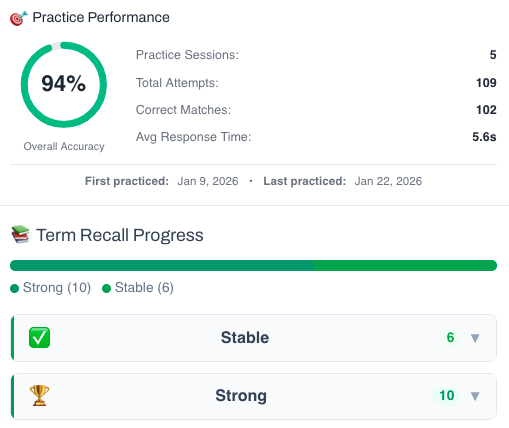
This isn’t a simple quiz — it’s a fully tracked learning system. You build knowledge through recognition, then recall, and your progress feeds directly into the Integrated Practice Bar (Writing tasks, AI Chat, and more).
- Practice sessions, accuracy, and response-time tracking
- Term strength levels (Learning → Stable → Strong)
- Personal progress history for each unit
This feature is available to YSP members.
Explore Membership Benefits