Paperwork: Everything You Need to Know
Core PathWay1 Section 1. What Is Paperwork?
You fill in forms. You sign contracts. You send reports. All of this is paperwork.
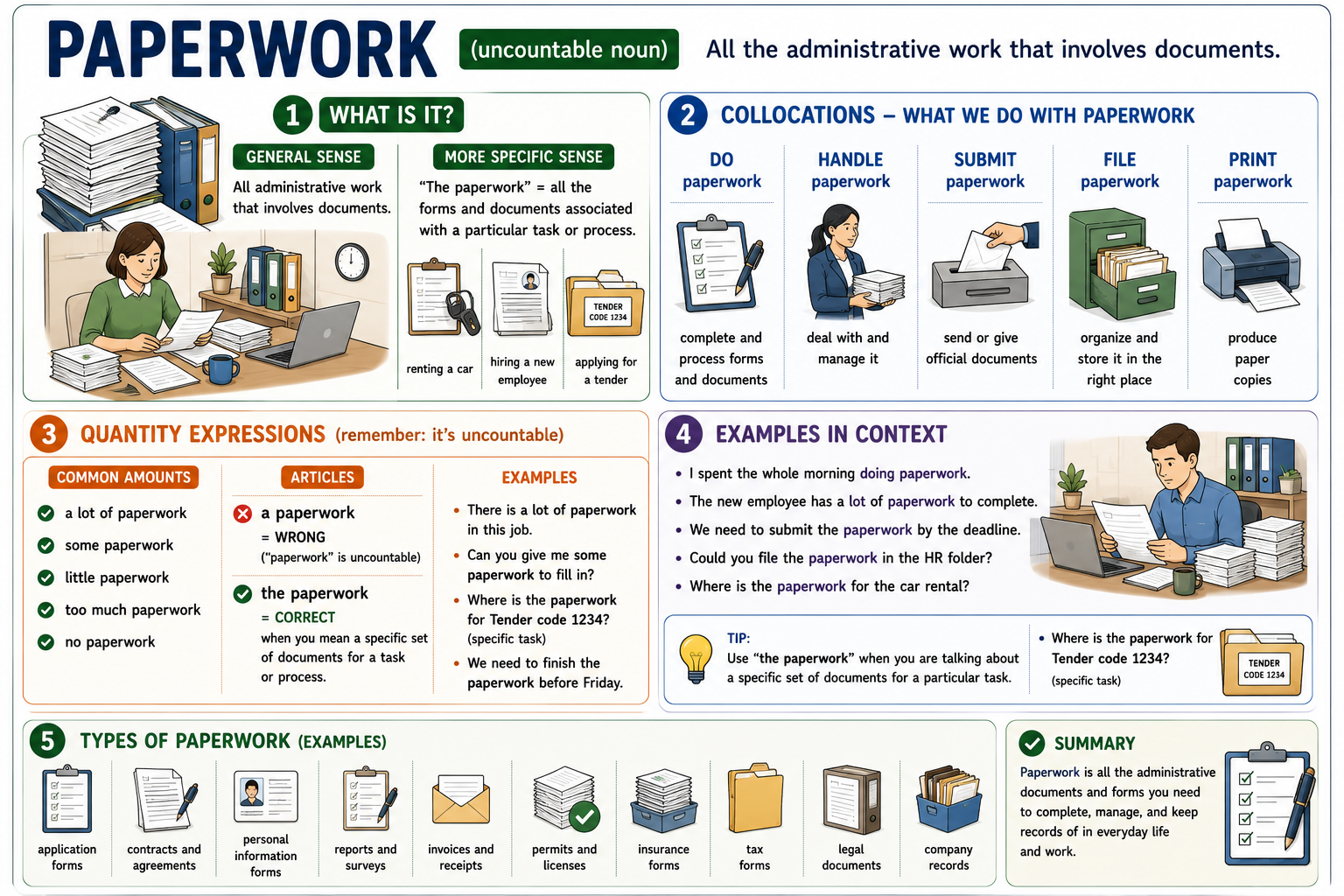
Paperwork means all the documents and administrative tasks connected to a job, process, or situation. It includes forms, reports, contracts, applications — any kind of official written material. Even when everything is digital, we still call it paperwork. The word has not changed, even if the paper has!
Here is something important: paperwork is an uncountable noun. This means we do not say ‘a paperwork’. That is incorrect. Instead, we talk about amounts of paperwork: a lot of paperwork, so much paperwork, all the paperwork.
However, we can say the paperwork when we mean the specific documents for one particular task or project. For example: ‘Where’s the paperwork for Tender 1234?’ Here, the paperwork refers to a specific set of documents — not paperwork in general.
2 Section 2. Paperwork — A Closer Look
Let’s look closely at how to use paperwork. It is an uncountable noun, so it follows special rules. You cannot count it like ‘one paperwork, two paperworks’. Instead, you use quantity expressions to describe how much there is. There is also an important difference between talking about paperwork in general and talking about the paperwork for something specific.
paperwork (general — uncountable)
- There is so much paperwork in this job — I spend half my day filling in forms.
- I hate doing paperwork, but it has to be done before the end of the week.
the paperwork (specific — with definite article)
- Can you send me the paperwork for the new contract? I need to sign it today.
- The paperwork for the visa application was finally approved yesterday.
Quantity expressions with paperwork
- Present simple: There is always a mountain of paperwork at the end of the month. Present continuous: I am dealing with a pile of paperwork right now — can I call you back? Present perfect: We have completed a lot of paperwork this week, so the project can move forward. Past simple: There was so much paperwork after the merger that the whole team worked overtime.
- Tip: 'A mountain of paperwork' and 'a pile of paperwork' are very common in spoken English. They show that there is a large and perhaps overwhelming amount. Use them to sound natural!
3 Section 3. Sam's Busy Monday
It was Monday morning, and Sam was already stressed. There was a mountain of paperwork on the desk, and the day had only just started.
‘I can’t believe how much paperwork there is this week,’ Sam said to a colleague, Jordan. ‘I’ve been here for an hour and I haven’t even started on the reports yet.’
Jordan looked sympathetic. ‘Is it all routine stuff, or is some of it urgent?’
‘Most of it is routine administrative paperwork,’ Sam replied. ‘But I also need to complete the paperwork for the Henderson account before noon. The client is waiting for it.’
‘Have you dealt with the paperwork for the new supplier yet?’ Jordan asked.
‘Not yet. There’s so much paperwork connected to that contract. I’m going to need the whole afternoon just to get through it all.’
By the end of the day, Sam had finally filed the paperwork for the Henderson account and made a good start on the rest. It wasn’t exciting work, but the paperwork had to be done.
4 Section 4. Writing Task — A Work Email
Now it is your turn to practise. Read the task below and write your email. Try to use ‘paperwork’ and quantity expressions several times.
In your email:
— Explain that there is a large amount of paperwork to complete this week.
— Mention the paperwork connected to one specific project or task (give it a name).
— Ask for help or more time to deal with the paperwork.
— Use the word 'paperwork' at least THREE times.
— Use at least TWO quantity expressions (for example: a lot of paperwork, a pile of paperwork, so much paperwork, a mountain of paperwork, too much paperwork).
Write in a polite, professional style. Start your email with: 'Dear Alex,'
5 Section 5. Recap — What You Have Learned
Great work! Let’s look at what you have covered on this page.
Paperwork means all the documents and administrative tasks connected to a job or process. It is an uncountable noun — so ‘a paperwork’ is always incorrect. Instead, use quantity expressions: a lot of paperwork, a pile of paperwork, a mountain of paperwork, so much paperwork.
Remember the key difference: paperwork (no article) = paperwork in general. The paperwork (with the) = the specific documents for one task or project. For example: ‘There is so much paperwork this week’ vs. ‘Where is the paperwork for the Henderson account?’
Common collocations to remember: do the paperwork, complete the paperwork, deal with the paperwork, file the paperwork, and submit the paperwork. These are the combinations that native speakers use most often — learn them together and you will sound natural every time.
Member-Exclusive Practice Bar
Access a wide range of integrated practice for this unit — from Vocabulary and Grammar activities to AI-curated Writing tasks and Thematic Chat practice.
This feature is available to YSP members.
Explore Membership BenefitsMember-Exclusive Vocabulary Review & Acquisition System
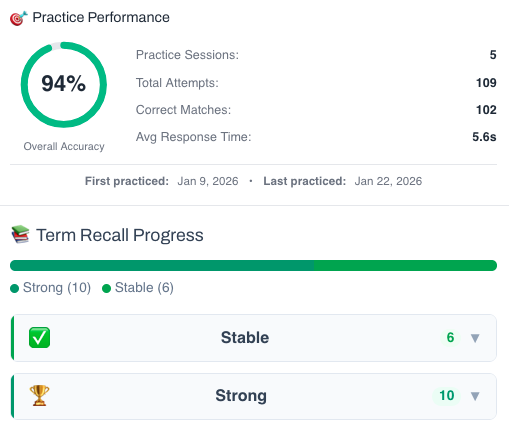
This isn’t a simple quiz — it’s a fully tracked learning system. You build knowledge through recognition, then recall, and your progress feeds directly into the Integrated Practice Bar (Writing tasks, AI Chat, and more).
- Practice sessions, accuracy, and response-time tracking
- Term strength levels (Learning → Stable → Strong)
- Personal progress history for each unit
This feature is available to YSP members.
Explore Membership Benefits