Procedures at Work: The Language of SOPs, Steps, and Compliance
Core PathWay1 Section 1. What Is a Procedure — and Why Does It Matter?
Every workplace runs on procedures. Whether you work in a hospital, a law firm, or a marketing agency, there is always an official way to do things — and knowing how to talk about that is a professional skill in itself.
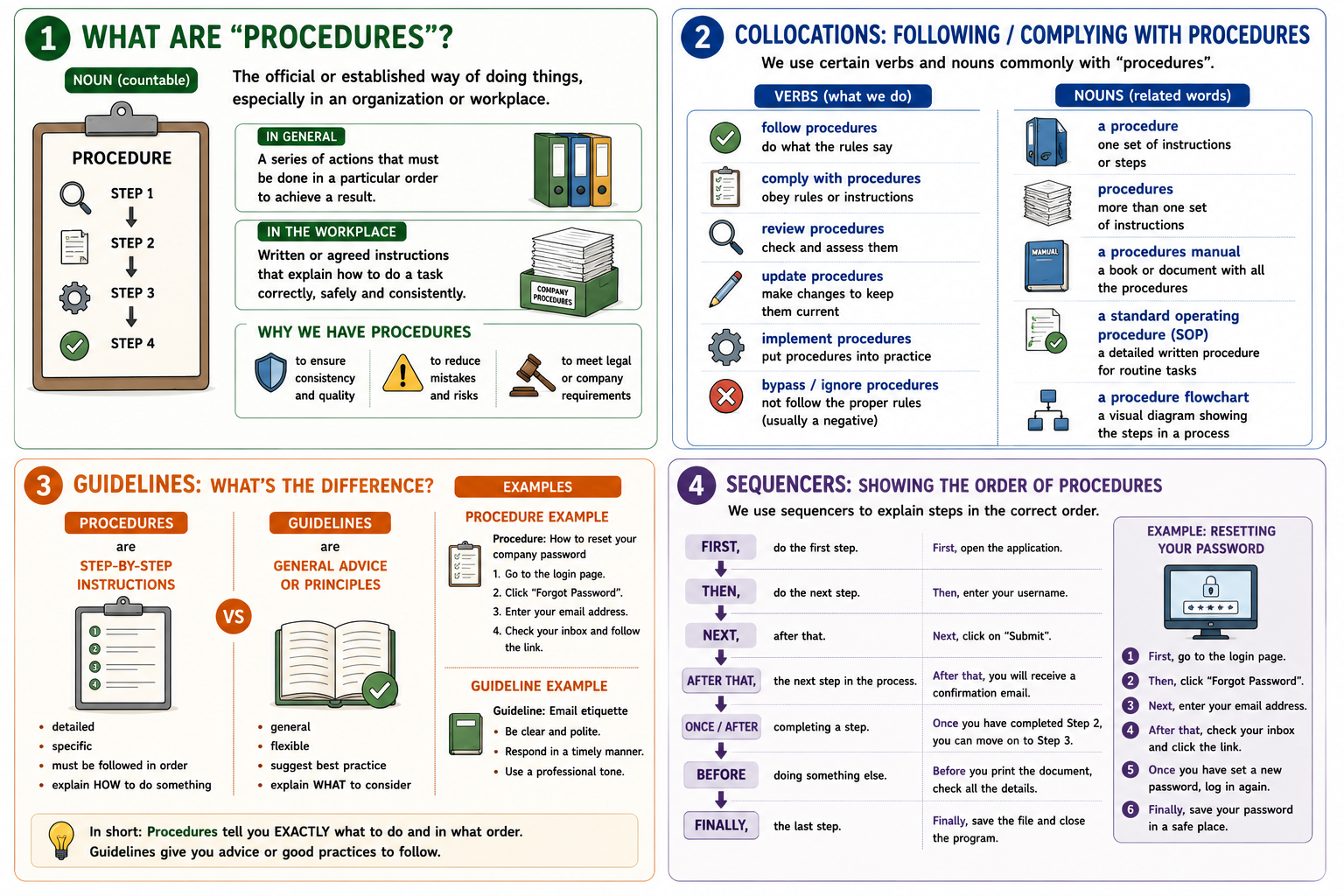
At its simplest, a procedure is the official or standard way to do something. It tells you what to do, in what order, and often who is responsible for each part. But the word ‘procedure’ belongs to a whole family of related terms, and choosing the right one matters.
A process is the full series of stages from beginning to end — the big picture. Inside that process, each individual action is called a step. A workflow describes how tasks move between people or systems in practice — it is the human reality of the process. When a procedure is written down formally in an organisation, it becomes an SOP (Standard Operating Procedure). In more technical, medical, safety, or official environments, the word protocol is used — this suggests something stricter and more binding than a standard procedure. Guidelines, on the other hand, are recommended practices that are usually less strict; they advise rather than require. Finally, a policy is the general principle or rule that sits behind the procedure — it explains why the procedure exists.
Think of it this way: the policy says ‘all financial requests must be approved.’ The procedure says how to request that approval. The SOP is the written document. The steps are each action inside it. The workflow is what actually happens on a Tuesday afternoon.
—
Three colleagues discuss their procedures
Alex (HR), Jordan (Procurement/Tenders), and Sam (Marketing) are talking over coffee.
Alex: In HR, almost everything we do is governed by a strict procedure. Recruitment, disciplinary matters, grievances — there are legal requirements behind all of it. We can’t just decide to do things differently one day. The policy is set at board level, and the SOP tells us exactly what to do at each stage. If we skip a step, we could expose the company to a legal challenge.
Jordan: Same for us in Procurement. Tendering processes are heavily regulated — there are EU directives and national laws we have to comply with. Every protocol around supplier selection, evaluation, and contract award is documented. The workflow involves multiple departments and sign-offs. There’s very little room for interpretation.
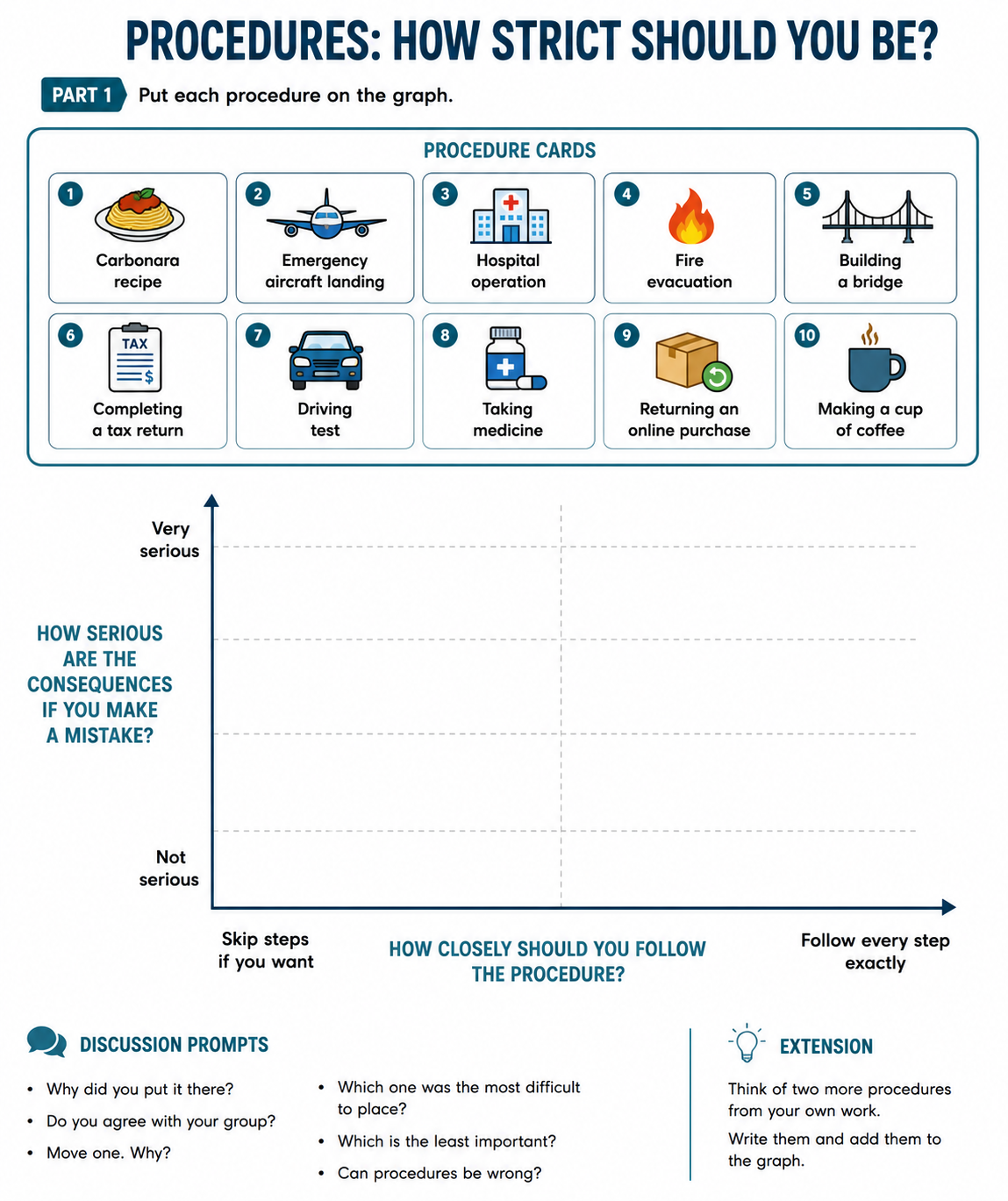
Sam: Marketing is… a bit different, honestly. We have guidelines for brand consistency and approval procedures for campaigns, but there’s a lot more flexibility. If I want to try a new approach on social media, I don’t need to follow a strict SOP — I just check with my manager. The policy exists, but the day-to-day steps are much more adaptable.
Alex: That makes sense. The more legal risk involved, the tighter the procedure needs to be.
Jordan: Exactly. In Tenders, if we deviate from the protocol, we can invalidate the entire process. It’s not a guideline — it’s a requirement.
2 Section 2. The Verbs of Procedures: Compliance and Monitoring
Knowing the nouns is a good start — but to actually talk about procedures at work, you need the verbs. This section looks at two key areas: the language of complying with procedures, and the language of checking and monitoring them.
These verb phrases are the engine of procedural language. They are the expressions professionals use every day in emails, reports, meetings, and conversations.
Complying with procedures — key verb phrases
When you follow the rules and do things the correct way, you use verbs like these:
— follow a procedure — the most common, general expression
— comply with a procedure — more formal; often used in legal or regulatory contexts
— stick to the procedure — slightly more conversational; emphasises not deviating
— carry out the steps — focuses on the individual actions involved
— complete each stage — useful when a process has clearly defined phases
— submit the required documents — essential in administrative and legal contexts
— obtain approval — to get official permission before proceeding
— escalate the issue — to pass a problem to a higher level of authority when you cannot resolve it yourself
— record the outcome — to document what happened at the end of a step or process
Notice the pattern: most of these phrases use a verb + noun structure. You follow a procedure, you obtain approval, you record the outcome. These are fixed collocations — the verb and noun belong together. Swapping them out (for example, saying ‘do the procedure’ or ‘get the approval’) sounds unnatural in formal professional contexts.
Checking and monitoring — key verb phrases
Procedures also need to be monitored. Here is the language for that:
— check that… — a simple, direct way to confirm something is correct
— make sure that… — slightly more emphatic than ‘check’; often used in instructions
— verify that… — more formal; implies a careful, systematic check
— confirm that… — often used after a check has been done, to report the result
— review the documentation — to look carefully at written records
— monitor compliance — to track whether people are following the procedure over time
— identify errors / gaps / delays — to find problems in the process
— flag an issue — to draw attention to a problem so it can be addressed
— keep a record of… — to maintain ongoing documentation
Again, notice the collocations: you monitor compliance, you flag an issue, you identify gaps. These pairings are standard in professional English — learning them as units, not as individual words, is the key.
—
The same three colleagues, later that day
Jordan: I had to escalate an issue this morning. A supplier submitted the required documents late, and I wasn’t sure whether we could still proceed with the next stage.
Alex: What did you do?
Jordan: I flagged the issue with my manager and we agreed to review the documentation together before making a decision. We also had to verify that the submission timestamp was within the legal window.
Sam: In Marketing, we rarely have to escalate anything formally. If I identify a gap in a campaign brief, I just send a message to the team. We keep a record of approvals, but it’s usually just an email thread.
Alex: In HR, we have to record the outcome of every meeting — especially disciplinary ones. We can’t rely on memory. And we always confirm that the employee has received a copy of the documentation.
Jordan: It’s the same principle in Procurement. You have to monitor compliance at every stage, not just at the end. If you don’t carry out the steps in the right order, the whole tender can be challenged.
3 Section 3. Sequencing Language: Putting the Steps in Order
A procedure without sequence is just a list of random actions. The whole point of a procedure is that things happen in order — and the language you use to show that order is just as important as the actions themselves.
Sequencing language tells your reader or listener: what comes first, what comes next, and when it is safe to move on.
Basic sequencing — clear and functional
These words are simple but effective, especially in spoken explanations:
First, you log into the system and open the request form. Then, you complete all the required fields. Next, you attach the supporting documents. After that, you submit the form and wait for confirmation. Finally, you record the outcome in the shared log.
These work well in conversation or informal written instructions. But in professional reports, emails, and SOPs, you will want more precise language.
More professional sequencing — formal and precise
These expressions are common in written procedures, emails to supervisors, and formal reports:
— Firstly / Secondly / Finally — more formal alternatives to first / then / last
— At this stage — useful when you want to describe what happens at a particular point
— Once this has been done — signals that the next step depends on completing the previous one
— After completing this step — similar to above; uses a participle phrase
— Before moving on to the next stage — emphasises that something must be finished first
— As soon as approval is received — links two actions with a time condition
— When the documents have been checked — uses the present perfect to show completion before the next action
Notice how the more professional expressions often use perfect aspect (‘has been done’, ‘have been checked’) or dependent clauses (‘once…’, ‘as soon as…’, ‘when…’). This is how formal procedural English signals that one action must be completed before the next can begin.
—
Model email: Reporting on a completed procedure
From: Sam Chen, Marketing Manager
To: Dr. Rivera, Head of Operations
Subject: Campaign Approval Procedure — Completion Report
Dear Dr. Rivera,
I am writing to confirm that the campaign approval procedure for the Q3 product launch has been completed in full.
Firstly, the campaign brief was drafted by the creative team and circulated to all relevant stakeholders for initial review. Once this had been done, feedback was consolidated and the brief was revised accordingly.
At this stage, the revised brief was submitted to the Legal and Compliance team for sign-off. After completing this step, the final version was approved by the Marketing Director and uploaded to the shared project folder.
Before moving on to the production phase, we also verified that all brand guidelines had been followed and that the required budget approval had been obtained from Finance.
As soon as all approvals had been received, the campaign was passed to the external agency for production. When the initial assets had been checked against the brief, they were approved and scheduled for release.
I will keep a full record of all documentation and can provide copies on request.
Kind regards,
Sam Chen
4 Section 4. Grammar Guide: Instructions, Modals, and the Passive Voice
When you write or talk about procedures, three grammar areas come up again and again: imperatives (direct instructions), modal verbs (expressing obligation and recommendation), and the passive voice (describing what happens without focusing on who does it).
These are not just grammar points — they are the building blocks of every SOP, policy document, and procedural email in professional English. Understanding how and when to use each one will immediately improve the way you describe your work.
Focus
- Imperatives: direct and softened instructions
- Modal verbs in formal SOP language: must / have to / should / need to / be required to
- Passive voice for describing procedures and actions
Rules
- IMPERATIVES — Direct instructions use the base verb form with no subject: 'Complete the form.' 'Attach the invoice.' 'Do not leave any mandatory fields blank.' These are common in step-by-step guides and checklists. For a more professional or polite tone, soften the instruction: 'Please complete the form.' / 'You should attach the invoice.' / 'Make sure you include the reference number.' / 'Remember to save a copy of the confirmation email.' The meaning is the same, but the register is more appropriate for a professional context.
- MODAL VERBS — In formal SOPs and policy documents, 'must' expresses a non-negotiable requirement: 'The employee must complete the form.' / 'The procedure must be followed in all cases.' 'Should' expresses strong recommendation: 'All documents should be stored in the shared folder.' 'Have to' is similar to 'must' but slightly less formal and often used in spoken language: 'You have to submit the form by Friday.' 'Need to' focuses on necessity from a practical point of view: 'You need to obtain approval before proceeding.' 'Be required to' is the most formal option, often found in legal or regulatory documents: 'All suppliers are required to submit a completed declaration form.'
- PASSIVE VOICE — Procedures often focus on the action, not the person performing it. This is why passive voice is so common in procedural writing. Compare: ACTIVE: 'The employee submits the form.' PASSIVE: 'The form is submitted to HR.' Both sentences describe the same action, but the passive version puts the focus on the form and the action — which is exactly what a procedure needs to do. Key passive forms for procedures: 'The form is completed by the employee.' / 'The documents are checked by the manager.' / 'The request is approved by Finance.' / 'The file is stored in the system.' / 'The customer is notified by email.' You can also combine passive voice with sequencing language: 'Once the form has been completed, it is sent to HR.' / 'After the documents have been checked, the request can be approved.'
Examples
- The request must be submitted by email within 48 hours of the incident. Once it has been received, it is reviewed by the line manager and a decision is communicated to the employee within five working days.
- Please complete all mandatory fields before submitting the form. You should attach a copy of the relevant invoice, and make sure you include the purchase order reference number. Do not submit the form without obtaining prior approval from your department head.
- All supplier contracts are required to be reviewed annually. The documentation is checked by the Procurement team, and any discrepancies are flagged to the Compliance Officer. Once the review has been completed, the updated contract is stored in the central system.
Common mistake
5 Section 5. Writing Task: Describe a Procedure from Your Work
Now it is your turn. Think about a real procedure from your own job — something you follow regularly. It could be anything: how you request leave, how you submit an expense claim, how you onboard a new client, or how you raise a complaint. Use the language from this page to describe it clearly and professionally.
Write approximately 100 words describing this procedure. Start with the sentence below, then continue in your own words.
Opening sentence: 'In my role as [your job title], one of the procedures I follow regularly is [name the procedure].'
Your description must include:
— At least THREE sequencing expressions (e.g. firstly, once this has been done, after completing this step, as soon as…, when the documents have been checked)
— At least TWO verb phrases for compliance or monitoring (e.g. submit the required documents, obtain approval, verify that, keep a record of, flag an issue, monitor compliance)
— At least ONE modal verb used for obligation or recommendation (must / have to / should / need to / be required to)
— At least ONE passive voice sentence (e.g. 'The form is submitted to…' / 'The request is approved by…')
Write in a professional, semi-formal register — as if you are explaining the procedure to a new colleague or reporting to your supervisor.
6 Section 6. Recap: What You Have Covered
You have now worked through the core language for describing workplace procedures in English. Here is a quick summary of what this page has covered.
Key vocabulary: You explored the difference between a procedure, a process, a step, a workflow, an SOP, a protocol, guidelines, and a policy. These words are related but not interchangeable — the right word depends on how formal, how strict, and how documented the procedure is.
Compliance and monitoring verbs: You studied two groups of verb phrases — those for following procedures (such as follow a procedure, comply with, obtain approval, escalate the issue, and record the outcome) and those for checking and monitoring (such as verify that, flag an issue, monitor compliance, and keep a record of). Remember: these are fixed collocations. Learn them as units.
Sequencing language: You saw how basic connectors (first, then, next) can be upgraded to more professional expressions (once this has been done, after completing this step, as soon as approval is received). The more formal expressions often use perfect aspect to show that one action must be completed before the next begins.
Grammar: You reviewed three key grammar areas — imperatives for giving instructions (direct and softened), modal verbs for expressing obligation and recommendation (must, have to, should, need to, be required to), and the passive voice for describing what happens in a procedure without focusing on who does it. The passive voice is especially important in formal procedural writing.
Writing: You applied all of this in a guided writing task, describing a real procedure from your own work.
The language on this page is immediately useful. Whether you are writing an email to your supervisor, explaining a process to a new colleague, or contributing to a formal SOP, these are the words, phrases, and structures that professional English speakers reach for every day.
Member-Exclusive Practice Bar
Access a wide range of integrated practice for this unit — from Vocabulary and Grammar activities to AI-curated Writing tasks and Thematic Chat practice.
This feature is available to YSP members.
Explore Membership BenefitsMember-Exclusive Vocabulary Review & Acquisition System
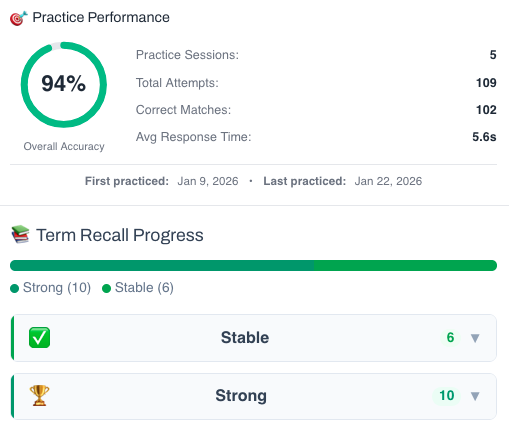
This isn’t a simple quiz — it’s a fully tracked learning system. You build knowledge through recognition, then recall, and your progress feeds directly into the Integrated Practice Bar (Writing tasks, AI Chat, and more).
- Practice sessions, accuracy, and response-time tracking
- Term strength levels (Learning → Stable → Strong)
- Personal progress history for each unit
This feature is available to YSP members.
Explore Membership Benefits