Passive 101: Understanding and Using the Passive Voice
Core PathWay
1 What Is the Passive Voice?
Have you ever wondered why we say ‘The report was written yesterday’ instead of ‘Someone wrote the report yesterday’?
The passive voice is a grammatical structure that changes the focus of a sentence. In an active sentence, we focus on who does the action. This means the subject performs the action. For example: ‘The manager signed the contract.’ However, in a passive sentence, we focus on what happens to something or someone. In other words, we focus on the action itself or the object that receives the action. For example: ‘The contract was signed.’
We use the passive for several important reasons. First, we use it when we don’t know who performed the action. For example: ‘My car was stolen last night.’ We don’t know who stole it. Second, we use passive when the agent (the person who does the action) is obvious or not important. For example: ‘The building was completed in 2020.’ It’s obvious that construction workers built it, so we don’t need to mention them. Third, we use passive to keep our focus on the object or result rather than the person. This is very common in formal writing, scientific reports, and business communication.
Here’s the key pattern to remember: the passive form always has an extra ‘be’ verb compared to the active form. This is true in any tense. The passive structure is always: form of ‘be’ + past participle. For example, active ‘They make cars here’ becomes passive ‘Cars are made here.’ Active ‘They were making cars’ becomes passive ‘Cars were being made.’ Notice that extra ‘be’ verb? That’s your signal that you’re looking at a passive structure. Once you understand this pattern, you can create passive forms in any tense.
Key Terms
2 Passive in Simple Tenses
Simple tenses are the foundation of English grammar, and they’re also the easiest place to start learning the passive voice. In simple tenses, you only need one form of ‘be’ plus the past participle. Let’s look at how passive works in present simple, past simple, present perfect simple, and past perfect simple. Understanding these patterns will help you communicate clearly in both spoken and written English.
Focus
- Present Simple Passive: am/is/are + past participle (used for general facts, routines, and processes)
- Past Simple Passive: was/were + past participle (used for completed actions in the past)
- Present Perfect Simple Passive: has/have been + past participle (used for actions with present relevance)
- Past Perfect Simple Passive: had been + past participle (used for actions completed before another past action)
Rules
- Always use the correct form of ‘be’ that matches the tense and subject
- The past participle never changes – it’s the same for all subjects
- Add ‘by + agent’ only when the agent is important or surprising information
- Simple passive structures need exactly one ‘be’ verb before the past participle
Examples
- Present Simple: English is spoken in many countries. / The office is cleaned every evening.
- Past Simple: The email was sent at 9am. / Three candidates were interviewed yesterday.
- Present Perfect Simple: The project has been completed. / All the invitations have been sent out.
- Past Perfect Simple: The decision had been made before the meeting started. / The documents had been signed by Friday.
Common mistake
3 Passive in Continuous Tenses
Continuous tenses describe actions that are in progress at a specific time. When we make continuous tenses passive, we need two ‘be’ verbs: one for the continuous aspect (‘being’) and one for the tense itself.
In present continuous passive, we use: am/is/are + being + past participle. This describes an action happening right now or around now. For example: ‘The building is being renovated.’ This means the renovation is in progress at the moment. Another example: ‘New employees are being trained this week.’ We use this when we want to focus on the training process, not on who is doing the training.
In past continuous passive, we use: was/were + being + past participle. This describes an action that was in progress at a specific time in the past. For example: ‘The road was being repaired when I drove past.’ This means the repair was happening at that moment in the past. Another example: ‘The documents were being reviewed during the meeting.’ Notice that we focus on what was happening to the documents, not on who was reviewing them.
The key pattern to remember is ‘being’ + past participle. This ‘being’ is your signal that you’re looking at a continuous passive structure. However, be careful: continuous passive can sound quite formal or technical. In everyday conversation, we often prefer active sentences or simple passive instead. For example, instead of ‘The dinner is being prepared,’ many people would say ‘They’re preparing dinner’ or ‘Dinner is almost ready.’
4 Passive with Modal Verbs
Modal verbs like can, could, should, must, might, and would add meaning to sentences by expressing possibility, ability, necessity, or advice. When we combine modals with passive voice, we create very useful structures for polite suggestions, rules, and predictions.
The pattern is simple: modal + be + past participle. Notice that we always use the base form ‘be’ after a modal verb, never ‘been’ or ‘being’. For example: ‘The report must be finished by Friday.’ This expresses necessity. Another example: ‘The meeting can be rescheduled.’ This expresses possibility.
Let’s look at more examples with different modals. ‘The documents should be checked carefully’ expresses advice or recommendation. ‘The problem could be solved with better communication’ expresses possibility. ‘The decision might be announced tomorrow’ expresses uncertainty about the future. ‘The rules must be followed by everyone’ expresses strong necessity or obligation.
Passive with modals is extremely common in workplace communication, rules, and formal writing. For example: ‘All visitors must be registered at reception.’ ‘Complaints can be made in writing.’ ‘The deadline could be extended if necessary.’ These structures are polite and professional because they focus on the action or rule rather than directly telling someone what to do.
Remember: the modal never changes form, ‘be’ stays as ‘be’, and only the past participle changes depending on the main verb. This makes the pattern very consistent and easy to use once you understand it.
5 The Industrial Site: A Development Story
The Riverside Industrial Park has an interesting history that shows how passive voice helps us tell stories when we focus on places and developments rather than the people behind them.
The site was purchased in 2015, although the original owners are unknown. During the first year, the land was cleared and prepared for construction. By early 2017, the main access road had been completed and the first warehouse had been built. These early structures were designed to attract manufacturing companies to the area. Throughout 2018 and 2019, additional buildings were constructed and the site was gradually transformed into a busy industrial zone.
Today, the park is home to over 30 companies. The facilities are used by businesses in various sectors, from food production to technology. The site is currently being expanded to include a new logistics centre. A modern office complex is being constructed near the main entrance, and the parking areas are being upgraded to handle increased traffic. These improvements are expected to be finished by the end of next year.
Looking ahead, further developments are planned for the next five years. A training centre will be built to support local employment. The site’s energy systems will be upgraded to renewable sources. According to recent announcements, green spaces will be created throughout the park, and a café and conference facility might be added if demand is sufficient. The entire project could be completed by 2028, although this timeline may be adjusted depending on economic conditions.
This development story shows how passive voice helps us maintain focus on the site itself – the buildings, facilities, and spaces – rather than constantly mentioning developers, construction companies, or planning authorities. The passive allows the story to flow naturally while keeping our attention on what matters most: the transformation of the industrial park.
Key Terms
6 Recap: Your Passive Voice Toolkit
You now have control over the passive voice in the most important tenses and structures. Let’s review the key patterns you’ve learned.
The passive voice shifts focus from who does something to what happens or what receives the action. We use it when the agent is unknown, obvious, or unimportant, or when we want to maintain focus on the object or result. The essential pattern is always the same: a form of ‘be’ + past participle. This means passive structures always have one extra ‘be’ verb compared to their active equivalents.
In simple tenses, you need just one ‘be’ verb: am/is/are for present simple, was/were for past simple, has/have been for present perfect, and had been for past perfect. In continuous tenses, you need ‘being’ plus the past participle: am/is/are being for present continuous, and was/were being for past continuous. With modal verbs, the pattern is modal + be + past participle, which is useful for expressing rules, possibilities, and polite suggestions.
As you practice, remember that passive voice is particularly common in formal writing, workplace communication, scientific reports, and news stories. It helps you sound professional and keeps the focus where it belongs. However, in everyday conversation, active voice is often more natural and direct. The key is knowing when each form is appropriate and having the confidence to use both effectively.
Member-Exclusive Vocabulary Review & Acquisition System
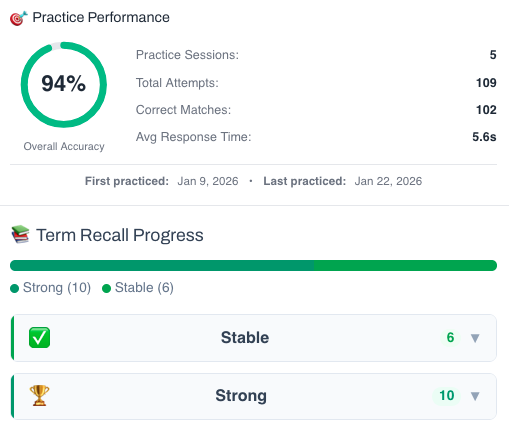
This isn’t a simple quiz — it’s a fully tracked learning system. You build knowledge through recognition, then recall, and your progress feeds directly into the Integrated Practice Bar (Writing tasks, AI Chat, and more).
- Practice sessions, accuracy, and response-time tracking
- Term strength levels (Learning → Stable → Strong)
- Personal progress history for each unit
This feature is available to YSP members.
Explore Membership BenefitsMember-Exclusive Practice Bar
Access a wide range of integrated practice for this unit — from Vocabulary and Grammar activities to AI-curated Writing tasks and Thematic Chat practice.
This feature is available to YSP members.
Explore Membership Benefits🎮 Practice Games
Section 1 – Fill in the Gaps
Passive 101 – Vocabulary Practice 1
Member-Exclusive Cloze Test
Fill in the gaps to complete authentic passages and reinforce your vocabulary in context.
This feature is available to YSP members.
Explore Membership BenefitsSection 2 – Fill in the Gaps
Passive 101 – Vocabulary Practice 2
Member-Exclusive Cloze Test
Fill in the gaps to complete authentic passages and reinforce your vocabulary in context.
This feature is available to YSP members.
Explore Membership BenefitsMember-Exclusive Sentence Builder
Reconstruct scrambled sentences to practice word order and develop your grammar intuition.
This feature is available to YSP members.
Explore Membership Benefits